Restaurant Direct Ordering Costs: Compare the Whole Order
Compare delivery-app fees with direct ordering using a worked example, an editable worksheet and checks for payment, delivery and customer acquisition.
A lower commission rate is useful only if the whole order leaves your business better off. Compare the same basket, the same fulfilment method and every cost you need to serve it. A direct website can give regulars another route back; it does not make delivery, payment processing or customer acquisition free.
This guide gives you a calculation you can challenge with your own statements. Start with Fuudster and websites for independent food businesses to explore the product behind the direct-ordering journey.
What does 30% actually mean?
Uber Eats’ published UK pricing, checked on 25 September 2026, lists 30% for Uber Delivery and 33% for Uber One orders. Its published self-delivery and pick-up rates are 13%. These percentages exclude VAT. Those are specific published arrangements, not a universal rate for every platform or merchant. Check your signed terms and settlement statements. Source: Uber Eats UK pricing.
On a £25 basket, a 30% fee is £7.50 before VAT on that fee. That calculation does not tell you how much you would save by moving the order. You still need to fulfil it, take payment and maintain the direct route.
A marketplace can also introduce someone who would never have found you otherwise. That discovery has value. Separate the decision to win a new customer from the decision to give an existing customer an easier return journey.
Build a fair comparison from your statements
Choose one completed trading period. Export completed orders, refunds and the settlement breakdown for each channel. A settlement is the payment the provider transfers to you after its deductions; it is not the same as sales revenue.
Split collection from delivery. Keep cancelled orders visible separately so failed orders do not make your cost per successful order look artificially low. Check which fees are already included in a bundled charge before adding payment or delivery costs again.
| Cost to check | What to ask for |
|---|---|
| Platform and transaction charges | Percentage, fixed fee, calculation base and VAT treatment |
| Website or ordering software | Monthly charge, per-location charge and minimum term |
| Setup and equipment | Upfront cost, ownership and replacement responsibility |
| Payment processing | Percentage, fixed fee, refund and dispute charges |
| Delivery | Courier quote, surcharges and the amount the customer pays |
| Promotions and discovery | Merchant-funded offers, advertising and printed materials |
| Handling problems | Staff time, refunds, failed deliveries and support |
Use the same VAT basis across both sides. Recoverable VAT and cash paid are different measures; ask your accountant which figures belong in your comparison. Do not add a blanket VAT percentage to a mixed basket and call the result profit.
A £25 order: worked delivery example
The figures below are deliberately hypothetical. They are not Fuudster pricing, a courier quote, a payment-provider rate or a promise of savings. Both routes deliver the same £25 food basket. Assume no customer delivery charge, no discount, equal food costs and 200 completed direct orders per month. Amounts use a consistent basis before VAT adjustments.
| Channel cost per completed order | Marketplace example | Direct example |
|---|---|---|
| Marketplace fee at an assumed 30%, including delivery | £7.50 | £0.00 |
| Card processing at an assumed 1.5% plus 20p | Included in assumed bundle | £0.575 |
| Courier | Included in assumed bundle | £4.00 |
| Assumed £100 monthly software cost divided by 200 orders | £0.00 | £0.50 |
| Allocated promotion and additional handling | £0.00 | £0.75 |
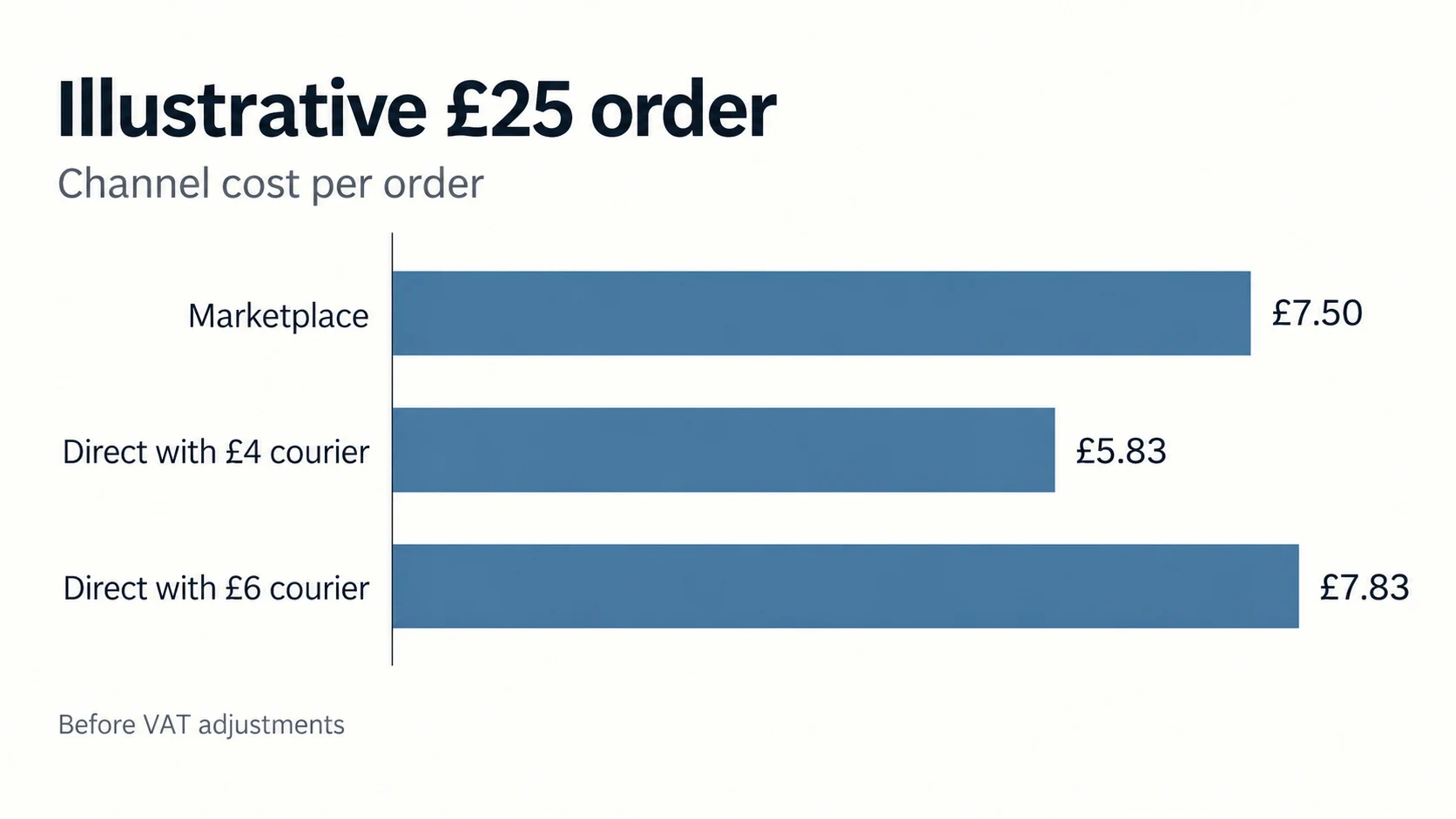
| Total channel cost, rounded after calculation | £7.50 | £5.83 |
The unrounded difference is £1.675 per order, or £335 across 200 identical orders. Displaying rounded order figures can produce a slightly different monthly total; keep full precision until the final result.
The point is the sensitivity, not the attractive number. If the courier cost rises from £4 to £6, the direct cost becomes £7.825 per order. In this example, direct ordering would cost £65 more across 200 orders. The same website and basket can produce a different decision when delivery changes.
Food, packaging and ordinary kitchen labour still need paying on both routes. They cancel out in this narrow comparison only because we assumed they were identical. Include any difference in portion, packaging or labour cost. This is a channel-cost comparison, not profit before overheads and tax.
Use the worksheet without hiding a cost
Download the editable order-cost worksheet. Open it in a spreadsheet and replace the assumptions with your own figures. Keep a separate copy for collection, own-driver delivery and courier delivery. The instructions explain each formula and which inputs use pounds rather than percentages.
The worksheet compares per-order channel costs and shows the monthly effect. Add setup costs separately: an ongoing monthly improvement does not mean you have recovered an upfront payment. If the monthly improvement is positive, divide the upfront cost by that improvement to estimate the months needed to recover it. If it is zero or negative, the model has no payback point.
Fuudster also has a direct-order calculator for exploring different assumptions. Check every input against your quote. A prefilled calculator value is not evidence of your business’s costs.
What would make a pilot worth continuing?
Agree the decision before promoting the link. Record completed orders, channel costs, refunds, late orders and staff time. Ask whether customers can reorder without help and whether the kitchen can fulfil the promise during a busy service.
Count new customers separately from people moving an existing order to a different channel. More direct orders can be worthwhile without being new demand. Equally, moving orders while increasing delivery subsidies or support work may leave less money after costs.
Before inviting customers, use the takeaway online-ordering launch checklist. Once the journey works, the Google Business Profile ordering-link guide helps connect a public profile to the right destination.
Questions to settle before signing
Ask who owns the domain, how menu and order data can be exported, who handles failed payments and what happens when you leave. Get the actual scope and exclusions in writing. Fuudster’s ordering-system selection guide offers a broader supplier checklist.
For a takeaway, a clear mobile menu and dependable handover matter more than a long feature list. Explore Ampliflow’s takeaway website page, or get unstuck with the journey you want to improve.