

Language. Vision. Action.

AI research

We are interested in what models can learn, how agents act, and what it takes to turn those capabilities into products people can rely on.

Our interests span machine learning, large language models, video generation, agentic editing, spatial world models and humanoid robotics. This is a record of our product work, research interests and the developments we are following.

Our timeline

Conversations, programme participation and recognition connected to our work.

  1. HKUDS conversations

    We have been in contact with HKUDS, the Data Intelligence Lab at the University of Hong Kong, about video generation models and agentic editing.

    Explore HKUDS research
  2. Google WebMCP

    Ampliflow received early access to Google WebMCP in February 2026. WebMCP explores how websites can expose structured tools for browser agents to use.

    Read Google’s programme announcement
  3. Alibaba Catalyst Award — Cellbot

    We received the Alibaba Catalyst Award for Cellbot, our app product.

    Explore the Cellbot case study
  4. Claude for Startups

    Ampliflow was accepted into Claude for Startups.

    Explore Claude for Startups

The questions we keep coming back to.

Machine learning & language models
Large language models learn patterns from data to work with language. We are interested in how that capability becomes a dependable product: grounded answers, explicit tool permissions and evaluation against the task people actually need done.
Weights, biases & evaluation
Weights and biases are learned numerical parameters inside a model. We are interested in how training and adaptation change behaviour, how that behaviour is measured, and where a model’s confidence exceeds the evidence.
Video generation & agentic editing
Generating a convincing frame is one challenge. Maintaining continuity, following an editing brief and preserving control across a sequence are others. We follow systems in which agents plan edits, use tools and check the result.
Spatial world models & robotics
Spatial models represent environments; world models can help predict how they change. We are interested in the bridge from seeing a scene to acting within it, including simulation, transfer to real hardware and human supervision.

Product work

Cellbot

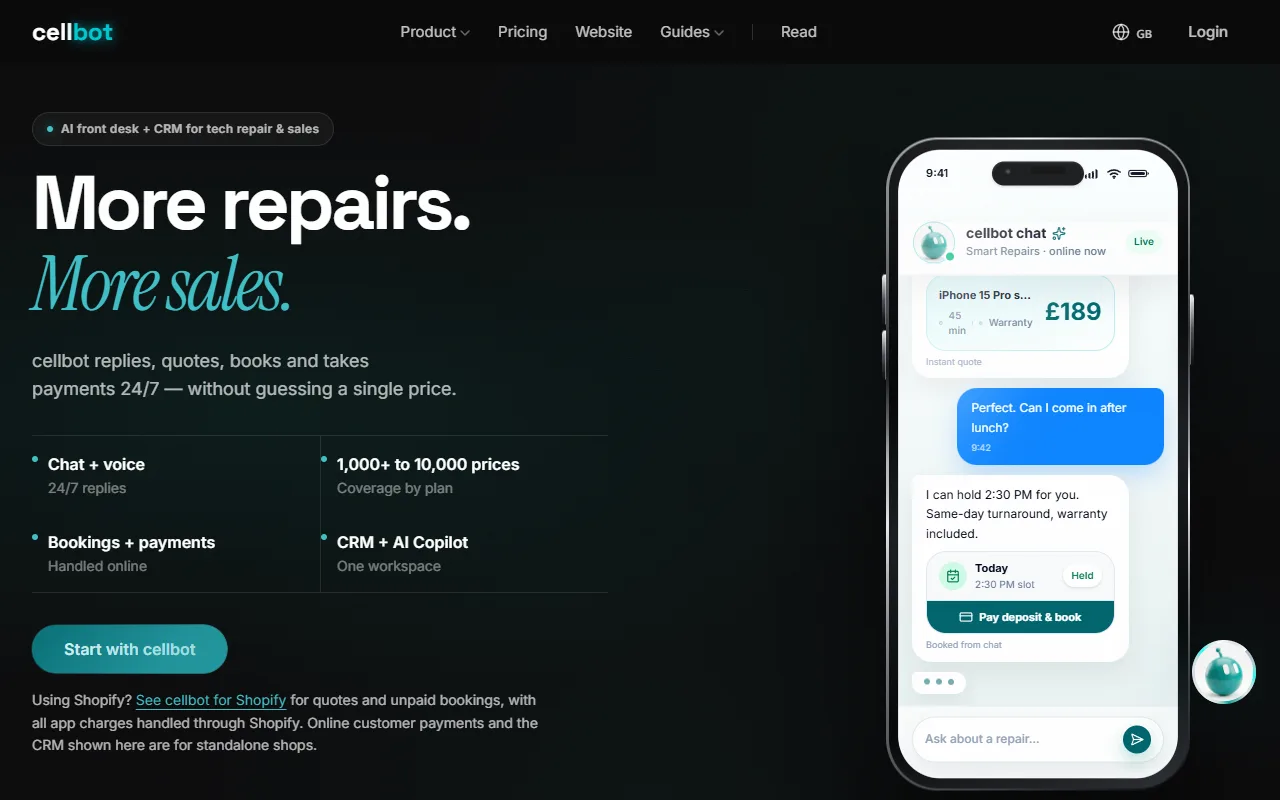
A software product designed and built by Ampliflow, connecting repair enquiries with quotations, bookings, customer tracking and follow-up.

Its published case study describes voice and chat intake, quotations grounded in a repair pricebook, and a customer portal. It separates the standalone-shop payment and CRM scope from the Shopify route’s quotes and unpaid bookings.

Read the product case study
Cellbot’s public product website, captured on 8 September 2026
Public product website · September 2026. A delivery example, not a measured customer outcome.

Source review:

October 2026 reading

Five October publications on embodied AI, world-action models and robotics. These are our reading notes, not results from Ampliflow experiments. Company announcements are attributed to their authors; questions below are our interpretation.

Google Cloud · ecosystem report

How startups are advancing robotics with Google AI

Google describes how robotics startups connect simulation, training, spatial reasoning and fleet operations. Its examples separate high-level planning from the fast control loops running on a robot.

Why we’re interested. Where should a system reason, where should it execute, and how does it recover when the two disagree? These are design questions for software agents as well as robots.

What this does not establish. A provider’s account of its ecosystem, rather than an independent comparison of robotics platforms.

Google Cloud · model announcement

Gemini Robotics Embodied Reasoning 2 on Google Cloud

Google announced public-preview access to Gemini Robotics ER 2 on its cloud platform. The model combines visual understanding and task planning, with tool calls connecting reasoning to lower-level robot controls.

Why we’re interested. Can a model recognise that a physical step failed before it continues? Progress checks and recovery matter more than a fluent explanation of the plan.

What this does not establish. Preview availability and reported model capabilities do not establish safe operation on every robot or in every environment.

Dream Labs · research release

Dream-1: a world-action model for unfamiliar robots

Dream Labs presents Dream-1 as a world-action model that transfers to unseen tasks and bimanual, parallel-gripper robots. Its release includes demonstrations and describes the tested hardware scope.

Why we’re interested. How much behaviour transfers to a new body, task or room without new training? The interesting boundary is where that transfer stops working.

What this does not establish. These are the developer’s reported results. Selected demonstrations are not a general guarantee of reliability or household readiness.

US Department of Energy · research selections

Robotics testbeds built around reusable evidence

Four laboratory-led selections address robotic scientific work through reusable skills, digital twins, failure testing and reproducible evaluation. They put infrastructure and evidence alongside autonomy.

Why we’re interested. Can another team rerun the evaluation, inspect the failures and transfer a capability to a different setting? That is a stronger test than a polished demonstration.

What this does not establish. Selection for award negotiations is not completed funding, and proposed work is not a delivered research outcome.

USA TODAY · original reporting

Tau Robotics brings humanoid cleaning into homes

Reporting from San Francisco describes Tau Robotics’ domestic cleaning service and its use of remote human operation. The company’s own FAQ also states that its robots are operated by humans and AI.

Why we’re interested. What does dependable help inside a real home require: dexterity, privacy, supervision, safe recovery and a clear account of who is in control?

What this does not establish. A supervised cleaning service is not evidence of a fully autonomous household robot. Ampliflow has not tested the service.

For Tau’s own account, read the Tau Robotics company FAQ (undated; checked 31 October 2026). Our interest in these organisations does not imply a partnership or endorsement.

Have a paper, model or practical result we should look at?

hello@ampliflow.ai