Your website is becoming a product
Customers need accounts, personalized journeys, live data, useful tools or a portal—not another brochure page.
Next.js development company · United States
Marketing sites, customer portals and connected products—designed around the business job, not forced into a template.
A custom website your team can actually run.
Custom interface
Built around the customer journey
Search foundations
Visible, crawlable and structured
Production performance
Measured on real pages
Controlled handoff
Routine content stays editable
Next.js earns its place when the site needs this control. If it does not, we will say so.
The fit test
The framework is a means, not the pitch. These signals make a custom build worth considering.
Customers need accounts, personalized journeys, live data, useful tools or a portal—not another brochure page.
The public experience needs to work with content, forms, directories or business data without feeling stitched together.
Important URLs, content, internal links and measurement need a controlled migration—not a launch-day redirect scramble.
The production site needs measured budgets, restrained third-party code and a clear handoff—not a perfect score on an empty demo.
What we build
Fast, distinctive sites with clear service journeys, proof, editable content and search foundations built in.
Useful private or public journeys that bring accounts, content, directories, forms and business data into one interface.
Customer-facing tools and internal workflows that behave like software while remaining easy to understand.
Controlled moves from WordPress or another platform, with page parity, redirect mapping, crawl checks and post-launch monitoring.
Proof in production
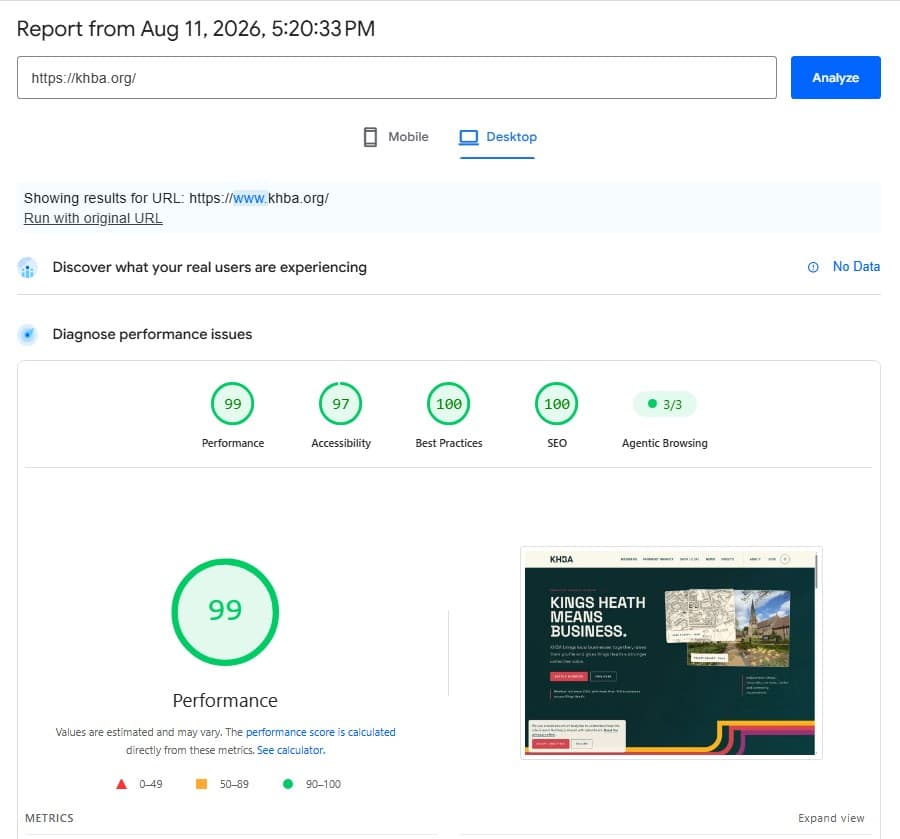
For Kings Heath Business Association, the live website recorded PageSpeed Insights performance scores of 93 on mobile and 99 on desktop on August 11, 2026. Its team can update most routine content without changing the public design.
These are dated lab measurements, not a promise that every run or every website will score the same.
See the full case study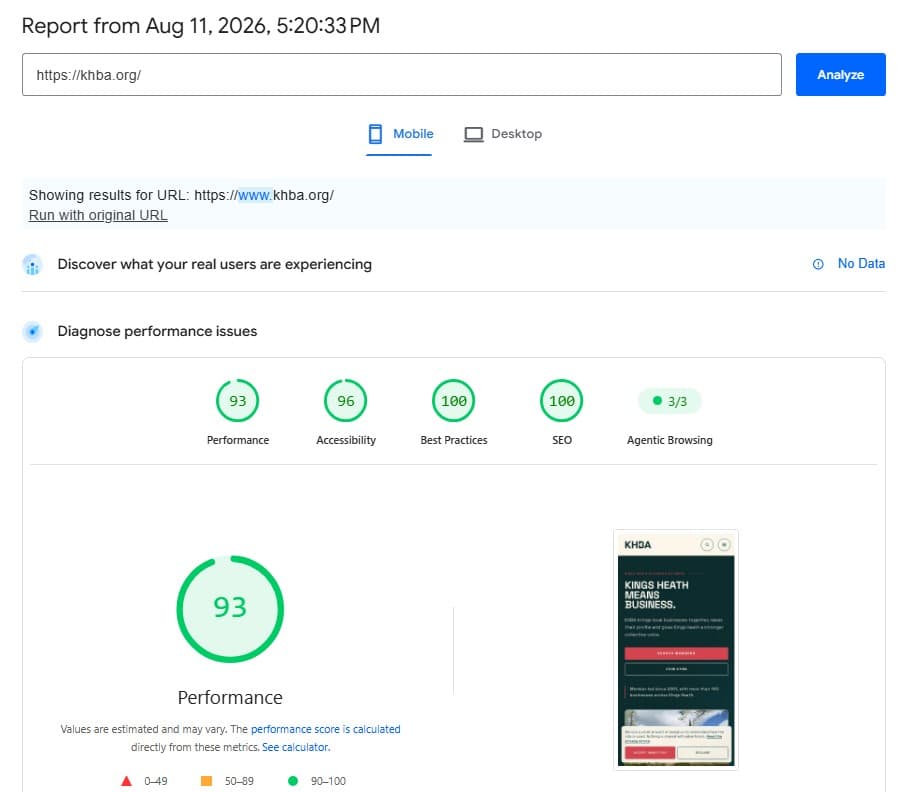
From brief to handoff
Next.js decision library
Choose the simpler fit for your content, team, integrations and plans.
02Protect URLs, search signals, analytics and editorial workflows before cutover.
03A production gate for rendered content, metadata, canonicals and discovery.
04A field-first method for finding the page, template and code that need attention.
Common questions
Next.js can support marketing websites, customer portals, directories, account journeys and connected web products. The right scope starts with the business job, then uses the framework only where its control is useful.
No. A straightforward publishing site may be better served by a simpler platform. Next.js becomes valuable when custom behavior, integrations, interface control or a separated content system justifies the extra engineering.
A careful migration can protect important search signals, but no responsible company should promise unchanged rankings. The work includes a URL inventory, page parity, one-to-one redirects, rendered metadata, internal-link updates, crawl testing, sitemaps and Search Console monitoring.
Yes. The editing experience comes from the content system connected to the website. The right setup lets a team update routine content without giving every page unrestricted layout controls.
No. Performance still depends on architecture, images, fonts, scripts, data loading, caching and the content added after launch. Field data and production testing matter more than the framework label.
Have a website, migration or product in mind?
We will tell you whether Next.js is the right tool—and what the first sensible step looks like.
Looking for a UK Next.js agency? See our UK service page.