Google Search Console Social Media Properties: The 2026 Guide
A practical guide to setting up Google Search Console Platform Properties, interpreting the reports and turning the data into better search and social decisions.
Co-founder of Ampliflow. Builds AI automation, websites, SEO/AEO, and growth systems for UK SMEs.
- 01What changed in Google Search Console?
- 02Do Platform Properties improve Google rankings?
- 03What is web entity optimisation?
- 04Platform Property vs Search Profile: what is the difference?
- 05How should web entity optimisation be measured?
Google has put Instagram, TikTok, X and YouTube beside “Add a website” inside Search Console.
The screenshot is easy to overread.
It looks like Google has confirmed social media as an SEO ranking lever. It has not. The new platform properties report how social posts and videos perform across Google Search, Discover and, where applicable, Google News.
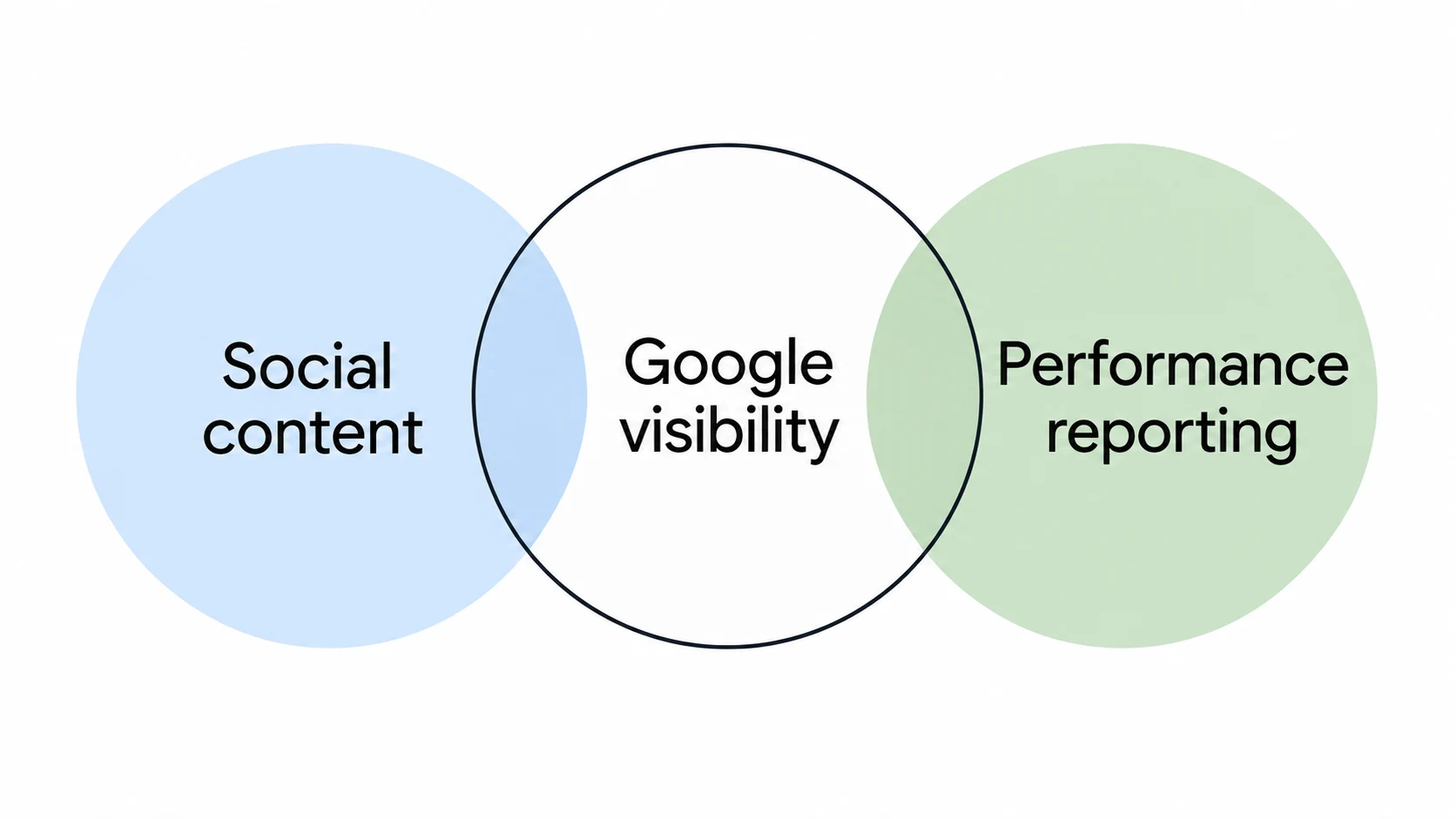
What Google has confirmed is quieter—and more useful. A website is no longer the only searchable asset a business can measure. Your social profiles, videos and posts can all form part of the route by which someone finds you.
That makes web entity optimisation practical: make the business recognisable, support it with real evidence and connect its website, social channels, video, reviews and credible third-party references.
Checked: 30 July 2026 · Based on Google’s current platform-property, Search-profile and structured-data documentation
In short
Google Search Console can now report how content from supported Instagram, TikTok, X and YouTube accounts performs on Google Search, Discover and, where eligible, Google News. Add each account as a separate Platform Property, verify ownership and allow a few days for data to appear.
The connection does not improve rankings. Its value is diagnostic: it shows which Google queries surface your social posts and videos, which assets earn clicks and where your website-and-social content system has unanswered demand.
How do you add Instagram, TikTok, X or YouTube to Search Console?
Google’s setup is short:
- Open the Search Console welcome screen, or open the property selector in the sidebar and choose Add property.
- Select Add beside Instagram, TikTok, X or YouTube.
- Follow the prompts to prove ownership. Google can verify through an existing website property or a direct platform login, depending on the account.
- When verification succeeds, select Go to property.
- Repeat the process for every account or channel you want to measure.
Treat each account as its own dataset. One Instagram account and one YouTube channel create two Platform Properties, not a combined brand dashboard.
Google says reports can remain empty for the first few days while it collects and processes data. The feature is also rolling out gradually, so the option may not appear in every Search Console account at the same time.
Ownership is checked periodically. If an external login expires or the connection is lost, reporting access pauses until you verify again. Reverification restores the same report; you do not have to rebuild its history.
At launch, Google lists four supported platforms: Instagram, TikTok, X and YouTube. Facebook, LinkedIn, Pinterest and other networks are not currently listed as Platform Property options.
What changed in Google Search Console?
Here is the change without the theory.
On 7 July 2026, Google introduced Platform Properties as a new Search Console property type. Account owners can add supported Instagram, TikTok, X or YouTube accounts and see how their content performs through Google.
Google’s official announcement describes three reporting surfaces:
- Performance: clicks, impressions, average click-through rate and average position, with filters for individual posts and queries;
- Insights: recent trends, leading content and the ways people discover the account;
- Achievements: click-based milestones as the account’s search audience grows.
Each account is a separate property; channels are not combined into one brand property.
The reports cover performance on Google. They do not replace the analytics inside Instagram, TikTok, X or YouTube. Google’s Platform Property guidance is explicit: the reports do not show how often content appeared inside the original platform.
You are looking at two different discovery systems. Search Console shows what happened on Google. The platform’s own analytics show what happened inside the platform.
Do Platform Properties improve Google rankings?
Koray Tuğberk Gübür gave the screenshot a bigger frame. In an X post about the launch, he argued that SEO is becoming less about optimising an isolated website and more about strengthening the wider web entity.
The direction is useful. But the screenshot does not prove every claim we might attach to it.
| Confirmed by Google | Not established by this update |
|---|---|
| Google can report Search performance for supported social and video content | Connecting a profile gives the website a ranking boost |
| Individual posts can receive impressions and clicks from Google | Follower count is a direct Google ranking factor |
| Queries can be associated with content hosted beyond a company website | Every social engagement strengthens organic rankings |
| Search, Discover and sometimes News can surface platform content | Platform properties merge profiles into one ranking entity |
| Website and platform assets can be measured in the same product | A Search Console connection creates authority by itself |
No. Google’s property setup documentation says that adding a property does not affect its performance in Search. It enables reporting.
That sentence belongs beside every excited interpretation of the launch.
The update still matters. Google was already finding and displaying social content. Now account owners can see more of that behaviour and act on it. Treat platform properties as a window, not a lever: they reveal where the opportunity is; they do not create authority for you.
What is web entity optimisation?
Web entity optimisation is the work of making a real person, organisation, product or place easy to identify and verify across the web. It aligns facts, content, relationships and proof so that search systems—and potential customers—can tell who you are, what you do and why they should trust the answer.
For a business, the entity is a set of connected facts and relationships:
- the official trading name and website;
- people associated with the company;
- products, services and locations;
- social and video profiles;
- articles, demonstrations, research and reviews;
- structured data that describes these relationships;
Google explains that knowledge panels are generated from its understanding of information gathered across the open web. Its organisation structured-data documentation also says that sameAs URLs can point to social-media or review profiles and help provide additional information about an organisation.
This is not a copy-and-paste exercise. Repeating the same description 100 times may improve consistency. It does not create authority.
Consistency helps a system identify you. Useful work, credible proof and relevant independent references give it a reason to trust what it finds.
Why is website-only SEO now incomplete?
The old mental model was simple:
The website is where you rank. Social media is where you distribute.
That line no longer holds.
A website is still the asset a business controls most fully. It can hold detailed explanations, commercial pages, research, structured data and conversion journeys without depending on another platform’s rules.
But buyers rarely move in a straight line. Someone might see a YouTube answer in Google, search the brand, read a customer discussion and visit the website days later. Platform properties make part of that journey visible.
Google’s separate Search profiles reinforce the direction: eligible creators can aggregate linked-platform content and let people follow them in Google. Creating one still does not directly change rankings.
Social is not replacing the website. It is becoming part of the searchable evidence around it.
That changes what you measure. One website traffic total cannot explain a journey that moved through five different surfaces.
Platform Property vs Search Profile: what is the difference?
The names are easy to confuse. They describe different Google features.
| Search Console Platform Property | Google Search Profile | |
|---|---|---|
| Primary purpose | Private reporting for one supported account or channel | Public profile that brings a creator’s content and links together |
| Where it lives | Google Search Console | Google Search and Discover |
| What it contains | Performance, Insights and Achievements reports | Bio, linked platforms, recent content and featured links or posts |
| Availability | Gradual rollout to Search Console users | Currently limited to eligible profiles in the United States |
| Eligibility | Ownership of a supported account or channel | Age, policy and audience thresholds apply |
| Ranking effect | None from creating the property | None directly from creating or editing the profile |
Google currently says a new Search Profile requires at least 100,000 followers or subscribers on YouTube, Instagram or X, or 300,000 on TikTok. Some eligible profiles may already have been generated and can be claimed.
A Search Profile can make a creator’s wider presence easier for people to explore. A Platform Property lets the owner study Google performance. One is a public destination; the other is a measurement property.
Neither is a shortcut to authority. Google states that creating a Search Profile does not directly affect rankings, just as adding a Search Console property does not.
How do you build a strong web entity?
Most advice stops at “be consistent everywhere”.
That is too vague to run a business on. Use five layers instead.
1. Identity: define the canonical facts
Start with the unglamorous part: write one internal fact sheet for the entity. Include the exact business name, preferred short name, official domain, contact details, locations, named people, products, services and verified profiles.
Then compare those facts with the website, social bios, Google Business Profile, Companies House where relevant, review sites and important directories.
Correct genuine contradictions. Do not flatten every description into duplicated copy. A TikTok bio and an About page serve different purposes. They should still agree about who the company is and what it offers.
2. Evidence: publish things worth retrieving
An empty profile does not become authoritative because its bio matches the website.
Profiles are containers. Evidence gives them value.
Useful evidence includes:
- an original explanation built from practical experience;
- a product demonstration that shows the result;
- a case study or first-party dataset with a transparent method;
- a clear comparison or expert answer;
- documentation that removes uncertainty before a purchase.
Google’s guidance for AI features says that the same foundational SEO practices still apply: technical eligibility, people-first content and information that is genuinely useful. There is no separate AI-ranking shortcut.
If the source material is weak, distribution only multiplies the weakness.
3. Connection: make relationships explicit
The official website should identify the organisation clearly and link to genuine profiles. Valid Organization structured data can include the website, logo, contact information and appropriate sameAs URLs. Google says this markup can help it understand and disambiguate an organisation.
Connect the evidence where the platform permits it:
- website to official social profile;
- social profile to official website;
- author page to the person’s genuine profiles;
- video or article to the source, demonstration or dataset it discusses.
Links are part of the work. Clarity is the point.
A system should not have to guess whether two similarly named accounts represent the same business.
4. Distribution: adapt one idea to each surface
One idea. Five different jobs.
Start with one substantial source that owns the complete argument. Then adapt it to the native strength of each platform:
| Asset | Job |
|---|---|
| Website article | Full explanation, sources, definitions and next steps |
| YouTube video | Demonstration, commentary and visible expertise |
| X thread | Compressed argument, distinctions and discussion |
| Instagram carousel | Visual sequence people can save and revisit |
| TikTok video | One sharp question, example or misconception |
Keep the entity, subject and central claim recognisable. Change the treatment.
Each asset should stand alone while making the wider body of work easier to understand.
5. Measurement: learn which asset answers which query
This is where the update becomes useful. Platform reports can connect Google queries to content hosted away from your website.
For each platform property, review:
- queries producing impressions;
- posts or videos receiving clicks;
- changes in click-through rate;
- average position as a directional measure, not a permanent rank;
- Search versus Discover performance;
- branded versus non-branded discovery and cross-surface topic patterns.
Compare this with the website property and on-site analytics. You are not trying to crown a winning platform. You are learning which asset does which job.
Our guide to measuring AI search visibility follows the same rule: keep distinct evidence separate instead of hiding it inside one vanity score.
How do you put web entity optimisation into practice?
- 01Identity: define the canonical facts
- 02Evidence: publish things worth retrieving
- 03Connection: make relationships explicit
- 04Distribution: adapt one idea to each surface
- 05Measurement: learn which asset answers which query
We could stop with the theory.
Better to show the system working.
This website version is the canonical source. It records the date, links to Google’s documentation and distinguishes fact from interpretation.
From here, a useful distribution set would be:
- X thread: summarise what the update proves and the ranking claim it does not prove.
- YouTube explainer: show how to add a platform property and read its first report.
- Instagram carousel: explain the update and the five layers of a web entity.
- TikTok or Short: correct one misconception, then explain the practical opportunity.
- Newsletter note: show owners why SEO and social can no longer be measured in isolation.
The format changes. The evidence does not.
After publishing, use the platform properties to see which queries surface each asset. Perhaps YouTube wins setup questions while the article wins conceptual searches. Good. Each asset has found its job.
Then stop asking, “What should we post next?”
Ask, “Which useful question is still unanswered?”
That is web entity optimisation in action: one expert idea, several useful forms and a feedback loop based on real demand.
What should the first 30 days look like?
Week 1: establish identity and access
- Create the canonical entity fact sheet.
- List every official website, profile, channel and important third-party listing.
- Confirm ownership and responsible account holders.
- Add supported accounts as separate platform properties.
- Keep the website properties; platform properties do not replace them.
Week 2: remove contradictions
Check names, handles, website links, bios, locations and service descriptions. Fix material inaccuracies first. Inspect the website’s organisation structured data and add only genuine profiles to sameAs.
Week 3: build one evidence-led content set
Choose one question with commercial relevance and enough substance for a definitive source.
Create one complete website resource, one demonstration or explanation in video and two or three native social adaptations.
Use a named author where readers would expect one. Google’s people-first guidance recommends making the who, how and why of content clear, especially when expertise matters.
Week 4: set the baseline
Platform Property data can take several days to appear. Once it does, use the default 28-day window as the first honest baseline:
- Export or record the leading queries and top content for each property.
- Separate branded queries from non-branded questions and topics.
- Group the non-branded queries by intent: definition, setup, comparison, problem or purchase.
- Match each query group to the post, video or page Google surfaced.
- Compare the platform results with the website property without adding the numbers together.
- Mark questions where you appeared but earned few clicks, and useful questions for which no suitable asset exists.
- Choose the next improvement from that evidence: refine the search snippet, strengthen the answer, make a more suitable format or create the missing source.
Combine that with the website property, conversions and customer-reported discovery. Record what cannot be attributed.
A truthful gap in the data is more useful than a neat fiction.
How should web entity optimisation be measured?
Resist the urge to compress everything into a “web entity authority” score. Use a small scorecard instead.
| Layer | Monthly check |
|---|---|
| Identity | Material factual conflicts found and resolved |
| Evidence | Useful primary assets published or improved |
| Connection | Official profiles and source relationships verified |
| Discovery | Queries, impressions and clicks by property and asset |
| Trust | Accurate third-party references, reviews and citations |
| Commercial | Qualified visits, enquiries and assisted journeys |
Look for patterns over time:
- Does non-branded discovery expand beyond the website?
- Which platform owns video, visual or first-hand queries?
- Do branded searches lead to a coherent set of official assets?
- Are AI answers and knowledge features describing the business accurately?
- Are useful discoveries producing enquiries, subscriptions or sales?
Search Console shows Google discovery. It does not prove revenue. Platform analytics and CRM notes complete the picture.
Where web entity optimisation goes wrong
Treating the connection as an SEO tactic
The connection is not a magic button. Adding a property gives you data. It does not manufacture authority.
Connect the account. Read the evidence. Improve what people actually find.
Optimising profiles while the website remains weak
A consistent bio cannot rescue thin service pages, vague claims or missing proof. Keep the website as the strongest complete source.
Calling engagement a Google ranking factor
Popular content may earn searches, links, mentions and demand. That is valuable. It still does not make likes or followers a confirmed direct ranking input.
Creating fake corroboration
Low-value profiles and manufactured mentions add noise, not trust. Apply the same people-first standard off-site.
Measuring only traffic to the website
Some search journeys now end on a video, post or answer. Measure useful discovery and commercial influence, not only sessions landing on your domain.
The real lesson from Google’s update
Your brand is no longer one URL.
But it still needs a centre.
The website is that centre of control. Social and video provide new formats, audiences and first-hand perspectives. Reviews and independent references add corroboration. Structured data and links make the relationships clearer.
The answer is not “do more social media”. It is to make every worthwhile asset contribute to one understandable body of expertise.
Define the entity.
Publish proof.
Connect the sources.
Adapt the idea.
Measure what gets discovered.
Then let the evidence decide what deserves to exist next.
That is more durable than chasing a new acronym. And it starts with the data Google has just made visible.
Frequently asked questions
Can Google Search Console track Instagram, TikTok, X and YouTube?
Yes. Platform properties report how supported content performs on Google Search, Discover and, when eligible, Google News. Add each account separately.
Does adding a social profile to Search Console improve rankings?
No. Google says adding a property does not affect its Search performance; it enables reporting.
What is the difference between a website property and a platform property?
A website property covers a verified domain or URL scope. A platform property covers a supported third-party account.
What is the difference between a Platform Property and a Search Profile?
A Platform Property is a private Search Console report for one account or channel. A Search Profile is a public Google profile that can aggregate an eligible creator’s linked content. Neither directly improves rankings.
Which social platforms does Search Console support?
Google currently lists Instagram, TikTok, X and YouTube. Other platforms, including Facebook and LinkedIn, are not currently listed as Platform Property options.
Is social media optimisation now part of SEO?
The disciplines overlap because social and video posts can appear in Google. Their integration point is shared identity, evidence, search data and customer outcomes.
What should a business do first?
Keep the website property, add supported platform properties, correct contradictory profiles and publish one evidence-led topic across several native formats. Use the first 28 days as a baseline.
Explore AI Search Optimisation →
Related: Google Search Console guide · Measure AI search visibility · What AI search cites · Managed social media