Celltech SEO Case Study: 20.8% More UK Search Clicks
A documented rise in UK search clicks, a clearer repair guide and an honest account of what the evidence can—and cannot—tell us.
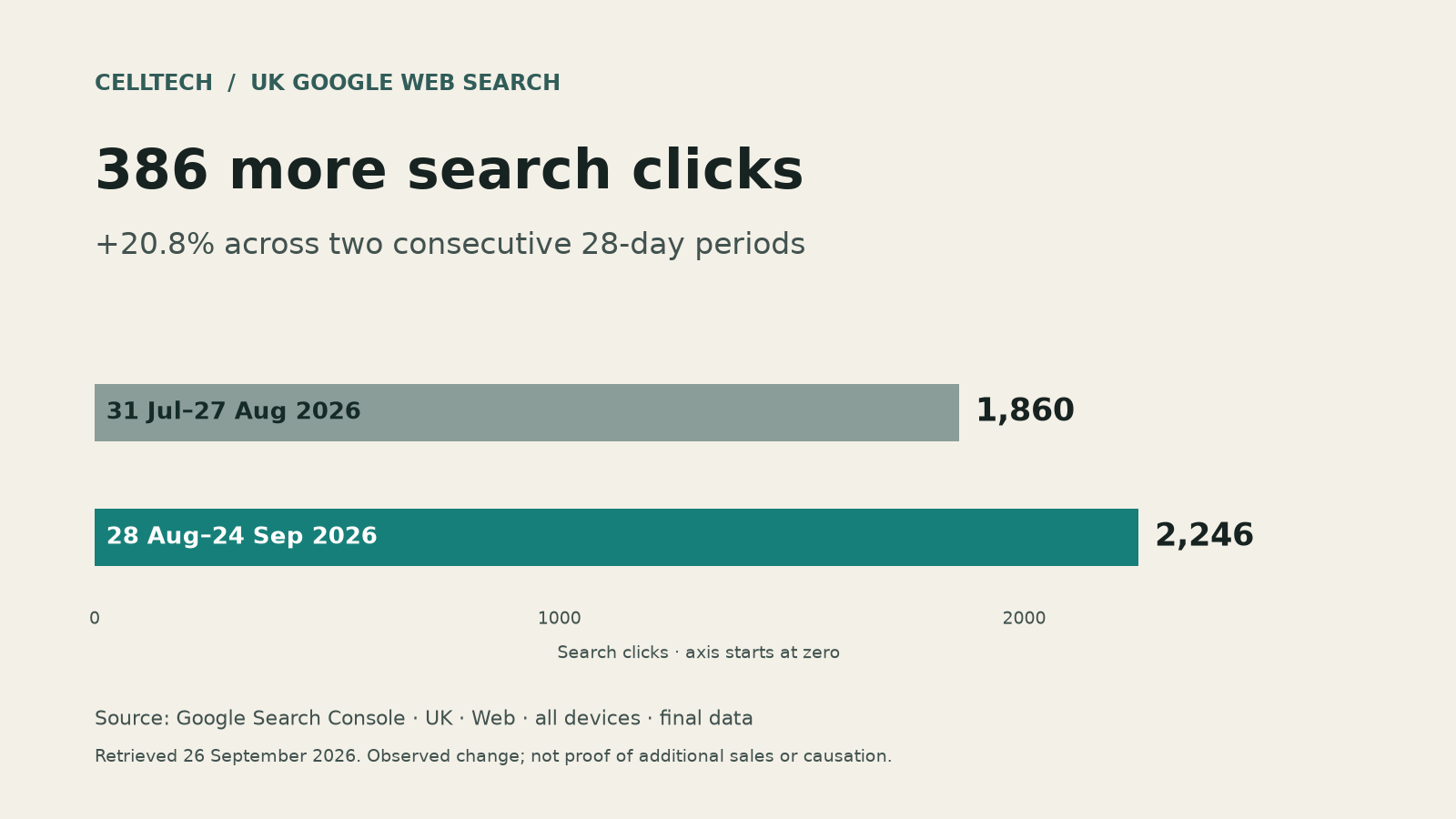
Celltech recorded 2,246 clicks from UK Google Web search between 28 August and 24 September 2026, compared with 1,860 in the preceding 28 days. That is 386 additional clicks, an increase of 20.8%. Search impressions rose by 33.5%, while the proportion of impressions that produced a click fell.
For a repair business, being found is only the start. Someone looking for a battery replacement needs a useful answer: the right model, a dependable price and a clear route to the relevant repair. This case study brings the search figures together with documented work on those practical details.
Celltech is an Ampliflow website project. The results below come from its Google Search Console property. They show a change in search performance; they do not establish how many repairs were booked or which individual change produced the increase.
The results, with the comparison in full
The comparison uses UK, Web search, all devices and final data. Both periods contain 28 days: 31 July–27 August 2026 and 28 August–24 September 2026. Data was retrieved on 26 September 2026. These are the fixed periods for this case study, not a rolling performance claim.
| Measure | 31 July–27 August | 28 August–24 September | Change |
|---|---|---|---|
| Search clicks | 1,860 | 2,246 | +386 / +20.8% |
| Search impressions | 203,062 | 271,046 | +67,984 / +33.5% |
| Click-through rate | 0.916% | 0.829% | Down 0.087 percentage points |
| Average position | 8.97 | 8.44 | Improved by 0.52 using unrounded values |
An impression records an appearance in search. A click records a click from a result; it is not a unique customer or a completed booking. Click-through rate (CTR) is clicks divided by impressions. Average position averages the topmost result across the relevant searches, so it is not a fixed ranking for one keyword. Google's Search Console performance guide explains the measures.
The chart above is an Ampliflow visualisation of the approved Search Console figures, not a screenshot of Google's interface. The aggregate comparison CSV provides the values and date ranges. Raw queries and private account information are not included.
A clearer answer to a practical buying question
The iPhone battery replacement cost guide recorded 121 UK search clicks, compared with 21 in the preceding period. That is 100 additional clicks to one useful page. We have shown the counts because a percentage alone would exaggerate the impression created by a small starting point.
The guide's 25 August update made its published prices consistent with the repair service information. It also clarified the qualifications around battery capacity and the messages a repaired phone might display. These details matter when a visitor is trying to compare repair options without assuming that every model or replacement part behaves identically.
The practical principle is simple: an article about cost should help someone make the actual buying decision. It should explain the relevant differences, keep its figures dependable and connect the reader to the service they need.
The page-level increase is an observation, not proof that the August update caused those clicks. It also does not mean every page on the site improved. Our repair-business digital marketing guide covers the wider route from useful information to an enquiry.
What changed, and when
A dated record helps keep the explanation honest. We checked the following changes against successful production releases:
| Date in 2026 | Published work | Where it falls in the comparison |
|---|---|---|
| 25 August | Battery cost information and clearer qualifications about replacement parts | Within the earlier period, three days before the later period began |
| 9 September | On-site repair search, device matching and routes to relevant repair pages | Within the later period |
| 12 September | Further on-site search and checkout accessibility improvements | Within the later period |
| 25 September | A later screen-repair page release | After both periods; excluded from explanations of this result |
On-site search helps visitors find a repair after they reach the website. Improving it is useful, but it does not by itself demonstrate an improvement in Google rankings.
Both measurement periods contain work. This is therefore an observational comparison, not a clean before-and-after experiment. A release date is also not the date Google necessarily recrawled or reassessed the page. Changes in demand, competing pages and the mix of searches may affect the results too.
Why the lower click-through rate matters
Impressions increased faster than clicks. More search appearances did not turn into visits at the same rate, and that belongs in the result alongside the growth figures.
A different mix of searches, positions or competing results could contribute to that change. This comparison does not isolate the cause. The next useful investigation is to compare the affected pages and queries across the same periods, separating established searches from newly appearing ones.
Some queries are omitted from Search Console for privacy. A visible query export therefore cannot establish an exhaustive split between searches for the brand and searches for a service. We have not labelled the whole increase as non-brand growth.
What another business can take from this
You do not need to copy the subject of the article. Follow the reader's decision:
- Choose a question close to a real purchase. Cost, suitability, repair options and practical next steps often require an answer more specific than a broad service description.
- Make the answer dependable. Check the article against the current service information and explain qualifications that could change a customer's decision.
- Connect the answer to the next useful page. Help the reader find the relevant service without making them search the website again.
- Keep a dated change record. Record when work reached the public site so later reporting does not credit changes that happened outside the measured period.
- Measure the business outcome separately. Search clicks, enquiries and completed work are different stages. A search-performance increase is not a verified sales increase.
For the website work behind this approach, explore Ampliflow's SEO service. To assess the quality of a proposed review, the AI visibility audit worksheet helps distinguish observed evidence, assumptions and actions.
How we checked the evidence
The headline figures are property-level totals from Google's Search Console API, with the same country, search type and final-data settings for each period. We reconciled the click and impression totals against all 56 daily rows. Percentage changes use (later − earlier) ÷ earlier × 100; CTR is calculated from the totals, not by averaging daily percentages.
The battery guide is a separate page-level comparison. Page and property aggregation can differ, particularly for impressions, so it is not used to reconstruct the site's totals. The public CSV includes unrounded average-position values; this explains why subtracting the two rounded display values gives a slightly different result.
The evidence supports more UK Google search clicks and impressions alongside documented content and usability work. It does not establish causal attribution, additional revenue, a fixed keyword ranking or an uplift in ChatGPT or other AI citations. Search visibility and AI search measurement need their own evidence.
If you want to understand which pages and buying questions deserve attention on your website, Get unstuck.