AI for law firms: practical workflows for UK solicitors
Explore practical AI uses for law firms, compare buying and building, and choose a first workflow with source checks, staff ownership and measurable value.

AI for law firms is most useful when it supports a defined task that a firm repeats, can check against an original source, and can measure from beginning to end. Document indexing, enquiry handoff and internal policy retrieval are sensible candidates to investigate. The right choice depends on where staff lose time and whether a responsible person can review the output.
Buying an AI subscription is only one part of that decision. Someone still needs to decide which information it can use, who checks its work, how it fits the case-management system, and what happens when it fails.
This guide is for partners and practice managers choosing an implementation, rather than people seeking advice on a legal matter.
Find a task with a clear finish
“Improve productivity” is too broad to evaluate. “Prepare a document register with a source reference for every entry” gives the firm something it can inspect.
Start by watching the current task. Record the time spent collecting inputs, preparing the work, reviewing it and correcting mistakes. Include the interruptions and handoffs. A faster first draft is of limited use if reviewing it takes longer than completing the original task.
| Candidate task | Useful output | What the firm still decides |
|---|---|---|
| Enquiry handoff | Minimum callback facts and an assigned staff task | Urgency, conflicts, availability and whether to act |
| Document preparation | Register, date/event list and links to source pages | Meaning, relevance, privilege and completeness |
| Internal knowledge | An answer drawn from an approved policy, with its version | Whether that policy applies and whether the answer is usable |
| Client communication | Draft update based on verified matter status | Wording, recipients, advice and permission to send |
These are examples to assess, not claims that every firm needs a separate system. The legal services hub connects the existing website, intake, automation and knowledge work.
Choose a starting point by the work involved
For a small firm, the most useful AI application may be document preparation rather than legal research. A document task works on supplied material; a research task also depends on the currency, jurisdiction and licence of external legal sources. Assess those needs separately.
- If the problem is an unowned enquiry, start with the client intake workflow. A routing rule may be enough.
- If staff repeatedly sort case documents, examine the source-linked chronology and its fictional source pack.
- If staff cannot find the current procedure, examine the internal knowledge assistant.
- If the firm needs a legal research or document product, use the legal AI tools comparison.
Compare licensing, setup, staff training, review and ongoing support. There is no useful universal cost estimate without the task, document volume and user numbers. Use the workflow selection scorecard to turn that initial choice into an investment decision.
Check the tools you already pay for
Ask the case-management supplier to demonstrate the exact task using a permitted sample. Check the document system and existing research subscriptions too. A native function may already handle the work with less integration and support effort.
For a new product, compare the whole process: import, permissions, source references, review, export, failures and deletion. A feature called “document analysis” does not establish whether the reviewer can open the correct page, distinguish versions or keep two matters separate.
Harvey and Legora belong in a legal-work platform evaluation. Research products, practice-management features and custom administrative workflows answer different buying questions. Shortlist products after defining the task, then run the same examples through each serious candidate.
Give review a place in the process
The SRA’s August 2026 AI warning identifies inaccurate material and confidentiality as central concerns. Firms and practitioners retain responsibility for work produced with AI. Appropriate safeguards must cover the information being processed; a paid account alone is not proof that a tool is suitable. SRA: misuse of AI.
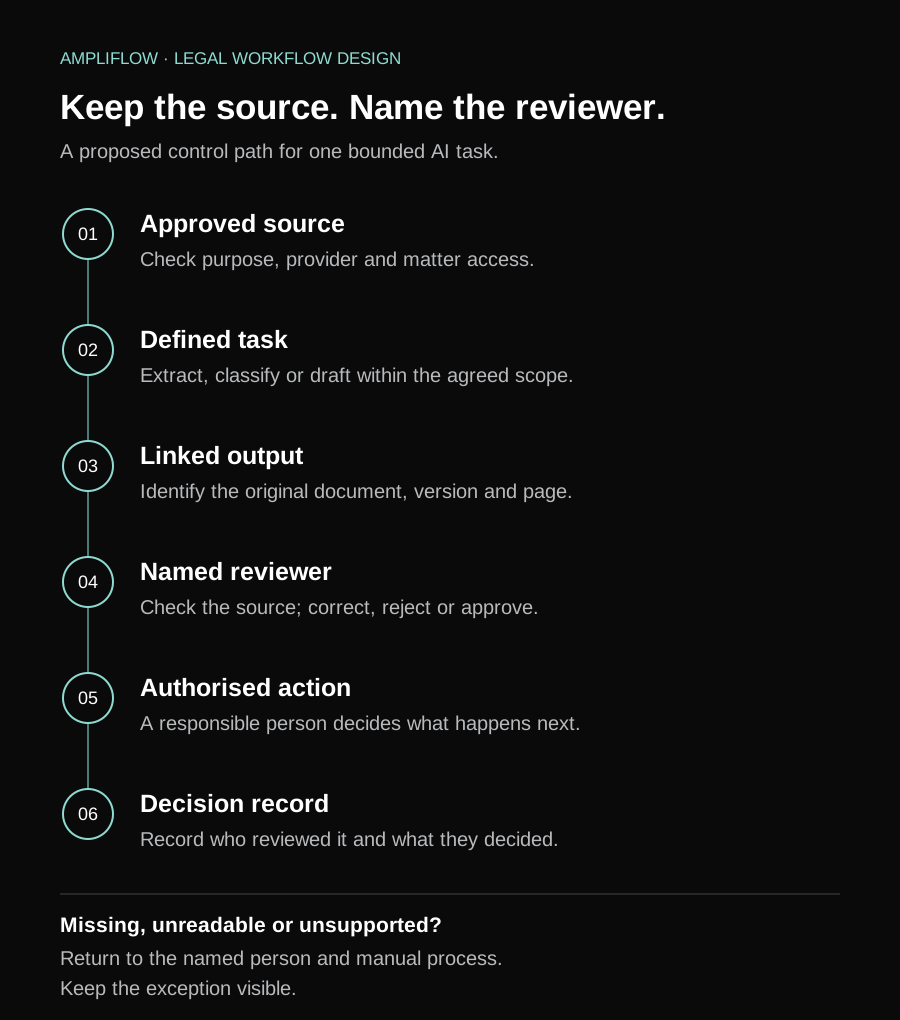
Our proposed workflow design makes review visible: approved source, defined AI task, linked output, named reviewer, approved action and a record of the decision. This is an implementation recommendation, not a regulator-prescribed six-step process.
The reviewer needs the original material, enough time to check it, and an obvious way to reject or correct the result. Unreadable documents and unsupported answers belong in an exception queue, where a named person can deal with them. They should not disappear behind an apparently completed status.
Look for evidence of adoption as well as speed
PwC’s account of its Hugh James project describes a 150-person pilot supported by education, an acceptable-use policy and partner involvement. After 11 weeks, it reports that 78% of users said they saved up to an hour a week and 93% were very likely to continue. These are supplier-published, self-reported findings from that deployment; they do not predict a smaller firm’s results. PwC and Hugh James.
The implementation case studies compare this account with five other published projects and explain which lessons a smaller practice can test.
The useful lesson is practical: adoption needs ownership and staff support. Measure whether people complete the workflow, where they abandon it, and how much correction it creates.
Decide whether a pilot earned its place
Compare total preparation and review time on comparable work. Record missing facts, unsupported statements, incorrect source references, failures and the number of outputs accepted after review. Include licence, support and integration costs.
Time released is capacity. It becomes a financial benefit only when the firm can show what changed: more useful work completed, less paid overtime, or another demonstrable effect. Do not turn every minute into assumed revenue.
For a first discussion, bring one repeated task, a description of the current tools, and a synthetic example. Identify its owner and agree what would make the trial worth continuing. That is enough to begin a useful conversation through Get unstuck.