Social Media Content at Scale: How AI Is Changing the Game for UK SMEs
A practical UK workflow for using AI to plan, draft and adapt social content while keeping human judgement, platform context, rights and disclosure in place.
Co-founder of Ampliflow. Builds AI automation, websites, SEO/AEO, and growth systems for UK SMEs.
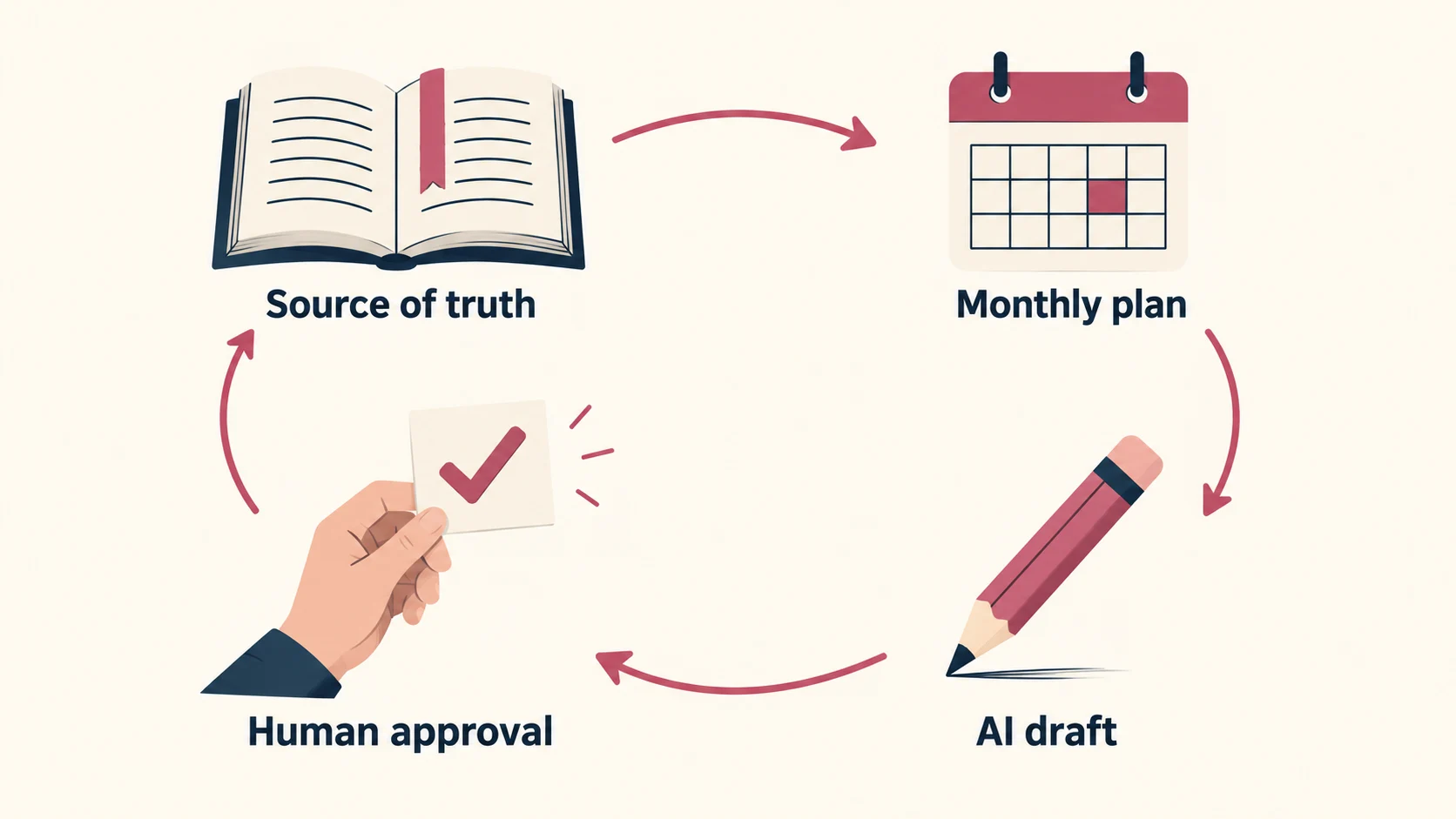
- 01The workflow in one view
- 02Step 1: build a source-of-truth library
- 03Step 3: batch drafting without flattening the voice
- 04Step 5: protect people, rights and claims
- 05A four-week production rhythm
AI can remove repetitive work from social publishing. It cannot decide what a business should stand for, whether a claim is true, whether an image is licensed or whether a reply deserves a person.
The useful model is a human-led content system: one source of truth, a clear monthly plan, AI-assisted transformations, platform-specific editing, approval and a feedback loop. “At scale” means the process stays coherent as volume rises—not that a tool pours identical posts into every channel.
The workflow in one view
- 01Plan
- 02Research
- 03Draft
- 04Adapt
- 05Approve
- 06Publish
- 07Learn
| Stage | AI can help with | Human responsibility |
|---|---|---|
| Planning | Turn approved themes into a draft calendar | Choose the audience, purpose and priority |
| Research | Summarise supplied sources and questions | Verify facts, rights and relevance |
| Drafting | Create variants in the approved voice | Edit claims, examples and tone |
| Production | Resize, subtitle or adapt assets | Check accessibility, branding and licences |
| Scheduling | Prepare channel-specific batches | Approve timing, disclosure and final copy |
| Engagement | Classify comments and suggest replies | Decide what to publish and when to escalate |
| Measurement | Group results by theme and format | Define the metric and act on the learning |
The ASA and CAP's current AI and deepfakes guidance is clear that AI does not create an exemption from the CAP Code. If a post is an ad, the usual advertising rules still apply.
Step 1: build a source-of-truth library
Give the workflow approved inputs:
- brand position and audience;
- services and exclusions;
- customer questions;
- evidence and dates;
- visual and accessibility rules;
- words or claims that need approval;
- response and escalation boundaries.
Do not ask an AI tool to “sound like us” without examples and constraints. Keep the original source next to each draft so an editor can check what changed.
Step 2: plan themes before posts
Choose a small set of recurring jobs:
- explain a customer problem;
- show how to make a decision;
- answer a question from real support or sales conversations;
- demonstrate work with permission and truthful context;
- offer a clear next step.
Each post should have one audience, one job and one proof point. A calendar full of “tips” is not a strategy if none of the tips answer a real question.
Step 3: batch drafting without flattening the voice
AI is useful for:
- turning a long approved article into a short outline;
- producing several openings for an editor to choose from;
- adapting a concept to different character limits;
- generating alt-text drafts and subtitle files;
- identifying repeated questions or missing explanations.
Keep the edit human. Remove filler, unsupported superlatives, invented numbers and wording that sounds like an unreviewed template. The final post should still make sense when the reader has not seen the source article.
Step 4: respect platform context
Do not copy the same post everywhere. A useful adaptation changes the job:
- a short video needs a clear first beat and captions;
- a professional network post needs a specific idea and reason to discuss it;
- a community channel needs context and a response owner;
- a visual platform needs a readable composition and descriptive alt text.
The tool can create variants. It cannot know the community's expectations unless the team supplies them and reviews the result.
Step 5: protect people, rights and claims
Before approval, check:
- the image, music, quotation and customer example are usable;
- a paid partnership or ad is disclosed clearly;
- an AI-generated person, voice or likeness is not misleading;
- health, financial, environmental and performance claims have evidence;
- personal data has not appeared in a prompt or caption;
- the route for a complaint or sensitive reply is obvious.
The CAP Code is media-neutral. A machine-produced claim is still the advertiser's responsibility.
Step 6: schedule with stop controls
Maintain a queue with owner, approval state, source, channel, scheduled time and expiry date. Pause scheduled posts after a serious incident, public tragedy, product change or factual correction. Automation is helpful only when the business can stop it.
Step 7: measure decisions, not vanity
Use a monthly view that groups posts by theme and purpose:
- qualified visits or enquiries;
- saves, replies and meaningful conversations;
- completed actions where attribution is defined;
- production time and review time;
- corrections, complaints and takedowns;
- the themes that produced useful questions.
Reach can show distribution. It cannot prove that a campaign created demand. Keep the metric definition and time window beside the report.
A four-week production rhythm
Week 1 — evidence: collect customer questions, approved source material and the next business priorities.
Week 2 — plan: choose themes, formats, owners and one measurement question per theme.
Week 3 — draft: use AI for transformations, then edit claims, examples, rights and accessibility.
Week 4 — publish and learn: schedule approved posts, monitor replies and update the source library with what customers actually asked.
The rhythm is more important than the tool name. Change platforms only when the workflow, governance or measurement needs change.
Common mistakes
- publishing the first generated draft;
- using one generic prompt for every platform;
- creating volume before a source library;
- copying a customer story without permission;
- mistaking disclosure for a substitute for truthful claims;
- allowing an agent to answer sensitive comments unattended;
- measuring impressions while ignoring review time and corrections.
FAQ
How many social posts should a UK business publish each week?
There is no universal number. Publish as often as the team can keep useful, accurate, platform-appropriate and supportable. A smaller consistent rhythm beats a burst followed by silence.
Can AI-generated content sound authentic?
It can help an editor explore a direction, but authenticity comes from real evidence, a recognisable point of view and a person willing to stand behind the post.
Should AI reply to comments and direct messages?
Use classification or draft replies first. Keep a human route for complaints, personal data, legal or financial questions, vulnerability and anything the source library cannot answer.
Does an AI label make an advert compliant?
No. The CAP Code still applies to the advertising claim, targeting, rights and presentation. Check the current ASA and CAP guidance for the format and audience.
For the wider plan, read AI marketing for UK businesses. To decide what should stay with your team, use the small-business social media guide and compare our managed social media service. If the next step is distributing content to existing contacts, read AI email marketing automation. Get unstuck if content is multiplying faster than the review process.