AI Email Marketing Automation: A Practical UK Guide
A practical UK guide to AI email automation: where AI helps, the sequences to build, the data and approval controls, and how to measure results.
Co-founder of Ampliflow. Builds AI automation, websites, SEO/AEO, and growth systems for UK SMEs.
- 01What AI email automation actually means
- 02Start with the customer journey, not the tool
- 03Five sequences worth building carefully
- 04Where AI helps—and where it does not
- 05UK privacy and electronic-marketing controls
AI can make email automation more useful when it helps a team understand what an enquiry needs, draft relevant messages or spot patterns in performance. It does not repair weak consent, poor data, an unclear offer or a damaged sender reputation.
The strongest starting point is usually a small number of email sequences, each with a named owner and clear rules for starting and stopping. Add AI only where it improves a decision that ordinary rules cannot handle cleanly.
If you are comparing an email marketing agency with an automation specialist, start with the job. Campaign planning and copy are different from connecting a form, customer relationship management system (CRM) and follow-up sequence. The CRM holds contact details, conversations and next steps. Our B2B email marketing guide helps you choose between customer campaigns, automation and new-business outreach.
What AI email automation actually means
Traditional automation follows fixed rules: when a person completes a form, send a message; when an account reaches a date, create a task.
AI can assist with less structured work:
- classify an enquiry by likely intent;
- summarise account or conversation context for a human;
- draft a message from approved facts;
- suggest a group of contacts with similar needs or behaviour;
- compare subject-line or content tests;
- identify unusual changes in engagement or complaints.
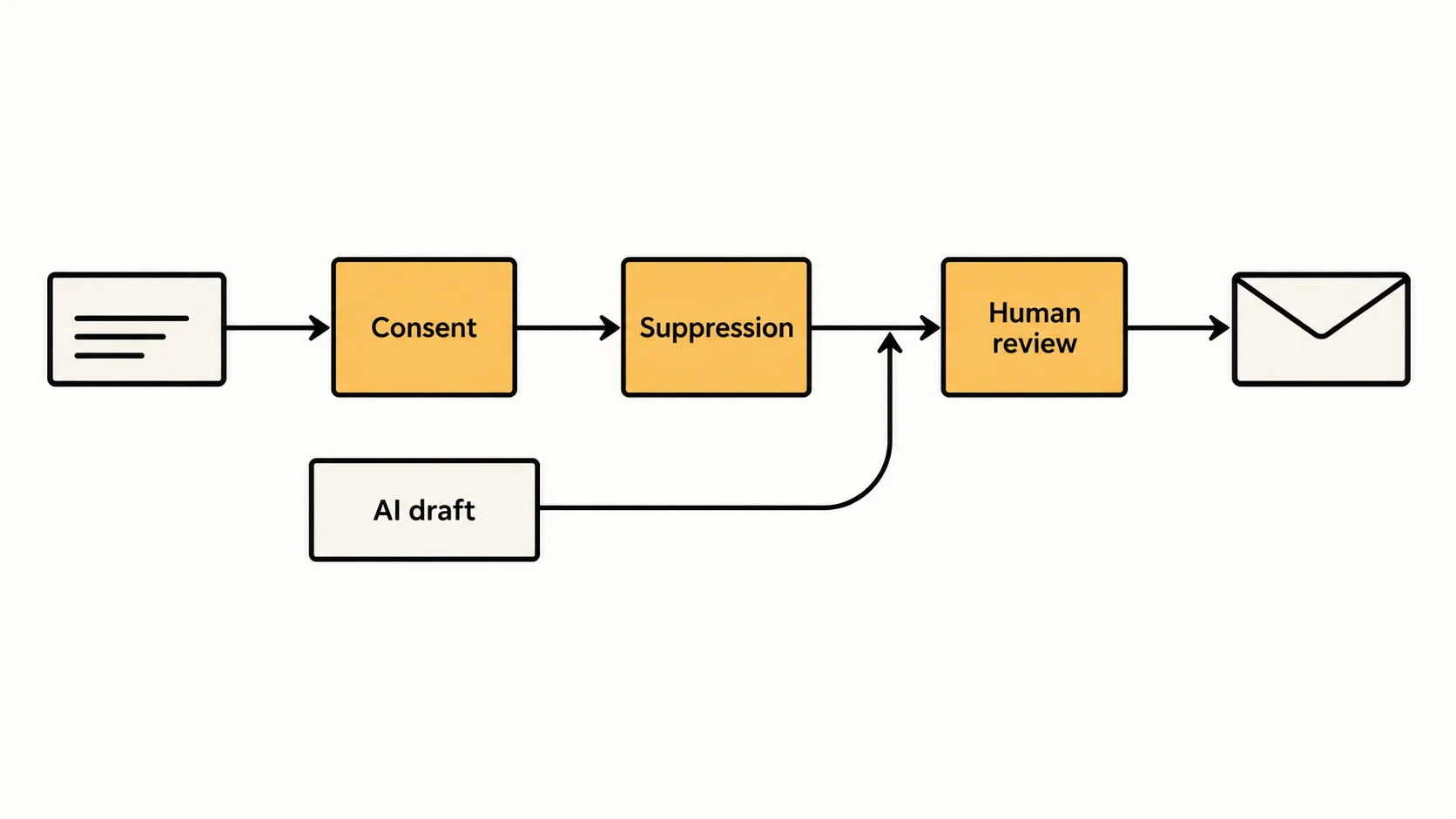
Keep fixed rules for consent, exclusions, sending frequency, unsubscribe and consequential account actions. Suppression means keeping opted-out or otherwise excluded contacts out of future sends. Those controls need predictable behaviour.
Start with the customer journey, not the tool
Map the moments where a relevant message is expected:
- someone asks for information;
- a new subscriber needs the promised resource;
- an enquiry needs a timely human response;
- a customer needs onboarding or service information;
- an engaged contact goes quiet;
- an existing customer reaches a genuine follow-up point.
For each moment, write the trigger, purpose, permitted data, owner and exit condition. If the purpose is vague—“nurture them until they buy”—the automation is not ready.
Five sequences worth building carefully
1. Welcome and delivery
Send the resource or confirmation a person requested, explain what happens next and make preferences clear. This sequence should be useful even if no later sale happens.
2. Enquiry follow-up
Confirm receipt, route the enquiry and create a human task. AI may classify the message or draft context, but it should not make promises about suitability, price or availability that the business has not approved.
3. Consideration sequence
Use a short sequence to answer common questions with relevant, approved material. Branch only when behaviour genuinely changes what would help next.
4. Customer onboarding
Deliver the right instructions at the right stage. Keep contractual and safety-critical information fixed and reviewed; do not let a model paraphrase it freely.
5. Re-engagement
Before sending, check the lawful basis, the relationship and how long the person has been inactive. A quiet contact is not automatically permission for an indefinite campaign.
Where AI helps—and where it does not
Worked example: an enquiry that needs a quotation
Consider a fictional industrial supplier receiving requests with missing specifications. This is a workflow example, not a reported customer result.
The form creates a record and assigns an owner. Fixed rules check whether the required fields are present. AI can summarise the buyer's free-text request and suggest the right team, but uncertain classifications go to a person. The acknowledgement confirms receipt without inventing a price or delivery date.
Before any follow-up, the system checks whether the buyer has replied, opted out or entered an active sales conversation. A technical question goes to the owner rather than another generic message. Any later marketing sequence needs its own eligibility check; requesting a quote is not blanket permission for unrelated promotions.
Test missing fields, duplicate submissions, delivery failures, objections and replies arriving just before a scheduled send. Measure whether suitable requests reach the right owner and progress, not simply whether more emails were sent.
| Use | Good AI role | Keep under fixed rules |
|---|---|---|
| Enquiry routing | Classify free text | Allowed queues and escalation |
| Personalisation | Choose from approved content | Eligibility and exclusions |
| Drafting | Produce a reviewable first draft | Claims, prices and legal wording |
| Testing | Summarise observed results | Random assignment and measurement |
| List health | Flag patterns for review | Suppression and unsubscribe |
AI output should be treated as a proposal unless the specific use has been evaluated and the consequence is low.
Test the whole sequence before switching it on
An email workflow is ready to review when you can show both what starts it and what prevents the next message. A successful test send proves only one path. Replies, opt-outs, duplicate submissions and uncertain delivery states need their own checks.
Download the email workflow acceptance worksheet (CSV). This is Ampliflow's original commissioning worksheet, version 23 September 2026. Its ten cases are proposed tests, not a record of completed tests, a legal assessment or a performance benchmark. The result, reviewer and date columns are deliberately blank. You can adapt it for your own review.
A reply arrives just before the follow-up
Imagine a fictional quotation enquiry. At 09:00, the workflow queues a follow-up. At 09:04, the buyer replies with a technical question. At 09:05, the queued message becomes due. A system that checked for replies only at 09:00 may now send an irrelevant prompt to someone already waiting for an answer.
The acceptance check is concrete: the reply reaches its owner, the generic follow-up is cancelled, and the record shows why. Recheck the latest reply and suppression state immediately before dispatch. If events can arrive late, agree how the system detects and handles that gap; a final check cannot undo a message already sent.
One sequence, three review points
- 1
At entry: can this contact enter?
Check the purpose, eligibility and existing enquiry. Assign an owner before the sequence begins.
- 2
Before sending: is this still appropriate?
Check for replies, opt-outs and changed circumstances. Hold the message when the required state is unavailable.
- 3
After action: what happened?
Record the send reference or hold reason. Reconcile uncertain delivery before attempting another send.
Evidence to ask for in the demonstration
| Test case | Expected behaviour | Evidence worth keeping |
|---|---|---|
| The same form event arrives twice | One enquiry and one follow-up path | Original event reference and duplicate-handling record |
| A recipient opts out while marketing is queued | Queued marketing is cancelled | Opt-out time, cancellation and suppression record |
| The provider times out after a send request | Check whether it accepted the message before retrying | Stable send reference and reconciled provider status |
| An AI draft invents a delivery promise | Hold the draft for correction | Rejected draft and human approval of the corrected version |
| The reply owner is absent | An agreed backup receives the task | Reassignment and next action |
Run these checks with synthetic contacts in an isolated test environment. Mark each case pass, fail or not tested, with the evidence and reviewer. A blank field is not a pass. Agree which failures block launch and repeat affected checks after changes.
Provider acceptance, recipient-server delivery and inbox placement are different observations. Record which one the evidence establishes. For commissioning and responsibility questions, use the B2B email marketing guide.
UK privacy and electronic-marketing controls
Email marketing in the UK can engage UK GDPR and PECR. The exact position depends on the recipient, data, relationship and message. The ICO's electronic-mail marketing guidance is the right starting point.
Important practical distinctions include:
- individual subscribers and sole traders are not treated the same as corporate subscribers for every PECR rule;
- using a work email can still involve personal data;
- legitimate interests is not a blanket exemption;
- the soft opt-in has conditions and is not a general prospecting permission;
- people need a clear way to object or unsubscribe;
- suppression records usually need to be retained so an address is not added again.
Document the lawful basis and purpose for each sequence. If the position is unclear, get qualified advice rather than asking the AI to declare the campaign compliant.
Data minimisation matters more with AI
Data minimisation means using only the information needed for the task. Do not send an entire CRM record to a model when the task needs three fields. List the permitted fields for each AI step and remove secrets, sensitive notes and unrelated history.
Check:
- which provider processes the data;
- whether prompts and outputs are retained;
- where processing occurs;
- who can inspect logs;
- how deletion and access requests reach downstream systems;
- whether the privacy information covers the use.
More context is not automatically better personalisation.
Deliverability comes before optimisation
Deliverability means whether an email reaches the inbox rather than being rejected or placed in spam. Sender authentication helps receiving services verify who sent it. These checks, list quality and complaint handling matter more than clever subject lines.
Have the sending setup checked before launch. Our email deliverability guide explains the technical records, encryption and monitoring to ask your provider about.
Google's email sender guidelines require authentication and other hygiene for mail sent to personal Gmail accounts, with additional requirements for higher-volume senders. Provider thresholds and policies can change, so check the live guidance.
Do not use AI to generate endless variants while sending to people who did not expect the email.
A measurement plan that can teach you something
Track each sequence separately. Compare groups of contacts who entered it during the same period, so different audiences and sales cycles do not distort the picture:
- delivery and bounce rate;
- spam complaints and unsubscribes;
- clicks or replies tied to the sequence purpose;
- qualified enquiries and completed next steps;
- time saved in routing or drafting;
- human corrections to AI drafts;
- revenue linked to the sequence, distinguishing sales it generated from purchases it may have helped along.
Open rate is now an imperfect signal because privacy features can affect it. Use it diagnostically, not as the sole definition of success.
Change one meaningful variable at a time. A system that changes subject, content, timing and audience together cannot explain its result.
A safe implementation order
- 01Audit permission and sender health
- 02Choose one owned journey
- 03Build deterministic controls
- 04Add one bounded AI step
- 05Review before expanding
- Audit consent, sources, suppression and sender authentication.
- Choose one journey with a clear owner and baseline.
- Build the sequence with fixed rules, including what happens when a step fails.
- Add one bounded AI decision or drafting step.
- Review real outputs before increasing volume.
- Record corrections and turn stable rules into tests.
- Expand only when the first sequence improves the intended outcome.
Briefing an email automation agency
Bring one real sequence and an anonymised example of where it breaks. Record the trigger, source system, fields needed, permitted recipients, approval step, reply owner and exit conditions. Include what should happen when an integration fails.
Ask the supplier to separate one-off implementation from ongoing monitoring, copy changes and software usage. Establish who owns the accounts and who can stop a sequence. A proposal should explain how it will work with your existing systems before recommending replacements. Our email marketing service explains the campaign and automation routes to discuss with Ampliflow.
For Birmingham and West Midlands teams, this can start with a single enquiry journey rather than a replacement of the whole CRM. See our workflow automation approach. If the actual requirement is finding new prospects, compare B2B email lead generation instead.
Frequently asked questions
Does AI automatically improve email conversion?
No. Relevance, permission, offer quality and timing still determine the result. AI is useful when it improves a defined decision and the change is measured.
Can AI write and send every email?
It can draft within approved facts. External messages need controls proportionate to their consequence, especially where commercial, legal or sensitive information is involved.
Is B2B cold email automatically allowed in the UK?
No. The rules depend on the recipient and how personal data is used. Review the ICO guidance and your exact campaign.
Which platform should a small business choose?
Choose the platform that supports the required journey, consent records, suppression, authentication, exports and reporting—and that someone on the team can own. Do not choose on AI features alone.
Related reading
- B2B email marketing: choose the right approach
- Lead generation costs and measurement
- Cold email deliverability
- GDPR-compliant database reactivation
- Unified communications for UK businesses
If your automation has more branches than evidence, Get unstuck.