The Future of Work for UK SMEs: AI, Automation and What Comes Next
TL;DR
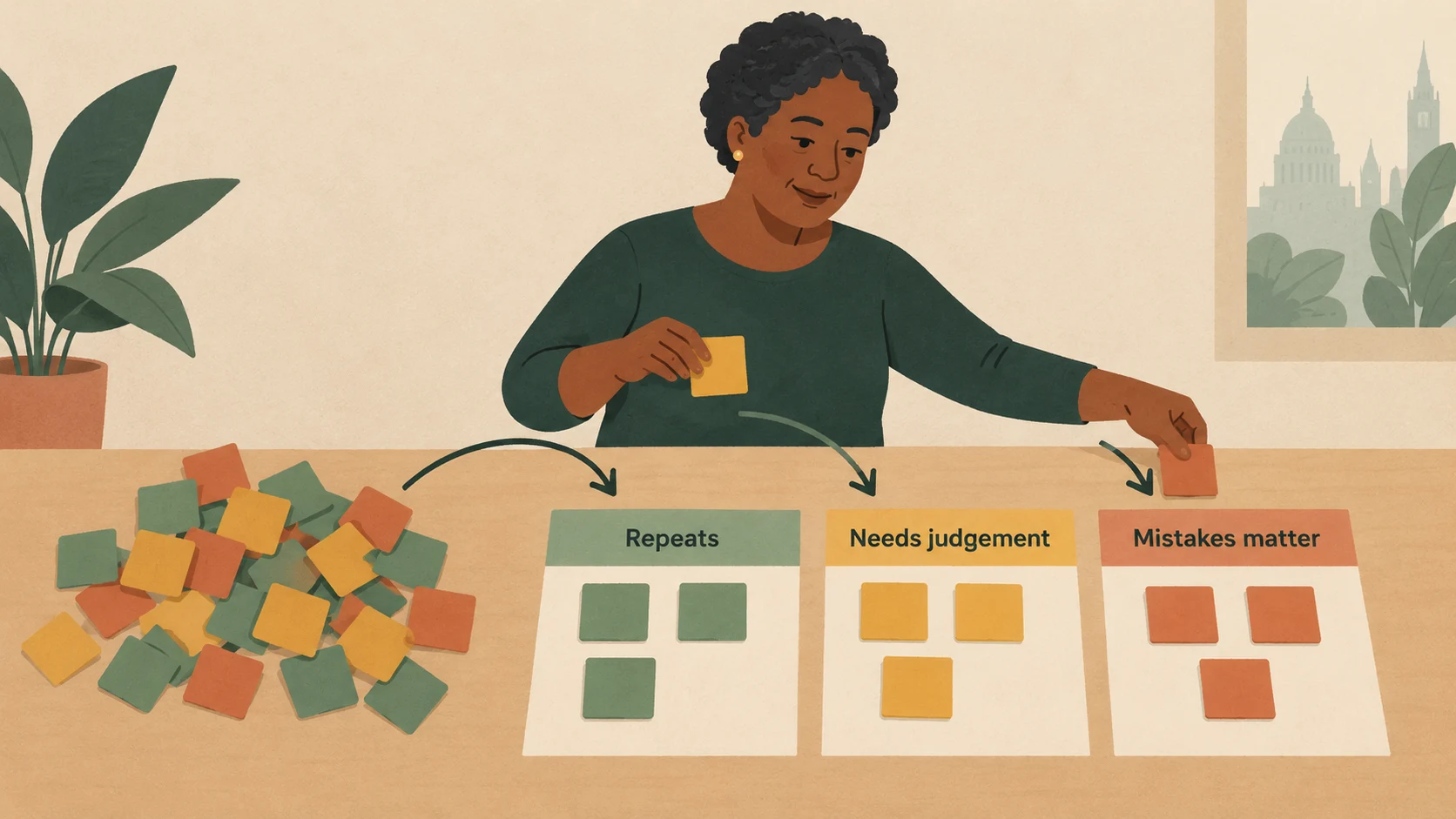
AI is changing some tasks in UK SMEs, but it does not tell us exactly how many jobs a particular business will need. Start with the work: what repeats, what needs judgement and where mistakes matter. This guide examines common roles, a possible two-person operating model, staff skills and a practical way to test changes without assuming a productivity or revenue gain.
Introduction: Stop Listening to the Extremes
There are two dominant narratives about AI and the future of work. Both are wrong.
Narrative one: "AI will take all the jobs." Current tools can assist some tasks and perform others under defined conditions. That does not establish how employment will change across every sector.
Narrative two: "AI will not affect my business." That is also too certain. Review the tasks, tools and customer expectations relevant to your business rather than relying on a broad forecast.
The truth, as usual, is more nuanced and more interesting than either extreme.
AI may change workloads, responsibilities and staffing needs. Outcomes depend on the work, how tools are introduced and whether quality holds up. Involve the team and measure what actually changes.
For a small business, preparation can start with one recurring task. You do not need to make a company-wide prediction before testing whether a tool helps.
For the foundational context on how AI fits into broader business strategy, start here: AI for Business Growth: What UK Business Owners Actually Need to Know in 2026.
What Is Actually Changing for UK SMEs? The Task-Level View
The conversation about AI and jobs is stuck at the wrong level of abstraction. People ask "will AI replace accountants?" or "will AI replace marketers?" These questions are unanswerable because they treat jobs as monolithic blocks. They are not.
Every job is a bundle of tasks. Some of those tasks are routine, data-heavy, and pattern-based — AI handles these well. Others require judgment, empathy, creativity, and relationship-building — AI handles these poorly (or not at all).
The shift is not job elimination. It is task reallocation. Here is what that looks like across common SME roles:
The Marketing Manager
Tasks AI can assist with, subject to checks:
- Keyword research and competitor analysis
- Content brief creation
- Social media scheduling and basic copywriting
- Campaign performance reporting
- A/B test setup and analysis
- Email list segmentation
Tasks that remain human:
- Brand strategy and positioning
- Creative direction
- Client relationship management
- Campaign strategy and judgment calls
- Interpreting data in business context
- Crisis communications
Net effect: Research, drafts and reporting may take less time, leaving more capacity for judgement and customer understanding. Measure the finished work; do not assume that one person can replace three.
The Sales Representative
Tasks AI can assist with, subject to checks:
- Lead research and enrichment
- Initial outreach and follow-up sequences
- Meeting scheduling
- CRM data entry and pipeline updates
- Proposal template generation
- Post-meeting summary and action item tracking
Tasks that remain human:
- Discovery conversations
- Relationship building
- Complex negotiation
- Understanding unspoken client needs
- Closing
- Account management and upselling
Net effect: SCALeMAIL can support research, reviewed drafts and reply routing within an agreed scope. People still approve messages, assess qualification and own sales conversations. There is no fixed headcount-equivalence claim.
The Operations Manager
Tasks AI can assist with, subject to checks:
- Invoice processing and reconciliation
- Scheduling and resource allocation
- Basic customer support triage
- Inventory management and reorder triggers
- Compliance checklist monitoring
- Routine reporting
Tasks that remain human:
- Process design and improvement
- Team management and motivation
- Vendor relationship management
- Exception handling and judgment calls
- Strategic planning
- Culture and training
Net effect: Routine work may become easier to manage. Include checking, failures and new maintenance tasks when measuring the net time released.
The Customer Service Representative
Tasks AI can assist with, subject to checks:
- First-response to common enquiries
- FAQ handling
- Order status updates
- Appointment scheduling
- Basic complaint triage and routing
- After-hours coverage
Tasks that remain human:
- Complex complaint resolution
- Empathetic handling of sensitive situations
- Upselling and cross-selling during service interactions
- Relationship recovery when things go wrong
- Feedback collection and insight generation
Net effect: Amplio and AI voice agents can support approved enquiries with a clear human handoff. Measure correct handling and customer experience; no fixed share of enquiries is automatically suitable for AI. Our business telephony guide explains the decisions involved.
The 2-Person AI Team: A New Operating Model for SMEs
Here is a concept that sounds radical until you think about it for five minutes: the 2-person AI team.
Consider a two-person team as an organisational example, not a staffing recommendation or a reported productivity benchmark. Its suitability depends on workload, service quality, cover and the work that must remain with qualified people.
The model works like this:
Person 1: The Strategist (usually the founder)
- Sets business direction
- Manages key client relationships
- Makes judgment calls on strategy, pricing, and positioning
- Handles complex sales conversations
- Oversees brand and reputation
Person 2: The Operator
- Manages AI systems and workflows
- Handles exceptions that AI cannot resolve
- Maintains quality control on AI outputs
- Coordinates with external partners (accountant, solicitor, etc.)
- Manages the human side of client delivery
Potential AI-assisted workflows, each separately scoped:
- Research and drafting support with human review (SCALeMAIL)
- Customer communications across all channels (Amplio)
- Content production and SEO
- Social media management
- Analytics and reporting (AmpliDash)
- Invoice processing and basic accounting
- Scheduling and calendar management
- Database reactivation (ReFlow)
This model does not establish equivalence with a larger team. Two people may still need specialist partners, holiday cover, supervision and a plan for system failures. Compare completed work and service standards rather than assumed headcount multiples.
The implications for the future of work UK SMEs navigate are significant:
- Different cost structure with software, usage and oversight costs to budget
- Faster decision-making because there are fewer people to consult
- Potential flexibility if the selected tools and contracts support changes in demand
- More room for focused work if the tools reduce administration without adding excessive checking
The question is which responsibilities need to be covered, not how few people can appear on the organisation chart.
The Skills That Will Matter: What to Invest In
If the future of work UK SMEs face is about task reallocation rather than job elimination, then the critical question becomes: which skills will be most valuable?
Skills That Are Increasing in Value
AI literacy (not AI expertise). You do not need to build AI models. You need to understand what AI can and cannot do, how to evaluate AI tools, and how to integrate them into business workflows. This is the difference between a business owner who says "we should use AI" and one who says "we should use AI for lead qualification because our response time is killing our conversion rate."
Strategic thinking. When AI handles execution, the value shifts to the person who decides what to execute. Strategy — understanding markets, positioning, competitive dynamics, and customer psychology — becomes the most valuable skill in the building.
Communication and relationship-building. The more AI handles transactional interactions, the more valuable genuine human connection becomes. The salesperson who can read a room, build trust over a handshake, and navigate a complex negotiation is more valuable than ever — precisely because AI cannot replicate those capabilities.
Prompting and AI direction. Clear instructions, relevant source material and a defined review standard help people use AI tools. The skill includes spotting unsupported output and knowing when a different approach is needed.
Cross-functional understanding. In a 2-person AI team, you cannot be purely a marketer or purely an operations person. You need to understand enough about multiple functions to manage the AI systems that handle them. Breadth of knowledge becomes more valuable than depth in any single domain.
Skills That Are Decreasing in Value
Repeated data entry and processing. Some copying and formatting tasks can be automated. Accuracy, permissions and exception handling still need an owner.
Template-based work. Software can help prepare routine documents and reports, while the person responsible checks whether the template and result fit the situation.
Research preparation. AI can assist gathering and summarising material. Checking sources, interpreting findings and deciding what matters remain essential.
Cross-channel coordination. Tools may help a small team coordinate channels, but specialist judgement still matters. Do not assume one generalist can replace every specialist.
What the Data Says About AI and UK Employment
Productivity evidence is not the same as employment evidence. The UK government’s AI Adoption Research, updated in February 2026, reports self-reported effects among adopters; it does not establish a general reduction in SME team size or a guaranteed revenue gain.
Our UK SME AI adoption guide explains why surveys with different samples and questions should not be joined into a single adoption curve.
| Business question | Evidence to collect |
|---|---|
| Is work completed faster? | Time for the whole task, including review and corrections |
| Does quality hold up? | Errors, rework, complaints and accepted output |
| Has expenditure fallen? | Actual costs before and after, including tools and support |
| Has capacity increased? | Extra completed work without reducing service quality |
| Does a role need to change? | Responsibilities, cover, skills and consultation with the people affected |
National forecasts can provide context. They should not be used as a substitute for evidence about your own team.
New Roles Emerging in SMEs
The future of work UK SMEs are building includes roles that did not exist five years ago:
AI Operations Manager
This person manages the intersection of AI tools and business processes. They do not build AI — they deploy, configure, and optimise it. They understand the business well enough to know which processes benefit from automation and the technology well enough to implement it correctly.
Whether this needs a dedicated role depends on the number, complexity and importance of the systems. In a small team, it may be a defined responsibility rather than a new hire.
Prompt Engineer / AI Director
This role is about getting the best output from AI systems. It is part writing, part logic, part domain expertise. A good prompt engineer in a marketing context can produce content that rivals a senior copywriter — not because they are a better writer, but because they know how to direct the AI effectively.
Customer Experience Orchestrator
As AI handles more customer touchpoints, someone needs to design the overall experience — ensuring that the handoff between AI and human is seamless, that the tone is consistent, and that the technology enhances rather than degrades the customer relationship.
Data Strategist
Someone needs to decide what data to collect, check its quality, ask the right questions and interpret the findings. AI can assist analysis; it does not remove analytical expertise or accountability.
How to Prepare Your Business: A Practical Framework
Enough theory. Here is what to actually do.
Step 1: Audit Your Tasks, Not Your Jobs
Go through every role in your business and list the tasks each person performs in a typical week. Categorise each task:
- Routine and rule-based (AI can handle this now)
- Data-heavy and analytical (AI can assist with this now)
- Judgment and relationship-based (remains human)
- Creative and strategic (remains human, AI assists)
The exercise produces a list to test, not an automatic percentage saving. Start with a repeatable task where the team can check the output and stop safely when something is wrong.
Get unstuck to discuss a process that is causing problems and whether a scoped assessment would help.
Step 2: Start with Your Biggest Bottleneck
Do not try to automate everything at once. Identify the single biggest bottleneck in your business — the place where work piles up, balls get dropped, or opportunities get missed — and apply AI there first.
For most UK SMEs, the biggest bottleneck is one of these:
- Lead response time (solve with Amplio)
- Lead generation volume (solve with SCALeMAIL)
- Content production capacity (solve with AI-assisted content + AmpliSearch — see our guide on AI marketing: content, video, and creative and learn how AEO is reshaping search visibility)
- Administrative overhead (solve with workflow automation)
Step 3: Invest in Your Team's AI Literacy
The future of work UK SMEs need to build is not about replacing people. It is about upskilling them. Every member of your team should understand:
- What AI can and cannot do (realistic expectations)
- How to use AI tools relevant to their role (practical skills)
- How to quality-control AI outputs (judgment and oversight)
- How to identify new opportunities for AI application (continuous improvement)
This does not require sending everyone on a three-month course. It requires a culture where AI tools are available, experimentation is encouraged, and learning is ongoing. If you want a structured approach, our 90-Day AI Implementation Roadmap breaks this down week by week — including team training milestones.
Step 4: Redesign Roles Around Value, Not Tasks
As AI absorbs routine tasks, redefine roles around the value each person delivers rather than the tasks they perform. A customer service representative whose routine enquiries are now handled by AI is not "doing less" — they are freed to do more of the high-value work that drives retention and satisfaction.
This requires honest conversations with your team. People are understandably anxious about AI. The most effective approach is transparency: "AI is going to handle X and Y so that you can focus on A and B, which is where you add the most value and — frankly — where you probably prefer to spend your time."
Step 5: Build Flexible Infrastructure
The businesses best positioned for the future of work UK SMEs face are those with flexible, modular infrastructure rather than rigid, monolithic systems.
This means:
- Cloud-based tools that can be swapped, upgraded, or integrated without rebuilding everything
- API-connected systems that allow data to flow between tools automatically
- Clear service terms covering scope changes, usage, ongoing support and exit arrangements
- Documented processes that can be automated when the right tool becomes available
Our services page shows the areas we work on. Confirm deliverables and terms before treating a service as part of your operating plan.
The Competitive Dynamics: Why Timing Matters
Starting a careful pilot can build experience before a workflow becomes urgent. That learning has value, but starting earlier does not guarantee better margins, rankings or growth.
A business that tests and reviews one process may learn what data, training and support it needs. A business that automates an unclear process may simply make mistakes faster. Compare outcomes, not the date each business first bought an AI subscription.
Use a baseline, a named owner and a review point. Continue when the evidence supports it; change or stop the work when it does not.
The Human Advantage: What AI Cannot Replace
Automation should leave clear human responsibility for the decisions and relationships that matter to the business.
Genuine empathy. AI can simulate understanding. It cannot feel it. When a client is going through a difficult period and needs someone who genuinely cares about their situation, no algorithm will suffice. The businesses that preserve and invest in human empathy will build deeper, more loyal client relationships than those that automate everything.
Creative judgement. AI can generate ideas and variations. People remain responsible for deciding what fits the brief, what is distinctive and what the business is willing to put its name to.
Trust and credibility. People buy from people they trust. AI can help you reach more potential clients and communicate more effectively, but the trust that closes a deal and sustains a relationship is built human-to-human. This is why the 2-person AI team still has people in it.
Ethical judgment. AI can follow rules. It cannot navigate moral ambiguity, weigh competing values, or make decisions that balance profit against principle. As businesses become more automated, the ethical judgment of the humans who direct those systems becomes more important, not less.
Adaptability to the truly novel. AI excels at pattern recognition — doing things that resemble things it has seen before. When something genuinely unprecedented happens (a pandemic, a regulatory shock, a market disruption), human adaptability and improvisation are irreplaceable.
The future of work UK SMEs should aspire to is not one where AI replaces humans. It is one where AI handles the work machines do well, so humans can focus on the work humans do best. That is not a compromise. It is an upgrade.
What Ampliflow Is Building Toward
Ampliflow combines a small senior team with tools that support research, production and administration. The service areas include communications, reviewed outreach, search visibility, creative production and reporting.
Each project needs a clear scope, human responsibility and evidence of whether the work helped. We do not claim a fixed equivalence with a larger agency’s headcount.
Get unstuck to discuss the process you want to improve.
Key Takeaways
- Assess tasks before drawing conclusions about jobs or team size.
- A two-person operating model is an example to examine, not a universal recommendation.
- Include review, correction, training and maintenance in any productivity calculation.
- Invest in AI literacy alongside specialist judgement and relationship skills.
- Involve staff in changes and be clear about responsibilities and uncertainty.
- Start with one process, measure the result and decide what to do next.
FAQ
Will AI really reduce team sizes in UK SMEs?
It may change staffing requirements in some businesses, but there is no general headcount formula. A tool might release capacity, improve quality, create new supervision work or fail to help. Assess the actual workload and responsibilities before making staffing decisions.
How do I talk to my team about AI without causing panic?
Transparency and specificity. Do not say "we are bringing in AI" and leave people to imagine the worst. Say "we are implementing AI to handle X, Y, and Z so that you can spend more time on A and B." Show them exactly which tasks AI will handle and exactly how their role will evolve. Most people, when they understand the specifics, are relieved rather than anxious — because the tasks AI absorbs are usually the ones they enjoy least.
What is the biggest mistake SMEs make when preparing for AI-driven work changes?
Buying tools without deciding which problem they should solve or who will check the work. Start with a clear process, measure the baseline and involve the people using it. The implementation roadmap provides a planning structure, not a promised timetable.
Is the 2-person AI team model realistic for service businesses?
Yes — with caveats. It works exceptionally well for professional services, consulting, marketing, and knowledge-work businesses where delivery is primarily intellectual rather than physical. It is less applicable to businesses that require physical presence — trades, hospitality, healthcare — though even those businesses can use the model for their back-office and marketing functions. The key is identifying which tasks in your specific business can be AI-handled and which genuinely require human hands.
How does the future of work differ for UK SMEs versus large enterprises?
UK SMEs have two advantages and two disadvantages compared to large enterprises. Advantages: faster decision-making (no committee approval needed to adopt AI) and lower implementation complexity (fewer systems to integrate). Disadvantages: smaller budgets and less internal expertise. The net effect is that SMEs can adopt AI faster but need external partners to do it well. That is precisely the gap that services like Ampliflow's are designed to fill — enterprise-grade AI capability at SME-appropriate pricing.