AEO Strategy for UK Businesses: From SEO to AI Search
Co-founder of Ampliflow. Builds AI automation, websites, SEO/AEO, and growth systems for UK SMEs.
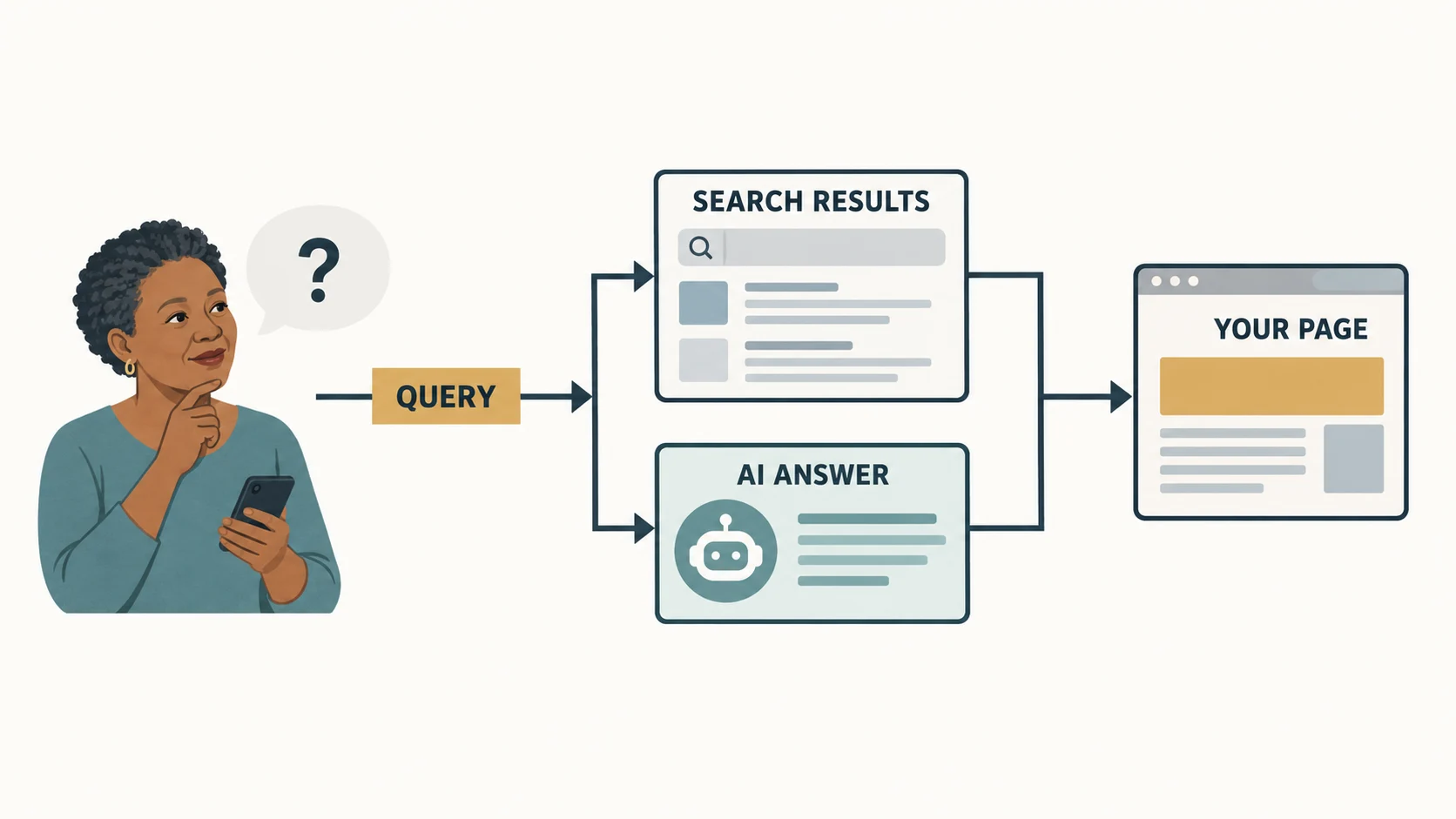
TL;DR: AEO, or answer engine optimisation, is work intended to improve how a business is discovered and cited in AI answers. Start with accurate, accessible pages, evidence from your own work and a clear route to the service. Google describes optimisation for its AI Search features as SEO; there is no separate schema or writing formula. This guide explains what to check, what to prioritise and how to measure results.
This is the implementation guide: the companion AEO explainer defines the discipline before you build the strategy.
How AI Answers Fit Into Business Search
Buyers can now research a service through conventional results, AI summaries and assistants. The practical question is which of those routes brings the right people to your business.
Review the queries and pages already producing enquiries before changing successful content. A new search feature is a reason to investigate, not a reason to start the website again.
Traditional SEO helps a relevant page appear when someone searches. That has never made visits or revenue predictable: search layouts, competition and customer decisions all affect the outcome.
Large language models can answer questions using retrieved web sources. Google AI Overviews, ChatGPT search and other assistants provide different search experiences; their access controls and reporting should be checked separately.
Some questions are answered without a website visit. Others lead to source links, comparisons and supplier enquiries. Measure both visibility and what happens after a visitor arrives.
The foundations remain relevant. Google’s generative Search guidance puts distinctive content and ordinary SEO ahead of special AI tactics.
That approach is answer engine optimisation.
Keep strong conventional search pages while reviewing the questions buyers ask in AI tools. A business can do this as one search programme.
This guide is the bridge. It covers what AEO actually is, how it differs from SEO, how AI search engines decide what to cite, and the framework to implement. If you run a UK business and you have not started thinking about this, now is the time to build the foundations.
What Is the Shift from Ten Blue Links to AI-Generated Answers?
To understand why answer engine optimisation matters, you need to understand what replaced the old model.
Traditional search was a referral engine. Google's job was to point you somewhere else. The value exchange was simple: Google organised the web, you clicked through, the destination site earned the visit.
AI-powered search is a resolution engine. Its job is to resolve your query directly — to give you the answer, not a list of places where the answer might live. The value exchange has changed: the AI synthesises information from multiple sources, delivers a complete response, and the user moves on.
This matters for UK businesses in three specific ways:
1. Zero-click searches are accelerating. Google AI Overviews, featured snippets, knowledge panels, and People Also Ask boxes all resolve more queries within the search results page itself.
2. AI assistants are becoming a first point of contact. Some buyers now ask ChatGPT or Perplexity before they ask Google. When they search for "best accountant in Birmingham" or "how to fix a leaking tap," they may get a direct answer from an LLM, complete with cited sources.
3. The cited source has an advantage. When an AI assistant recommends a specific company, the user is no longer browsing ten equal options. They have been given one or two recommendations by a system they trust. The citation can become the new click.
This is happening now across many research-heavy and service-led categories in the UK.
What Is Answer Engine Optimisation?
Answer engine optimisation is the practice of structuring your digital presence — content, technical architecture, authority signals, and data formats — so that AI-powered search systems can find, understand, trust, and cite your business.
If you want a deeper breakdown of the concept and its origins, read our full explainer: What is AEO? A UK business guide.
Where traditional SEO asks "how do I rank on page one?", AEO asks "how do I become the answer?"
The products present answers differently, but their full source-selection systems are not public. Use these as quality checks, not a list of confirmed AI ranking factors:
- Clarity — Can the system extract a useful answer from your content?
- Authority — Is this source recognised as credible on this topic?
- Structure — Is the content formatted in a way that machines can parse (schema, headings, tables, lists)?
- Freshness — Is the information current and regularly updated?
- Corroboration — Do other trusted sources reference this content or entity?
AEO is not a replacement for SEO. It is an evolution. Think of it as SEO's next layer — the one that determines whether your content gets surfaced in the AI-generated answer, not just in the link list beneath it.
For a detailed comparison of the two disciplines, see our breakdown: AEO vs SEO: What UK businesses need to know in 2026.
How Do AI Search Engines Decide What to Cite?
This is the question every business owner should be asking. When ChatGPT, Gemini, or Perplexity generates an answer, it does not pull from thin air. It follows a process — and understanding that process is the key to getting cited.
Here is a simplified model of how AI answer engines select sources:
| Stage | What happens in a simplified retrieval model | What to check |
|---|---|---|
| 1. Interpret the question | The system identifies the information needed | Does the page answer a real buyer task? |
| 2. Retrieve sources | A search or retrieval system finds candidate pages | Are the relevant public pages accessible and discoverable? |
| 3. Assess relevance | The system chooses information for the response | Is the information accurate, specific and supported? |
| 4. Generate an answer | The model combines information and may link sources | Are qualifications clear enough to avoid a misleading summary? |
| 5. Observe the result | Sources and answers may vary between runs | Record the question, date, mode and cited URL |
Give readers the main point clearly, with the evidence and qualifications they need. That is good communication; it should not be presented as a universal AI extraction rule.
This is why answer engine optimisation is as much a technical discipline as it is a content one.
Is SEO Dead — Or Is It No Longer Enough?
SEO is not dead. That headline gets written every year, and it is wrong every time.
SEO remains relevant to Google’s AI features. Neither conventional SEO nor work labelled AEO can guarantee selection. The additional practical task is checking how specific AI products retrieve and represent the business.
Here is how the two disciplines compare:
| Dimension | Conventional results | AI answers |
|---|---|---|
| Visibility | A linked result for a relevant search | A mention or supporting source link |
| Content | The length and format the reader needs | The same standard; no fixed answer length |
| Foundations | Access, relevance, evidence and page experience | Shared foundations, with platform-specific controls |
| Measurement | Query/page performance and enquiries | Platform reports, dated samples, referrals and enquiries |
| Local work | Accurate eligible profiles and real local evidence | Check how that evidence appears in sampled answers |
The businesses best placed for 2026 are those running both engines simultaneously: solid traditional SEO as the foundation, with an AEO layer on top that makes their content easier for AI systems to understand and cite.
If your SEO foundations need work first, start with our technical SEO audit checklist for UK businesses. If your site is not ranking at all, diagnose the root causes with our guide on why your website is not ranking.
What Are the 7 Pillars of AEO for UK Businesses?
After working through AEO strategy for UK service and SME websites, we use seven practical pillars. Each one strengthens the system. Skip too many, and the framework weakens.
Pillar 1: Entity Establishment
Make it easy to identify the real business: its name, services, people, locations and official profiles. Consistent facts help prevent confusion; declaring an entity does not manufacture authority.
Maintain an eligible Google Business Profile, accurate directories and official profiles. Only claim memberships, credentials or coverage you can substantiate. Wikipedia is not an agency deliverable or a routine requirement.
The goal is not just to be indexed. It is to be known.
Pillar 2: Structured Content Architecture
Organise the site around the decisions customers need to make. Related pages should explain different aspects of a topic rather than repeat the same answer under new keywords.
This is where content clusters become critical. A pillar page (like this one) supported by detailed spoke articles creates a web of topical coverage that signals to AI systems: this source is comprehensive on this subject.
Use descriptive headings and focused paragraphs. Question headings and answer-first sections can help when they fit the subject; they are not compulsory.
Pillar 3: Technical Readiness
Check the requirements of each search surface. For Google AI Search, ordinary indexing and snippet eligibility apply. Review:
- Relevant structured data that matches the visible page; no special AI schema is required
- Page experience on mobile and desktop
- Readable HTML content and working internal links
- Sitemap accuracy and Search Console evidence
- Crawler controls that distinguish search, training and user-requested retrieval
Pillar 4: E-E-A-T Amplification
Experience, expertise, authoritativeness and trustworthiness describe qualities Google asks content creators to assess. E-E-A-T is not a single ranking factor or a schema property. Google’s people-first guidance explains the distinction.
For UK businesses, this means:
- Named authors with verifiable credentials on every article
- Case studies and first-hand experience documented on your site
- Industry certifications, awards, and memberships prominently displayed
- Consistent publication of original research and data
- Authorised reviews and testimonials; do not add self-serving rating markup to seek Google review stars
Pillar 5: Conversational Query Optimisation
People talk to AI differently than they type into Google. Queries to ChatGPT and Perplexity are longer, more conversational, and more specific. "Best accountant near me" becomes "I need an accountant in Solihull who specialises in construction industry tax and can handle CIS returns."
Your content needs to match these natural language patterns. FAQ pages, conversational headings, and content that addresses specific scenarios — not just generic topics — are essential.
Pillar 6: Multi-Platform Presence
AI systems pull from more than just your website. They reference:
- Google Business Profile data
- Social media profiles and posts
- Directory listings and review platforms
- YouTube video transcripts
- Podcast transcripts
- Industry publications and guest articles
- Government and regulatory databases (Companies House, FCA register, etc.)
Choose the profiles and publications relevant to your buyers. Keep their facts accurate; there is no known requirement to appear across every listed channel.
Pillar 7: Measurement and Iteration
You cannot optimise what you cannot measure. AEO introduces new metrics that most businesses are not tracking:
- LLM citation frequency — How often do AI systems mention your brand?
- AI Overview appearances — Are you being featured in Google AI Overviews?
- Brand mention velocity — Is your mention rate increasing or declining?
- Conversational query coverage — What percentage of relevant conversational queries does your content address?
We cover these metrics in detail in the measurement section below. For a full walkthrough of what a comprehensive audit covers, read our guide on online audits and growth reports.
See how AmpliSearch can implement the full AEO framework for your business.
What Do UK Businesses Need to Know About Google AI Overviews?
Google AI Overviews became available in the UK in August 2024. They can appear for some searches and link to supporting pages; availability and presentation vary by query.
When a user searches for an informational or commercial query, Google may display an AI-generated summary at the top of the results page. This summary synthesises information from multiple web sources and provides direct links to the cited pages.
Here is what matters for UK businesses:
AI Overviews are already visible across UK commercial and informational searches. If your business operates in a sector where customers research before buying — legal, financial, health, home improvement, technology — your queries may already be affected.
The cited sources need not all occupy the highest organic positions. Google uses Search systems to choose supporting pages. Clear explanations help readers, but schema or question-form headings are not citation requirements.
Local queries are increasingly exposed to AI summaries and assistant-style recommendations. Searches like "best solicitor for employment disputes Birmingham" can become AI-assisted research journeys. If you are not optimised for this, competitors may be easier for AI systems to understand and recommend.
The click-through behaviour from AI citations is different. Users who click through from an AI-generated answer may already have context from the summary. The traffic can be lower in volume but more informed.
For UK service businesses specifically, understanding how AI Overviews interact with local search is critical. Our local SEO guide for UK service businesses covers this in detail.
How Can You Get Cited by ChatGPT, Gemini and Perplexity?
The following actions improve the quality and accessibility of the source material. They do not establish a repeatable recipe for winning a citation.
For the full tactical playbook, read our dedicated guide: How to get cited by ChatGPT, Gemini and Perplexity.
Here is the summary framework:
1. Answer the buyer’s real question. A dental practice explaining implants, for example, should make suitability, the process and its own service clear, using appropriate clinical review. A mention of the keyword is not enough to inform a decision.
2. Structure content for extraction. Use clear question-answer formatting. Start each section with a direct answer in the first sentence, then expand. Use tables, numbered lists, and bullet points that AI systems can parse cleanly.
3. Build your entity graph. Get mentioned on other authoritative sites. Guest articles, PR coverage, directory listings, industry association pages, and social proof all contribute to AI systems recognising your business as a citable entity.
4. Publish evidence you can stand behind. Explain the method, date and limitations of measurements. Our 45-query Google AI Overviews study is a dated sample; it does not establish how every platform selects sources.
5. Correct facts when they change. Preserve publication dates and record substantive updates. A recent timestamp does not make a page better than an older accurate source.
6. Keep markup accurate. Use applicable types and verify the visible facts. Google does not require AI-specific markup and no longer shows FAQ or HowTo rich results.
7. Monitor and respond. Use tools to track when AI systems mention your brand — and when they do not. Identify the queries where competitors are getting cited and reverse-engineer their approach.
What Technical Foundations Does AEO Require?
Answer engine optimisation sits on top of solid technical SEO. If your technical foundations are broken, no amount of content strategy will get you cited.
The critical technical elements:
Structured Data (Schema Markup)
Choose markup by the page’s actual purpose. Organization, applicable LocalBusiness, Article and BreadcrumbList can describe visible information. Review rich-result eligibility separately; do not add self-serving review ratings or pretend every page requires every type.
Use the valid Schema.org name Organization, not Organisation. Include only real, visible information and genuine official profile relationships.
E-E-A-T Signals in Code
- Author pages with
Personschema linking to credentials and social profiles sameAsproperties connecting your entity across platforms- Structured author bios on every piece of content
isPartOfandmainEntityrelationships between pages
Crawl and Index Health
- Clean XML sitemap submitted to Google Search Console
- No orphaned pages or broken internal links
- Logical URL structure reflecting topic hierarchy
- Proper canonical tags preventing duplication
- Reliable server responses and performance checked against the actual visitor experience
For a complete walkthrough, use our technical SEO audit checklist. If you need professional implementation, our web development team builds sites with AEO-ready architecture from day one.
What Does a Content Strategy for the AI Search Era Look Like?
The content strategies that worked in 2020 are not the ones that will work in 2026. AI-powered search demands a different approach to planning, creating, and structuring content.
Topic clusters over keyword lists. Connect pages that answer different parts of a buyer’s question. Article counts do not establish authority, and covering every synonym on a separate page can create unnecessary duplication.
This is why we structure content around content clusters — pillar pages supported by detailed spokes that cover every angle of a subject.
Question-first content design. Every page should be designed around the questions your customers actually ask — not the keywords a tool suggests. AI assistants are asked questions. Your content needs to answer them directly.
Choose formats for the reader. A diagram, captioned video or comparison table can explain something text alone does not. Add accessible alternatives and avoid a quota of formats, words or markup.
For businesses that need high-quality visual content to complement their written strategy, our Amplex creative production service delivers video, motion graphics, and infographics designed for both human engagement and AI extraction.
Regular review. Check priority pages when facts, services or evidence change. Improve a demonstrated gap rather than rewriting successful content on a fixed calendar.
Internal knowledge as content fuel. Your business has proprietary knowledge — customer patterns, industry insights, operational data — that no competitor has. Publishing this as original research, benchmarks, and case studies makes your content uniquely valuable and highly citable.
If your business has deep internal knowledge that needs organising, our Company Cortex service builds a structured knowledge base that can fuel both your content strategy and your operations.
How Can UK Service Businesses Dominate Local AI Results?
Local search is where AEO gets immediately practical for UK service businesses.
When a customer asks an assistant for a local supplier, inspect the cited sources in that answer rather than assuming it uses a fixed mix of business profiles, directories and training data. Keep your own service area and business details accurate.
The businesses that get recommended share these characteristics:
- Complete, optimised Google Business Profile with accurate categories, services, photos, and regular posts
- Consistent citations across Yell, Thomson Local, Yelp, industry-specific directories, and professional body listings
- Location-specific content on their website — not just a single "areas we serve" page, but detailed content addressing the specific needs of customers in each area
- Genuine reviews that help customers assess the service; there is no universal review count or star-rating combination that guarantees selection
- Accurate local information — use applicable structured data to describe visible business facts, without treating it as a promise of local AI inclusion
Many local businesses have not yet started optimising for AI-powered search. That creates a practical window for early movers who already have strong local proof, clean service pages, and structured content.
For the complete local strategy, read our local SEO guide for UK service businesses.
How Do You Measure AEO Success?
Traditional SEO metrics — rankings, organic traffic, click-through rate — still matter. But answer engine optimisation introduces a new layer of measurement.
Here are the metrics that matter for AEO in the UK:
| Metric | What it measures | How to track it |
|---|---|---|
| Sampled mentions and citations | Appearance within a defined question set | Record engine, mode, date, exact question and cited URL |
| Google AI visibility | Metrics in the property’s dedicated report, where available | Check access to the Generative AI performance report |
| Search performance | Query and page trends in ordinary results | Compare consistent Search Console cohorts |
| Identifiable AI referrals | Visits where the source is available | Analytics, with consent and attribution limits |
| Qualified enquiries | Relevant commercial conversations | Form/call records and CRM outcomes |
Most UK businesses are tracking none of these. Setting up measurement is the first step to improvement.
Use our AI search visibility measurement framework to define the prompt sample, preserve raw answers and connect citation changes to commercial outcomes. If you are appointing outside help, the AI search agency selection guide shows how to test the proposed method before signing.
If reporting needs several sources, review the business dashboard service. Available metrics and refresh timing depend on the agreed sources; a dashboard cannot reveal information a platform does not provide.
Talk to us about building an AEO strategy for your business.
Where Should You Focus Your AEO Effort?
AI search is another place customers may research services. Early publication alone does not secure a lasting advantage; accuracy, relevance and evidence still matter.
Here is why:
Build a credible public record. Consistent business information and earned recognition can help customers assess your offer. There is no verified first-publisher rule that gives a business permanent authority inside AI systems.
Content moats take time to build. A comprehensive content cluster with a pillar page and eight spoke articles does not appear overnight. The business that starts building now will have a mature, well-indexed content ecosystem by the time competitors realise they need one.
Do not plan around a model’s training cycle. Search retrieval and model training are different processes. You cannot schedule a brand’s inclusion in training data.
Customer behaviour is shifting now. AI assistants are becoming part of the research journey. Every month you wait is a month where potential customers may be asking AI for recommendations — and getting your competitors' names instead.
This applies across many service-led sectors. Whether you are in AI automation for UK SMEs, professional services, trades, healthcare, or e-commerce, the direction is similar: businesses that are easier for AI systems to understand have a better chance of being recommended.
Get your AEO strategy started — book a call with our team.
Key Takeaways
- AEO concerns discovery and answers, with substantial overlap with SEO.
- Google does not require a special AI schema, file or answer length.
- Support claims with evidence and keep business details consistent.
- Distinguish search crawling from model training.
- Preserve successful URLs, intent and customer journeys.
- Measure relevant visits and qualified enquiries alongside sampled citations.
Frequently Asked Questions
What is the difference between AEO and SEO?
SEO helps search systems discover and understand pages and helps people choose a result. AEO is a label for work focused on answer experiences and citations, with substantial overlap. Google treats optimisation for its generative Search features as SEO. See the AEO vs SEO comparison.
Is answer engine optimisation relevant for small UK businesses?
Yes. Small UK businesses can benefit because local recommendation journeys often narrow the options quickly. When an AI system recommends a local accountant, solicitor, or tradesperson, being one of the named options can matter more than being one of many blue links.
How long does it take to see results from AEO?
There is no dependable time to citation. Fix demonstrated access and factual problems, preserve existing search performance and compare repeated samples with relevant visits and enquiries.
Can I do answer engine optimisation myself, or do I need an agency?
A business can begin by clarifying its pages, checking accurate facts and reviewing Search Console. More complex technical faults, research or ongoing implementation may benefit from specialist help. Compare the current AmpliSearch scope rather than buying an undefined AI layer.
Will AEO replace traditional SEO entirely?
No. AEO builds on top of SEO. You still need a technically sound website, quality content, and strong authority signals — these are SEO fundamentals that also serve AEO. What changes is the optimisation layer on top: structured data, conversational query targeting, entity establishment, and AI-specific content formatting. Think of it as upgrading from SEO to SEO + AEO, not replacing one with the other.
Published 6 March 2026. This article is part of the Ampliflow AEO and SEO cluster — a series of guides covering every aspect of search optimisation for UK businesses in the AI era.
Related: Generative engine optimisation · LLM SEO · Google AI Overviews · Getting cited by Perplexity · AEO implementation checklist