Why Your Website Isn't Ranking: 10 SEO Mistakes UK Businesses Make
Co-founder of Ampliflow. Builds AI automation, websites, SEO/AEO, and growth systems for UK SMEs.
TL;DR: If you are asking why your website isn't ranking, the answer is almost certainly one (or several) of these ten mistakes. From having no keyword strategy to completely ignoring AI-powered search, UK businesses repeat the same errors year after year — and each one silently drains revenue. This guide covers what each mistake is, why it hurts, and how to fix it in 2026.
Why Your Website Isn't Ranking: The Pattern Behind UK Business Invisibility
There are 5.5 million SMEs in the United Kingdom. The vast majority have a website. And the vast majority of those websites are not ranking for anything meaningful.
This is not a mystery. It is a pattern.
Most businesses build a site, maybe write a few pages about their services, and then wait. They assume Google will simply notice them. When it does not — when the phone stays quiet, when the enquiry form collects dust — they blame the algorithm, or the market, or bad luck.
A weak result needs investigation. Technical faults, relevance, competition, demand and search-system changes can all matter; the explanation is not always the same.
The frustrating part is that most of these structural problems are fixable. Not with some mythical SEO secret, but with clear, methodical work that addresses the actual google ranking factors 2026 demands. The businesses that rank are not necessarily bigger or better funded. They have simply avoided the mistakes everyone else keeps making.
This article is the list. Ten mistakes. Each one explained: what it is, why it kills your rankings, and what to do about it. If your website is not on Google where it should be, the answer is in here somewhere.
Mistake 1: Is Your Keyword Strategy Non-Existent?
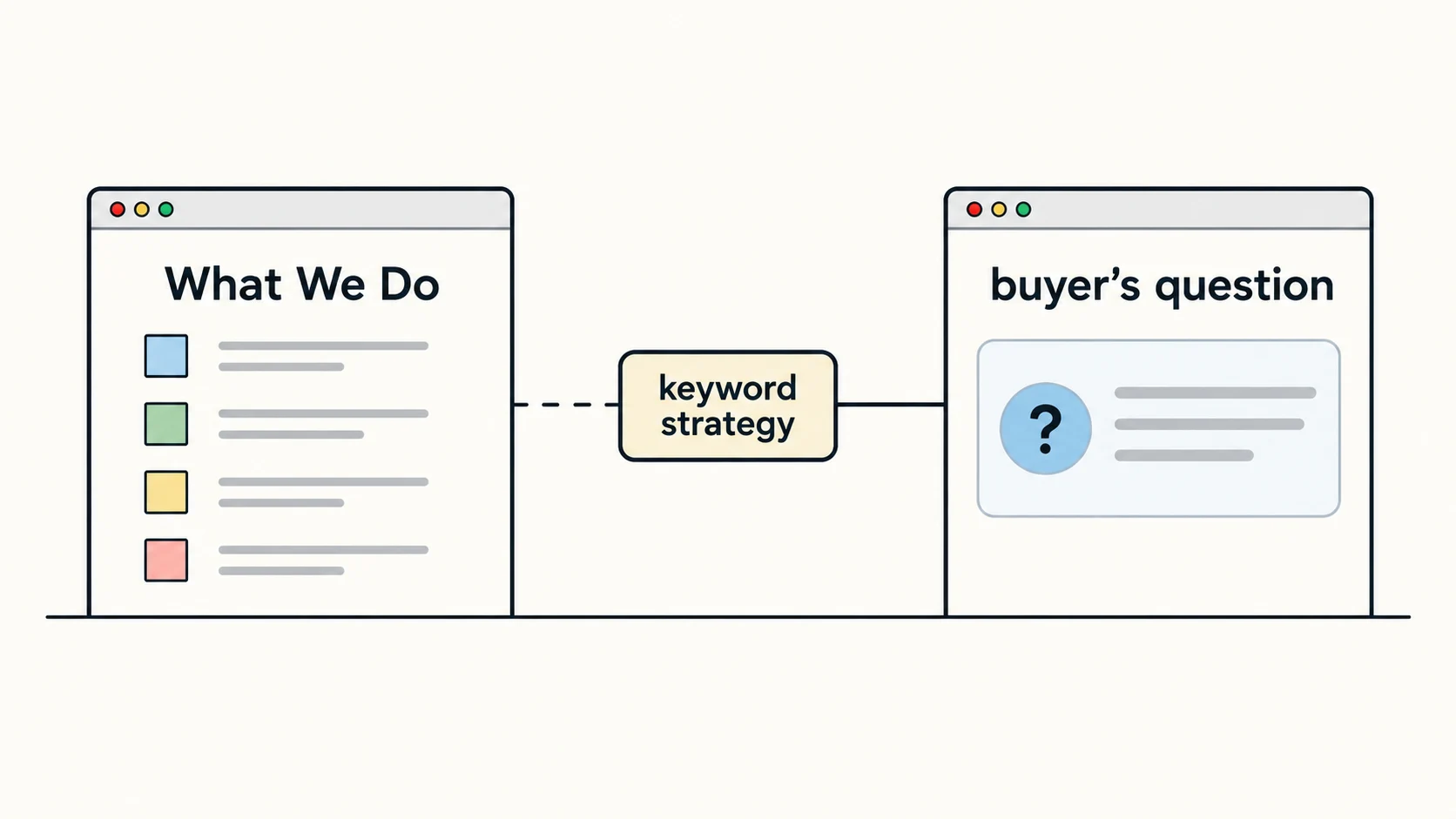
A mismatch between the page and the buyer’s question is one possibility worth checking.
What it looks like: Service pages titled "Our Solutions" or "What We Do." Blog posts about company news nobody outside the building cares about. Zero research into what potential customers type into Google before they buy.
Why it hurts: Google matches search queries to content. If your content does not target any real queries, it will not appear in any real results. It is that simple. You could have the most beautifully designed site in your industry and it would still be invisible because there is no bridge between what you wrote and what people search.
How to fix it: Start with keyword research. Use Google Search Console to see what you already appear for (even at low positions). Look at competitor sites that rank well and reverse-engineer their keyword targets. Build a content plan around terms that have real search volume and genuine commercial intent. Every page on your site should target at least one primary keyword — deliberately, not accidentally.
This is one of the most damaging SEO mistakes UK businesses make because it compounds. Without a keyword strategy, every piece of content you publish is a shot in the dark. If you have been wondering why your website isn't ranking, a missing keyword strategy is the most likely culprit.
Mistake 2: Are Your Pages Too Thin to Compete?
A short service page can be complete, and a long guide can still leave the buyer confused. Judge whether the page answers its actual question rather than comparing word counts.
What it looks like: Service pages with three paragraphs of generic copy. Blog posts that barely scratch the surface of a topic. Pages that exist to "have something there" rather than to genuinely help the reader.
Why it hurts: A page that does not answer the searcher’s question may be less suitable than competing results. Assess relevance, accuracy and completeness; length alone does not establish quality.
How to fix it: Review existing query and enquiry evidence. Add missing scope, examples, proof or explanations where the reader needs them. Preserve successful pages and avoid padding to meet an arbitrary minimum.
| Reader task | What the page should provide |
|---|---|
| Choose a service | Suitability, approved scope, evidence and a contact route |
| Compare options | Meaningful differences, limitations and selection criteria |
| Solve a problem | An accurate explanation and the steps needed |
| Understand a topic | Clear definitions, context and supporting sources |
Mistake 3: Is Your Technical SEO Holding You Back?
You can have perfect content and still rank nowhere if your technical foundation is broken. This is the silent killer — the problems you cannot see without tools.
What it looks like: Slow page load times (over 3 seconds). No HTTPS. Crawl errors blocking Google from indexing key pages. Broken XML sitemaps. Missing robots.txt directives. Poor Core Web Vitals scores.
Why it hurts: Google cannot rank what it cannot crawl and index. Technical SEO issues create a ceiling on your visibility regardless of how good your content is. A slow, insecure site also drives users away before they even read your offer.
How to fix it: Run a technical audit. Check Google Search Console for crawl errors and indexing issues. Test your Core Web Vitals. Ensure every page loads over HTTPS. Compress images, enable caching, and eliminate render-blocking resources. If this sounds overwhelming, it does not have to be — we have a full walkthrough in our technical SEO audit checklist for UK businesses that takes you through it step by step.
Mistake 4: Do You Have an Internal Linking Strategy?
Internal links are one of the most underused ranking levers in SEO. Most businesses treat them as an afterthought — or do not think about them at all.
What it looks like: Blog posts that link to nothing. Service pages that exist in isolation. No logical structure connecting related content. Important pages buried three or four clicks deep with no pathway to reach them.
Why it hurts: Internal links distribute authority across your site. They tell Google which pages are important and how your content relates to each other. Without them, your best pages are starved of link equity and Google cannot understand your site's topical structure. Orphan pages — those with no internal links pointing to them — may not get crawled at all.
How to fix it: Map your content into clusters. Each cluster should have a pillar page with supporting articles linking back to it (and to each other). Every new piece of content should link to at least two or three relevant existing pages. Every important service page should be reachable within two clicks from the homepage. This is not complicated — it just requires intentionality.
Want a site structure that actually supports your rankings? See how we build SEO-first websites.
Mistake 5: Are Your Meta Titles and Descriptions Costing You Clicks?
Your meta title and description are your advert in the search results. If they are missing, generic, or poorly written, people scroll past — even if you rank.
What it looks like: Pages with auto-generated titles like "Home | Company Name." Descriptions that are blank or truncated mid-sentence. Duplicate titles across multiple pages. No keywords, no value proposition, no reason to click.
Why it hurts: An unclear title or snippet can make it harder for the right reader to recognise the page. Low CTR alone does not diagnose weak copy; position, intent and result features also affect it.
How to fix it: Write accurate, distinct titles and descriptions. Keep them concise enough to display clearly, without treating a character count as a ranking rule. Review comparable query, page, device and country data before testing a change.
Mistake 6: Is Your Site Actually Mobile-Optimised in 2026?
Google has used mobile-first indexing since 2019. It is 2026 now. And there are still UK business websites that are barely functional on a phone.
What it looks like: Text too small to read without zooming. Buttons too close together to tap accurately. Horizontal scrolling. Pop-ups that cover the entire screen on mobile. Layouts that clearly were designed for desktop and squeezed onto a smaller screen as an afterthought.
Why it hurts: Google generally uses the mobile version of content for indexing. Missing information or inaccessible controls can affect search discovery and customers. Test the important pages on a phone as well as a desktop.
How to fix it: Test your site on actual mobile devices, not just by resizing your browser window. Use Google's PageSpeed Insights for mobile-specific scores. Ensure tap targets are properly sized, fonts are readable without zooming, and the viewport is configured correctly. If your site was built more than three years ago and has never been audited for mobile, assume it needs work.
Mistake 7: Have You Claimed Your Google Business Profile?
If you serve customers in a specific area and you have not set up and optimised your Google Business Profile, you are invisible in local search. Full stop.
What it looks like: No GBP listing at all. Or a listing that was claimed once and never updated — wrong opening hours, no photos, no reviews, incorrect categories.
Why it hurts: Local pack results (the map listings) appear above organic results for local searches. They capture a disproportionate share of clicks. If you are not in the local pack, you are losing business to competitors who are — even if your website is better than theirs.
How to fix it: Claim your profile. Fill out every field completely. Choose accurate categories. Upload quality photos. Actively request reviews from customers and respond to all of them. Post updates regularly. Ensure your name, address, and phone number are consistent across every online directory. Local SEO is its own discipline, but the GBP is the foundation.
Mistake 8: Is Duplicate Content Cannibalising Your Rankings?
Several pages may appear for related queries without causing a problem. Investigate whether they serve distinct tasks or unnecessarily duplicate each other.
What it looks like: Two blog posts covering essentially the same topic with slight variations. Service pages for different locations with identical copy except the city name swapped. Product pages with duplicate descriptions.
Why it hurts: Overlapping pages can confuse visitors and split maintenance effort. Do not assume Google ranks neither merely because two pages use the same phrase.
How to fix it: Compare page/query performance, links and enquiries first. Improve or distinguish the existing owners where possible. Merge or redirect only after an evidence-led migration review that protects valuable URLs and content.
Mistake 9: Are You Building Any Backlinks at All?
Links can help search engines discover pages and understand relevance. Inspect the actual links and competing results rather than assuming a particular link count explains a ranking.
What it looks like: Zero outreach. No digital PR. No guest posting. No link-worthy content assets (research, tools, original data). The site has a handful of links from directory submissions done five years ago and nothing since.
Why it hurts: A page with little relevant recognition may face stronger competition, but links do not decide the result alone. Avoid buying ranking links or arranging manipulative exchanges.
How to fix it: Create content worth linking to: original research, comprehensive guides, useful tools, or expert commentary on industry trends. Reach out to relevant publications, industry blogs, and local news sites. Look for unlinked brand mentions and ask for links. Build relationships with complementary (non-competing) businesses. Link building is slow, but the compound returns are enormous.
If you want to understand exactly where your backlink profile stands and what opportunities exist, our online audit and growth report includes a full competitive backlink analysis.
Mistake 10: Are You Ignoring Answer Engine Optimisation Entirely?
AI-search discovery is worth reviewing where customers use it. General business AI-adoption statistics do not establish a site’s SEO fault.
What it looks like: The site has no clear view of whether relevant AI-search products can access and accurately represent its public information. Missing FAQ schema is not evidence of that problem.
Why it hurts: AI-powered search is not coming — it is here. Large language models are generating direct answers to user queries, pulling from websites that structure their content for extraction. If your site is not optimised for this, you are being excluded from an entirely new discovery channel. The businesses that appear in AI answers are capturing attention (and clicks) before traditional organic results even load.
How to fix it: Check ordinary search eligibility, accurate visible content, applicable markup and the target platform’s access controls. Google does not require special AI schema or fixed question formats. Use the SEO-to-AEO guide and AI marketing guide to assess the wider work.
If you want to improve your Google ranking in the UK in 2026, you cannot afford to optimise for one search paradigm and ignore the other. Traditional SEO and AEO must work together.
How Do These Mistakes Compound?
The real danger is not any single mistake in isolation. It is the compounding effect.
A business with no keyword strategy writes thin content that targets nothing. That content sits on a technically broken site with no internal links. The pages have poor meta titles, so even when they accidentally rank, nobody clicks. There is no GBP, so local searchers never find them. No backlinks, so no authority builds. And no AEO strategy, so AI search ignores them entirely.
Each mistake amplifies the others. The gap between this business and a well-optimised competitor is not linear — it is exponential.
| Finding | Evidence to collect | First action |
|---|---|---|
| Important page not indexed | URL Inspection and public response | Investigate the specific exclusion |
| Relevant impressions but few enquiries | Query/page cohorts and enquiry journey | Check intent, offer and contact friction |
| Overlapping content | Current rankings, links and reader tasks | Improve the existing page owner |
| Mobile friction | A reproducible problem on the page | Fix it and retest |
This is why asking why your website isn't ranking rarely has a single answer. It is usually a system failure, not an isolated bug.
What Should You Fix First?
Not all mistakes are equal. Here is the priority order we recommend for most UK businesses:
- Technical SEO — fix the foundation first. Nothing else matters if Google cannot crawl your site.
- Keyword strategy — know what you are targeting before you write another word.
- Meta titles and descriptions — correct unclear or inaccurate wording when query and result evidence supports a change; preserve successful intent.
- Google Business Profile — if you are a local business, this is non-negotiable.
- Thin content — upgrade your most important pages to compete with what currently ranks.
- Internal linking — connect your content and distribute authority.
- Mobile optimisation — audit and fix any mobile usability issues.
- Duplicate content — consolidate cannibalised pages.
- Backlinks — begin a sustained link-building programme.
- AEO — layer in answer engine optimisation to future-proof your visibility.
Fix verified access and usability faults first, then assess improvements over a period that gives enough evidence. There is no universal completion schedule or guaranteed ranking lift.
Our approach at Ampliflow combines all ten areas into a single, coordinated strategy. If you want to understand how that works in practice, the From SEO to AEO pillar guide is the best place to start.
Key Takeaways
- Diagnose before editing. Weak rankings can involve technical faults, relevance, demand, competition or search changes.
- The 10 most common SEO mistakes UK businesses make are: no keyword strategy, thin content, poor technical SEO, no internal linking, weak meta data, poor mobile experience, missing GBP, duplicate content, no backlinks, and ignoring AEO.
- Several problems can interact, but a count of issues cannot calculate lost traffic or a recovery deadline.
- Prioritise technical fixes and keyword strategy first. They unlock the value of everything else.
- In 2026, google ranking factors include both traditional SEO signals and AI search readiness. Ignoring either one leaves revenue on the table.
- 5.5 million UK SMEs are competing online. The ones that rank are simply the ones that have addressed these fundamentals.
Frequently Asked Questions
Why is my website not showing up on Google at all?
Use Search Console URL Inspection for the exact page and check the Page indexing report. A site: search is only a spot check and may be incomplete. Review robots, noindex, canonicals, server responses and manual actions before deciding why a page is absent.
How long does it take to improve Google rankings?
There is no universal timeframe. Verify technical repairs promptly, allow time for recrawling and compare consistent search cohorts. Content, competition and demand can take longer to assess; implementation milestones are separate from ranking outcomes.
What are the most important Google ranking factors in 2026?
Google describes many ranking systems rather than a single checklist of factors. Relevant, reliable content and accessible pages matter; E-E-A-T is not one ranking factor, and special AI schema is not required. Use Google’s people-first guidance to assess the page.
Can a small business compete with larger companies in SEO?
A small business can compete for relevant searches, but size alone does not make the work easier. Focus on a clear service, supported expertise, accurate local information and the questions your customers ask. Compare real results rather than assuming nearby competitors share the same faults.
Stop Guessing. Start Fixing.
If you have read this far, you now understand why your website isn't ranking — and more importantly, what to do about it. Every week your site sits with these problems unaddressed is a week your competitors pull further ahead. The good news is that none of these ten mistakes are permanent. They are all fixable. And fixing them does not require guesswork — it requires a structured audit, a clear plan, and consistent execution.
If the site runs on Shopify, continue with the Shopify SEO guide for collection architecture, product evidence, duplicate URLs and storefront performance.
That is exactly what we do.