Claude Models Explained (2026): Fable 5 vs Opus 5 vs Sonnet 5 vs Haiku 4.5
A plain-English comparison of the current Claude models for UK businesses: Fable 5, Opus 5, Sonnet 5 and Haiku 4.5, with pricing and a practical routing framework.
Co-founder of Ampliflow. Builds AI automation, websites, SEO/AEO, and growth systems for UK SMEs.
- 01What are the current Claude models?
- 02Which Claude model should you use?
- 03How much do Claude models cost?
- 04What changed from Opus 4.8 and Sonnet 4.6?
- 05How Ampliflow approaches model routing
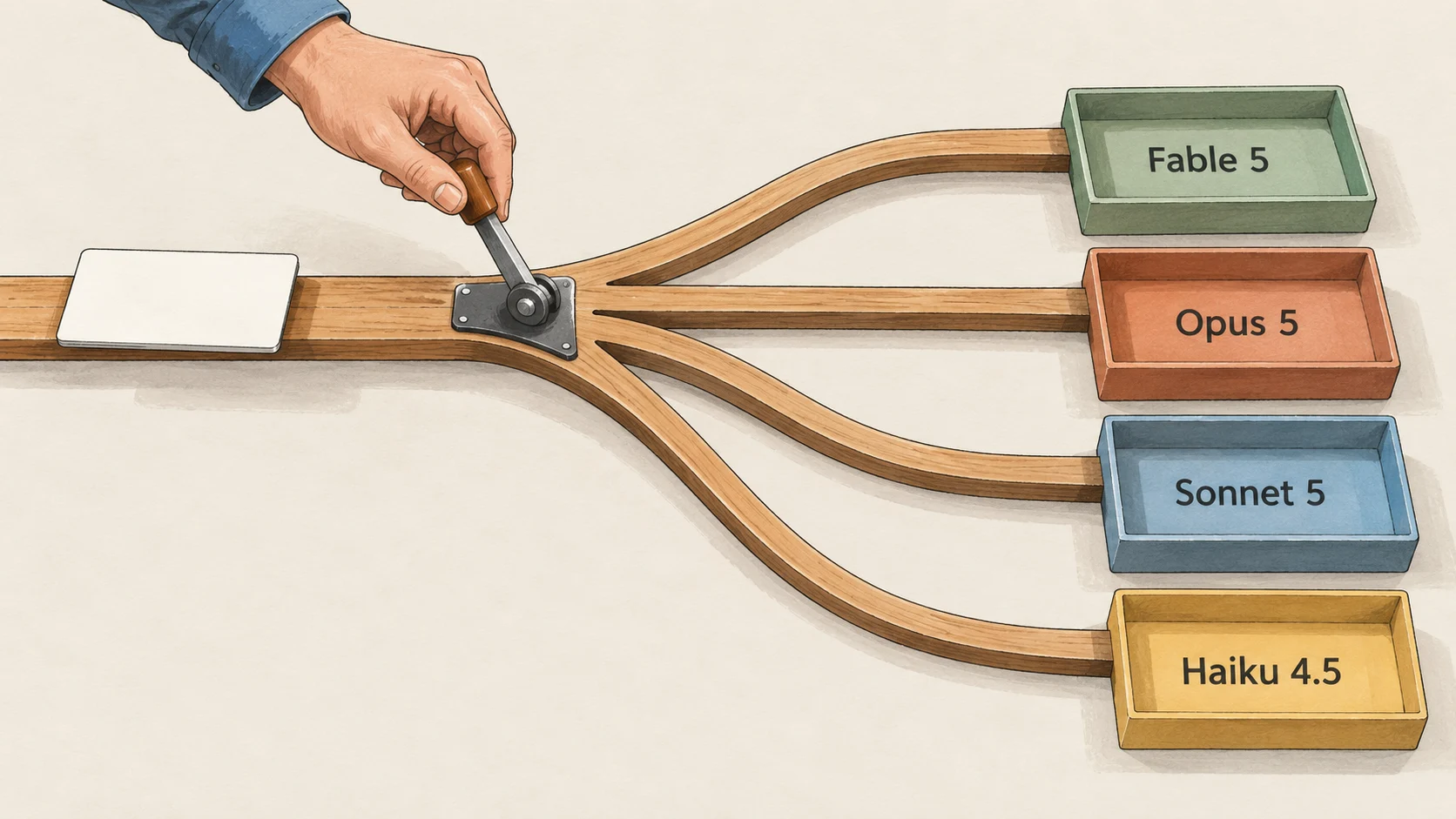
Anthropic's current Claude range has four practical choices: Fable 5.1 for the most demanding work, Opus 5 for complex reasoning and agentic coding, Sonnet 5 as the capable everyday default, and Haiku 4.5 for fast, high-volume tasks. The right model is not the most expensive one. It is the cheapest model that passes your real quality threshold.
Last checked: 21 September 2026 · Current pricing and model documentation. Fable 5.1 now succeeds Fable 5 in that tier.
TL;DR: Our cost-conscious starting point is to test Sonnet 5 on everyday tasks, Haiku 4.5 on high-volume work, and Opus or Fable on cases the smaller models fail. This is an evaluation approach, not a universal ranking: Anthropic currently recommends Opus 5 for most workloads. Compare quality, latency and total cost on your own examples.
Contents
- What are the current Claude models?
- Claude Fable 5: the highest-capability tier
- Claude Opus 5: complex reasoning and agentic work
- Claude Sonnet 5: the production default
- Claude Haiku 4.5: speed and volume
- Which Claude model should you use?
- How much do Claude models cost?
- What changed from Opus 4.8 and Sonnet 4.6?
- Frequently asked questions
What are the current Claude models?
- 01Claude Fable 5
- 02Claude Opus 5
- 03Claude Sonnet 5
- 04Claude Haiku 4.5
Claude is a family of models from Anthropic. The models share text and image input, text output, multilingual capability and vision, but differ in capability, latency, context size and price.
This is the current range shown in Anthropic's model documentation:
| Claude Fable 5.1 | Claude Opus 5 | Claude Sonnet 5 | Claude Haiku 4.5 | |
|---|---|---|---|---|
| Practical role | Highest available capability | Complex reasoning and agentic work | Best speed-capability balance | Fast, high-volume work |
| API model ID | `claude-fable-5-1` | `claude-opus-5` | `claude-sonnet-5` | `claude-haiku-4-5` |
| Context window | 1M tokens | 1M tokens | 1M tokens | 200k tokens |
| Maximum output | 128k tokens | 128k tokens | 128k tokens | 64k tokens |
| Input price | $10 / million tokens | $5 / million tokens | $2 / million tokens | $1 / million tokens |
| Output price | $50 / million tokens | $25 / million tokens | $10 / million tokens | $5 / million tokens |
| Relative latency | Slower | Moderate | Fast | Fastest |
| Reliable knowledge cutoff | June 2026 | May 2026 | January 2026 | February 2025 |
Anthropic has made Sonnet 5’s $2 input / $10 output price per million tokens permanent, cancelling the previously announced 1 September rise. Check the official pricing page before budgeting.
The table is a starting point, not a buying decision. A one-million-token context window does not mean every request should contain one million tokens. More context costs more, takes longer to process, and can make a poorly structured task harder rather than easier.
Source: Anthropic's current model overview.
Claude Fable 5: the highest-capability tier
Fable 5.1 is Anthropic's most capable widely released model. It is aimed at the most demanding reasoning and long-running agent work, with a one-million-token context window and a $10/$50 API price.
That price matters. Fable costs twice as much as Opus 5 on both input and output. Use it where your own evaluation shows a material improvement: difficult research synthesis, complex planning across a large evidence set, or autonomous work where a missed dependency would be expensive.
Do not default to Fable because the task sounds important. Importance should change the review and approval process. Model choice should still be based on measured output quality.
Use Fable 5.1 when:
- Opus has been tested and misses critical cases.
- The task needs the highest available reasoning capability across a large context.
- The value of a correct result comfortably exceeds the additional model cost.
- A human or separate verification step still reviews consequential output.
Claude Opus 5: complex reasoning and agentic work
Opus 5 is the current Opus-tier model for complex reasoning, agentic coding and high-autonomy work. Anthropic describes it as a step-change from Opus 4.8. It has the same one-million-token context window as Fable and Sonnet, at half the price of Fable.
For many teams, Opus is the practical top tier. It suits production code changes, difficult debugging, long-document analysis, and review tasks where a cheaper worker model needs a stronger second pass.
The useful pattern is selective escalation. Run the ordinary steps on Sonnet, then route the small number of difficult or high-risk cases to Opus. That usually delivers more value than putting the entire workflow on Opus from the start.
Use Opus 5 when:
- A task has several dependent steps and weak reasoning will compound errors.
- The model is editing production code or analysing a large body of evidence.
- You need a stronger reviewer for work created by Sonnet or Haiku.
- Your evaluation set shows a repeatable quality gain over Sonnet.
Claude Sonnet 5: the production default
Sonnet 5 is the model most teams should test first. Anthropic positions it as the best combination of speed and intelligence, and its $2/$10 price sits well below Opus and Fable.
Sonnet is a sensible default for customer-facing drafts, content and research workflows, data transformation, internal tools, routine coding and agent steps that need good judgement without the highest possible reasoning ceiling.
Starting with Sonnet also makes evaluation easier. If a specific task fails, you can compare that task on Opus rather than paying Opus rates for every successful routine request as well.
Use Sonnet 5 when:
- You need one capable general model to establish a baseline.
- The work is interactive and response time matters.
- The task needs judgement but not the highest available reasoning tier.
- You want a production default with clear escalation paths.
Claude Haiku 4.5: speed and volume
Haiku 4.5 is the fastest and cheapest current Claude model. Its 200,000-token context is smaller than the other current models, but still large enough for most classification, extraction and routing tasks.
Haiku is where volume economics become useful. If a workflow handles thousands of simple items, a fivefold price difference from Opus can matter more than a small quality difference that never changes the business outcome.
Its reliable knowledge cutoff is older, so recent facts should be supplied in the prompt or retrieved from an approved source. That is good practice for every model, but particularly important when a workflow depends on current product, legal or market information.
Use Haiku 4.5 when:
- The task is narrow, repeatable and easy to score.
- Latency matters more than deep reasoning.
- You are classifying, tagging, routing or extracting at scale.
- Uncertain cases can be escalated to Sonnet or a human.
Which Claude model should you use?
Choose against the cost of failure and the measured difficulty of the task. Do not choose against the prestige of the model name.
| If the task is… | Start with | Escalate when… |
|---|---|---|
| Classification, tagging, routing or structured extraction | Haiku 4.5 | A tested failure signal appears or the item falls outside known patterns |
| Customer drafts, research synthesis, routine code or internal tools | Sonnet 5 | The task fails an agreed quality test |
| Production code, difficult reasoning or large evidence sets | Opus 5 | Opus still misses critical cases and Fable proves better |
| The most demanding long-horizon agent work | Fable 5.1 | Keep human approval for consequential actions |
| You have no evaluation data yet | Sonnet 5 | Build a small test set before changing the route |
A production routing test can be small. Take 20 to 50 real examples, define what a pass looks like, run them on two models, and compare quality, latency and cost. That evidence is worth more than a benchmark that measures a task unlike yours.
The safest systems also make uncertainty visible. A classifier can return a confidence score and escalate weak matches. A drafting model can produce a source list. A coding agent can run tests and stop before deployment. Model routing helps, but verification is what makes the workflow trustworthy.
How much do Claude models cost?
API usage is billed separately for input and output tokens. Output costs five times as much as input across the four current tiers.
| Model | Input per million tokens | Output per million tokens |
|---|---|---|
| Fable 5.1 | $10 | $50 |
| Opus 5 | $5 | $25 |
| Sonnet 5 | $2 | $10 |
| Haiku 4.5 | $1 | $5 |
Here is a deliberately simple example. A monthly classification workflow processes 50 million input tokens and produces 10 million output tokens:
- Haiku 4.5: $50 input + $50 output = $100.
- Sonnet 5: $100 input + $100 output = $200 at current pricing.
- Opus 5: $250 input + $250 output = $500.
- Fable 5.1: $500 input + $500 output = $1,000.
If Haiku passes the same classification test, using Fable would add $10,800 a year without improving the outcome. If Haiku misses important cases, test an escalation route before moving every item to the biggest model. Use measured failure signals rather than treating an uncalibrated confidence score as proof.
Prompt caching, batch processing and shorter outputs can reduce cost further. Price is only one constraint: include development, evaluation, monitoring, human review and failure handling in the real business case.
For setup details, see our Anthropic API key and cost guide.
What changed from Opus 4.8 and Sonnet 4.6?
This guide previously compared Opus 4.8, Sonnet 5 and Haiku 4.5. Anthropic's current model overview now leads with Fable 5.1, Opus 5, Sonnet 5 and Haiku 4.5. Opus 4.8 remains active, but Anthropic describes Opus 5 as a step-change from Opus 4.8. It is the current starting point for new Opus evaluations and keeps the same $5/$25 standard token price.
That does not mean every older model stops working immediately. It means new evaluations and architecture decisions should start from the current range, while existing systems should check Anthropic's model lifecycle before migrating.
There is another important detail: Anthropic says model IDs from the 4.6 generation onward are fixed snapshots even when the ID has no date. Do not assume claude-sonnet-5 silently becomes a future Sonnet release. Use the Models API and Anthropic's deprecation documentation as part of routine dependency maintenance.
How Ampliflow approaches model routing
We start with the smallest model likely to pass the task, then test the exceptions. High-volume, well-defined work belongs on Haiku when it meets the quality bar. General production work starts on Sonnet. Difficult cases move to Opus, with Fable reserved for the narrow set where evaluation proves the extra capability earns its cost.
The route is only half the system. We also define what the model may do, what evidence it must return, what gets checked automatically, and where a person must approve the next action. That is how model choice becomes an operating decision rather than a monthly argument about benchmarks.
Frequently asked questions
What is the best Claude model in August 2026?
The August comparison focused on Fable 5, Opus 5, Sonnet 5 and Haiku 4.5. At this guide’s 21 September check, Fable 5.1 is the current Fable model. “Best” still depends on the task: compare accepted output, latency and cost rather than assuming the largest model is always the right choice.
Is Sonnet 5 good enough for business use?
For many production workflows, yes. It is the sensible first model for a baseline. Escalate a task to Opus or Fable only when a real test shows that Sonnet misses something important.
Which Claude model is cheapest?
Haiku 4.5, at $1 per million input tokens and $5 per million output tokens. It is designed for fast, high-volume work.
How large is the Claude context window?
Fable 5.1, Opus 5 and Sonnet 5 each have a one-million-token context window. Haiku 4.5 has a 200,000-token context window. More context is not automatically better; send the smallest relevant evidence set.
Can I keep using Opus 4.8 or Sonnet 4.6?
Check the current model list and deprecation policy for the platform you use. Existing availability is not a reason to start a new system on an older model without testing the current replacement.
Do I need the API?
Use the API when you are building a product, agent or automation and need control over prompts, tools, routing and data flow. A Claude or Claude Code subscription is usually simpler for individual chat and coding work.
Related reading
- ↔ How to Get an Anthropic API Key — And What It Really Costs — API setup, billing and the costs around the model
- ↔ The Latest Claude Code Features — the current coding surface for teams
- ↔ The Claude Agent SDK: Building Production Agents — when to build directly on the models
- ↔ What Is MCP? — how models connect to approved tools and data
- ↔ What Is Claude Code? — the coding product most teams use before building on the API
What should you do next?
Most businesses do not need the biggest Claude model everywhere. They need a tested route: the right model for each task, clear escalation rules, and a human approval point where the consequence demands one.
Want a costed model-routing plan for your workflow? Get unstuck →
Ampliflow builds websites, apps, automations and AI systems for UK businesses. We use current primary documentation, real evaluation sets and human approval where the work can affect customers or production systems.