AI Readiness Assessment: 5-Dimension Framework for UK SMEs
TL;DR
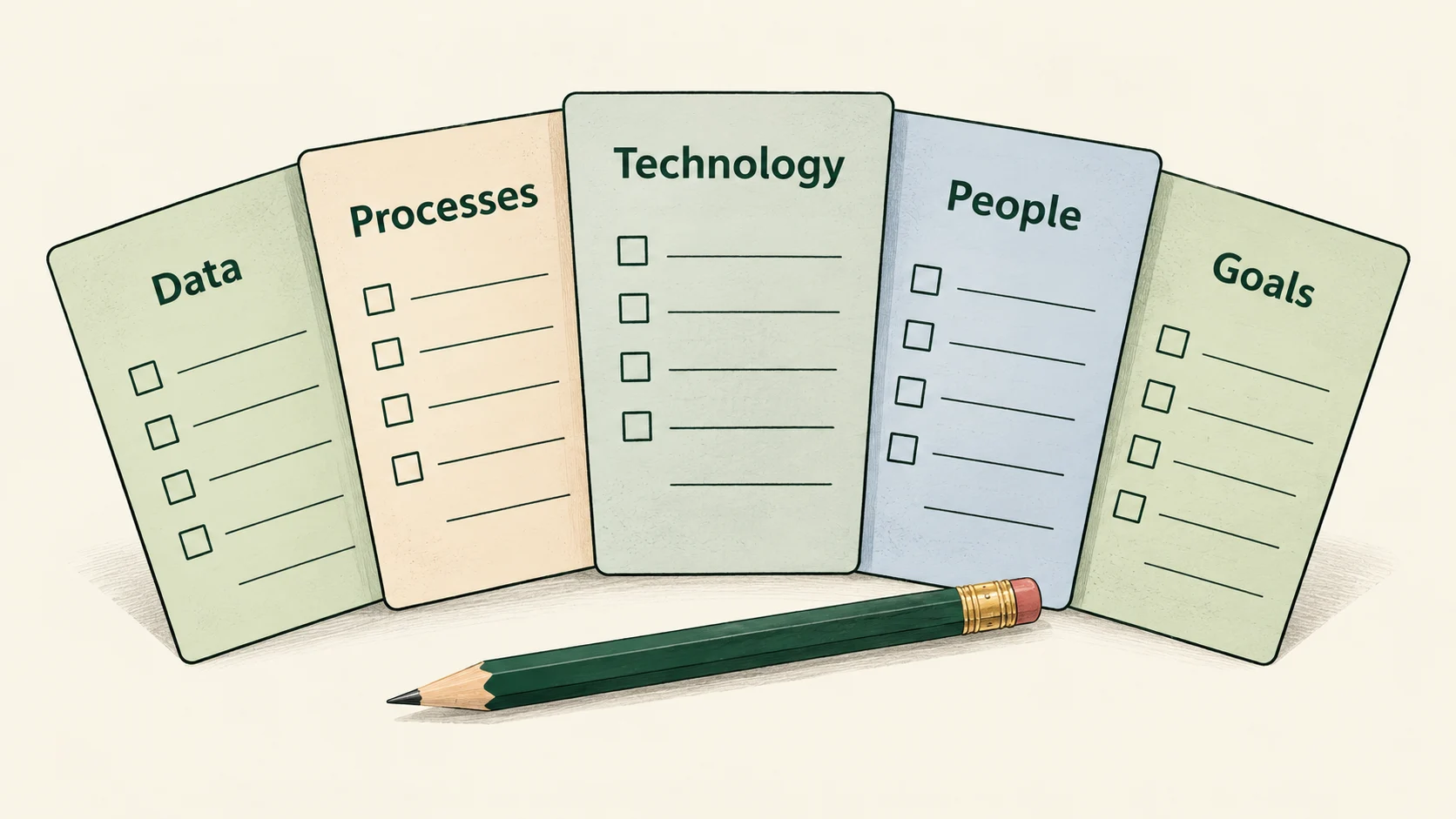
This AI readiness assessment helps you discuss five areas: data, processes, technology, people and goals. Score each from one to five, then use the gaps to choose what to investigate next. It is an editorial planning checklist, not a validated diagnostic, a forecast of ROI or proof that a business should buy automation.
Introduction: What Can Go Wrong Before an AI Project Starts?
An AI tool can disappoint because the process is unclear, the data is unsuitable, nobody owns the work or the tool itself is a poor fit. A readiness discussion helps identify these problems before committing to a wider project.
For example, buying a tool without giving anyone time to configure and review it can leave the subscription unused. That is an illustrative failure mode, not a reported client case.
Both the tool and the working conditions need checking.
Some projects need preparation before automation makes sense. Others can start with a small, well-defined task. The assessment helps frame that discussion; it does not prescribe months of work.
Use this framework to start a discussion with the people who know the work. The score helps organise questions; your team still needs to check the evidence behind each answer.
Why Does AI Readiness Actually Matter?
The cost of getting AI adoption wrong isn't just the subscription fee. It's the opportunity cost, the team morale damage, and the reinforcement of a narrative that your business "isn't the type" for AI.
Three failure modes to check:
1. The Premature Deployment
A business with no documented processes tries to automate them. The AI system has nothing consistent to learn from, so it produces inconsistent outputs. The team loses trust in the system within the first week.
2. The Orphaned Implementation
Leadership buys the tool. Nobody is assigned to manage it. Configuration stalls. The AI operates on default settings that don't match the business's actual workflows. It becomes another piece of unused software.
3. The Goalless Experiment
"Let's just try AI and see what happens." Without specific outcomes defined, there's no way to measure success. The experiment runs indefinitely, produces no clear verdict, and eventually gets quietly abandoned.
These examples show why it helps to agree the process, owner and success criteria before introducing a tool.
Common questions concern skills, cost and the evidence needed for a business case. Use the table as a discussion guide, not a survey result.
| Barrier | Question to answer |
|---|---|
| Skills or expertise | Who can configure, review and support the workflow? |
| Cost | What are the full setup and ongoing costs? |
| Uncertain value | What baseline and outcome would justify continuing? |
Every single one of these barriers becomes manageable — or disappears entirely — when you know your starting position. An AI readiness framework doesn't remove the challenges. It makes them visible, measurable, and actionable.
If you want to understand the financial case for getting this right, our deep dive into AI automation ROI for UK businesses breaks down the numbers in detail.
What Are the Five Dimensions of AI Readiness?
This five-dimension framework is a simple way to organise a conversation. Each area is rated one to five, giving a maximum of 25. The weights and thresholds are editorial aids, not findings validated across client assessments.
Here's the full scoring table:
| Dimension | 1 (Critical Gap) | 2 (Weak) | 3 (Adequate) | 4 (Strong) | 5 (Excellent) |
|---|---|---|---|---|---|
| Data Readiness | No digital customer records | Scattered spreadsheets, duplicates everywhere | Basic CRM in use, some data hygiene | Clean CRM with segmentation, regular updates | Unified data across all channels, automated enrichment |
| Process Maturity | No documented workflows | Some processes written down, rarely followed | Key workflows documented and repeatable | SOPs for all core operations, regularly reviewed | Fully mapped processes with clear ownership and KPIs |
| Technology Foundation | No website, no CRM, paper-based | Basic website, free email, no integrations | Professional website, CRM, email marketing tool | Integrated stack (CRM + email + analytics + booking) | API-connected ecosystem with automation already running |
| Team Capacity | No one available to manage new tools | One overloaded person "might" handle it | Dedicated person with some bandwidth | Team member with clear AI/digital responsibility | Internal champion plus external support arrangement |
| Strategic Clarity | "We should probably do something with AI" | Vague goals like "be more efficient" | Specific pain points identified | Defined outcomes with measurable targets | Clear AI roadmap aligned to business strategy |
Let's break each dimension down.
Dimension 1: How Clean and Accessible Is Your Customer Data?
Data is the fuel for every AI system. Not big data. Not exotic data. Just clean, accessible, structured information about your customers, operations, and performance.
Ask yourself:
- Where do your customer records live? (CRM, spreadsheets, someone's memory?)
- When was the last time you deduplicated your contact list?
- Can you segment your customers by value, recency, or service type right now?
- If you needed to email your top 50 clients, how long would it take?
A business scoring 1 or 2 on data readiness will struggle with any AI implementation that involves personalisation, lead scoring, or automated follow-ups. The AI has nothing reliable to work with.
Better-organised information may make a Company Cortex discussion easier. GraphRAG means combining relevant source material with relationships between records; readiness still depends on access, accuracy, permissions and the questions the system must answer.
The fix for low scores: Identify the records needed for the selected workflow, remove duplicates safely and agree consistent fields. A customer relationship management system (CRM) can help, but do not import everything without checking retention and permissions.
Dimension 2: Are Your Workflows Documented and Repeatable?
AI automates processes. If your processes exist only in people's heads, there's nothing to automate.
This is the dimension that catches the most businesses off guard. They assume their operations are systematic because "everyone knows how we do things." But when you ask three team members to describe the same process, you get three different answers.
Ask yourself:
- Could a new hire follow your sales process without shadowing someone for a week?
- Is your onboarding sequence written down step by step?
- Do you have standard operating procedures for client communications?
- When something goes wrong, is there a documented escalation path?
Documented workflows are easier to assess for automation. A score alone does not prove that a process is suitable or reliable.
Dimension 3: What Technology Foundation Is Already in Place?
AI doesn't operate in a vacuum. It integrates with your existing tools — your CRM, your website, your email platform, your booking system. The more connected your current stack, the faster AI can deliver value.
Ask yourself:
- Do you have a CRM? Is it actively used by the whole team?
- Does your website capture leads automatically (forms, chat, booking)?
- Are your email marketing and CRM connected?
- Can your systems share data, or are they isolated silos?
Connected tools may reduce some integration work, but access, compatibility, data quality and approvals still need checking. A simple workflow may be possible without a large technology stack.
Explore how our automation service connects your existing tools into an AI-ready ecosystem →
Dimension 4: Who Will Manage and Oversee the AI Systems?
This is the human dimension, and it's the one most vendors conveniently ignore. AI systems need oversight. They need someone to review outputs, adjust configurations, monitor performance, and escalate issues.
Ask yourself:
- Is there a specific person accountable for digital tools and systems?
- Does that person have actual bandwidth, or are they already at 110% capacity?
- Is leadership willing to allocate time for AI training and onboarding?
- Have you considered external support for the first 90 days?
Give someone clear responsibility and enough time to review outputs, investigate failures and maintain the workflow. Agree training and external support around the actual system rather than assuming minimal training is enough.
Dimension 5: What Specific Outcomes Do You Actually Want?
"We want to use AI" is not a strategy. "We want to reduce our average lead response time from 4 hours to 15 minutes" is a strategy. The difference between those two statements is the difference between a successful implementation and an expensive experiment.
Ask yourself:
- Can you name three specific problems you want AI to solve?
- Have you quantified what those problems cost you today?
- Do you have a timeline for when you need results?
- Is leadership aligned on what success looks like?
Strategic clarity is the dimension that separates businesses that are genuinely ready to scale with AI from those that are still exploring. It's also the dimension where our AI readiness scorecard provides the most immediate value — it forces you to articulate specific outcomes before you spend a penny on tools.
Our complete guide to AI automation for UK SMEs covers how to build this strategic foundation from scratch.
How to Score Your AI Readiness Assessment
Rate your business 1 to 5 on each dimension. Be honest — inflating your score only hurts you. Here's a quick reference:
| Dimension | Your Score (1-5) |
|---|---|
| Data Readiness | ___ |
| Process Maturity | ___ |
| Technology Foundation | ___ |
| Team Capacity | ___ |
| Strategic Clarity | ___ |
| Total | ___ / 25 |
Scoring guidance:
- If you hesitate between two numbers, pick the lower one. Overestimating readiness is far more costly than underestimating it.
- Score based on where you are today, not where you plan to be.
- If a dimension varies across departments, score the weakest area. AI implementations expose the weakest link.
This AI readiness assessment is deliberately simple. Complexity doesn't improve accuracy here — it just reduces the chance you'll actually complete it.
What Does Your Score Mean?
The bands below organise the discussion. Look at individual gaps as well as the total: a high total does not cancel out a serious issue with permissions, safety or ownership.
Tier 1: Not Ready (5-9 points)
Several foundations need attention. Start with a clearly bounded task and establish the data, owner and controls it needs before deciding whether to automate. This score does not predict failure or set a fixed preparation period. The UK AI adoption guide explains the wider evidence without using it to diagnose your business.
Tier 2: Foundation Phase (10-14 points)
Some foundations are present. Investigate the weakest relevant area and consider a low-risk pilot only when its inputs, review and stopping rules are clear.
Tier 3: Ready to Scale (15-19 points)
The checklist suggests several foundations are in place. Validate them against the specific workflow before deployment. This score does not establish investment readiness or promise returns within a set period.
Tier 4: Advanced (20-25 points)
Review the evidence behind the score and the performance of any existing workflows. A high total does not justify adding complexity without a business need or removing human controls.
What's the Action Plan for Each Tier?
Use this as a sequence of possible actions. The week and month labels are planning prompts, not fixed delivery times or recommended work for every business.
| Tier | Immediate Priority (Week 1-2) | Short-Term (Month 1) | Medium-Term (Month 2-3) |
|---|---|---|---|
| Not Ready (5-9) | Choose and set up a CRM. Begin documenting your three core workflows. | Migrate customer data into CRM. Clean and deduplicate. Assign a digital lead. | Define 3 specific AI objectives. Research solutions. Discuss the next step. |
| Foundation (10-14) | Audit your weakest dimension. Identify the single biggest gap. | Close that gap. Connect CRM to email. Document remaining workflows. | Deploy one low-risk AI tool (e.g., chatbot, email sequences). Measure results. |
| Ready to Scale (15-19) | Define measurable AI objectives. Map integration points in your tech stack. | Deploy AI across 1-2 high-impact workflows. Assign oversight responsibility. | Expand to additional workflows. Begin tracking ROI monthly. |
| Advanced (20-25) | Audit current AI performance. Identify compounding opportunities. | Implement cross-system automation. Build internal AI knowledge base. | Review whether further custom work is justified by measured outcomes. |
The pattern is consistent: lower tiers focus on foundations, higher tiers focus on optimisation. There are no shortcuts. A Tier 1 business buying Tier 3 tools will get Tier 1 results.
What Are the Most Common Readiness Gaps — and How Do You Close Them?
The following five gaps are practical examples to check for. They are not ranked by prevalence or presented as results from a study of Ampliflow clients.
Gap 1: "Our Data Is Everywhere"
Symptom: Customer information lives across email inboxes, spreadsheets, WhatsApp threads, and sticky notes. No single source of truth exists.
The fix: Consolidate into one CRM. Not the fanciest one — the one your team will actually use. HubSpot free tier, Pipedrive, or even a well-structured Airtable. Import only the records you need and are entitled to retain. Deduplicate carefully. Make it the rule: if it's not in the CRM, it didn't happen.
Planning check: Agree the effort and review date after assessing scope, access and dependencies.
Gap 2: "Everyone Does Things Differently"
Symptom: The same task (quoting, onboarding, follow-ups) is done differently by each team member. There's no documented process.
The fix: Pick your three highest-volume workflows. Sit with the team member who does each one best. Document the steps in plain language. Publish internally. Review monthly. This isn't bureaucracy — it's the foundation for automation.
Planning check: Agree the effort and review date after assessing scope, access and dependencies.
Gap 3: "Our Systems Don't Talk to Each Other"
Symptom: CRM doesn't connect to email. Website forms don't feed into the CRM. Calendar bookings don't trigger follow-up sequences. Everything requires manual data entry.
The fix: Most modern tools offer native integrations or work with middleware like Zapier or Make. Start with the highest-friction handoff — usually web lead to CRM — and automate that first. Then expand.
Planning check: Agree the effort and review date after assessing scope, access and dependencies.
Gap 4: "Nobody Has Time to Manage This"
Symptom: Every team member is at capacity. The AI tool needs configuration, monitoring, and iteration, but nobody has been given the bandwidth.
The fix: Allocate named responsibility and time based on the work involved, or agree external support. Discuss the process with an automation specialist; a new tool will not solve missing ownership.
Planning check: Agree the effort and review date after assessing scope, access and dependencies.
Gap 5: "We Don't Know What We Want AI to Do"
Symptom: General enthusiasm for AI but no specific objectives. "We should probably be using AI" is the extent of the strategy.
The fix: Start with pain, not technology. List your three biggest operational frustrations. Quantify the cost (time, money, or missed opportunities). The AI objective writes itself: "Reduce X by Y within Z timeframe." If you want to understand is my business ready for ai, start by asking what you'd want it to fix.
Planning check: Agree the effort and review date after assessing scope, access and dependencies.
Key Takeaways
- Use the five dimensions to discuss data, processes, technology, team capacity and goals.
- Treat the score as a conversation aid, not a validated assessment or ROI prediction.
- Investigate the most important gap for the selected workflow, not every possible system at once.
- Agree an owner, a baseline, review steps and stopping conditions before a pilot.
- Revisit the assessment when the process, data, people or tools change.
FAQ
How long does a proper AI readiness assessment take?
The checklist can start a short discussion, but a detailed assessment depends on the number of systems, people and workflows involved. Agree the scope and outputs before commissioning an external review; the checklist is not a substitute for examining the actual process.
Is there a minimum business size for AI adoption to make sense?
No. Solo operators and micro-businesses can benefit from AI — particularly in areas like email automation, lead follow-up, and content creation. The AI readiness framework applies regardless of size. What changes is the scale of implementation. A five-person firm might automate two workflows. A fifty-person firm might automate twenty. The readiness dimensions remain the same. An AI for small business UK approach simply means starting with the highest-impact, lowest-complexity applications first.
What if we score low — should we abandon AI plans entirely?
Absolutely not. A low score means you have foundation work to do before deploying AI — it doesn't mean AI isn't for you. In fact, the businesses that benefit most from our AI readiness framework are those who score 5-9, because they avoid the costly mistake of deploying prematurely. Think of it as building a house: you wouldn't skip the foundation and go straight to the roof. A business AI checklist like this one simply tells you which layer to build next.
How often should we reassess our AI readiness?
Quarterly is the right cadence for most SMEs. Your score will shift as you close gaps, adopt new tools, hire team members, or refine your strategy. A business that scores 10 today might score 16 in 90 days with focused effort. Reassessing keeps your AI investments aligned with your actual capabilities rather than your aspirations.
What Happens After the Assessment?
You've scored yourself. You know your tier. You have an action plan. The question now is execution.
If the relevant foundations appear sound, use the AI automation ROI guide to build a business case. Our automation service can assess the proposed workflow and agree a scope.
If the relevant foundations are weak, decide which gap needs attention first. More points do not mathematically multiply the return on an investment.
Either way, the worst response to this AI readiness assessment is to do nothing with it.
A deliberate decision to postpone an unsuitable project can be sensible. Record why, and what would need to change before revisiting it.
Five minutes of honest assessment. A clear tier. A specific action plan. That's all it takes to start.