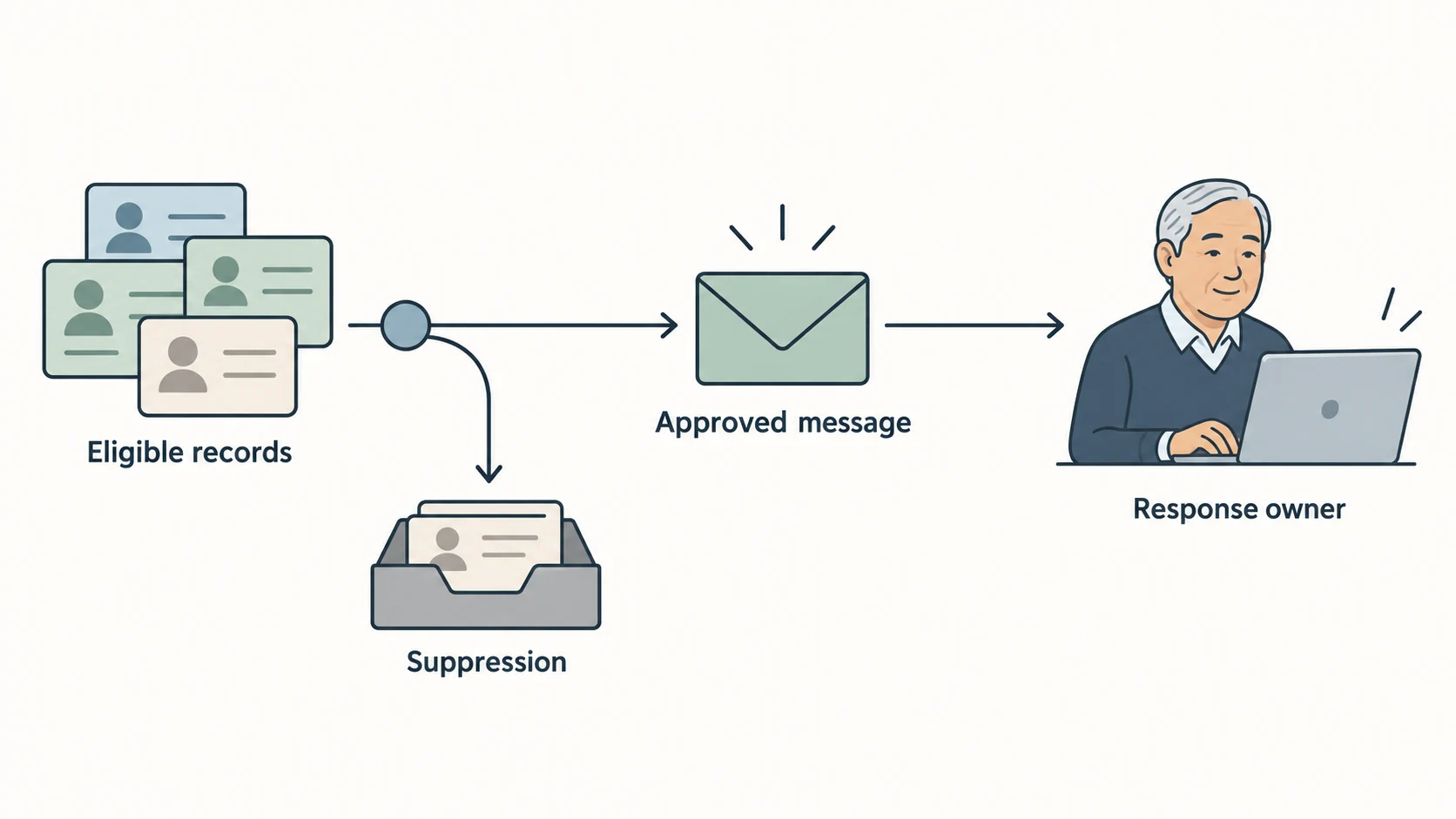
The 5-Step Database Reactivation Campaign That Generates 7:1 ROI
Ampliflow
Advanced AI frontier lab and business growth agency. Helping UK businesses deploy agentic AI systems.

Published: March 2026 | Ampliflow.ai
TL;DR: A well-structured database reactivation campaign follows five steps: audit your data, segment by value and recency, craft personalised messages for each segment, deploy across the right channels at the right times, and measure everything. Businesses that follow this framework consistently see a 7:1 ROI (based on Ampliflow client data) — and the best reach 12x ROI within 90 days. This article gives you the exact playbook, with message templates, channel selection logic, and the KPIs you should be tracking.
Most Reactivation Campaigns Fail Because They Skip the Framework
Here is what most UK businesses do when they decide to "reactivate" their database:
They open Mailchimp. They write an email that says something like "We miss you! Here's 10% off." They blast it to their entire list. They get a 12% open rate, a 0.3% click rate, and no measurable revenue. They conclude that database reactivation does not work.
It does work. They just did it badly.
A database reactivation campaign is not a single email. It is not a discount code. It is a structured, multi-step process that treats your dormant customers as what they actually are: your highest-value growth opportunity.
The difference between a campaign that generates 7:1 ROI and one that generates nothing is framework. Structure. Discipline. The five steps outlined below are not optional. They are sequential. Skip one and the entire thing collapses.
If you want a broader understanding of what database reactivation is and why it matters, start with our pillar guide: Database Reactivation: How UK Businesses Are Recovering Lost Revenue.
Step 1: Audit Your Data
Every reactivation effort begins with a brutally honest assessment of what you are working with.
Most business owners overestimate the quality of their customer data. They think they have 5,000 contacts. In reality, they have 5,000 rows in a spreadsheet — 30% of which have invalid email addresses, 15% have no phone number, and a significant chunk have not been updated since 2022.
What the Audit Covers
Data hygiene check:
- Email validation — remove bounced, invalid, and disposable addresses
- Phone number verification — check format, remove disconnected numbers
- Duplicate removal — merge records for the same customer
- Missing fields — identify gaps in name, purchase history, channel preference
Volume assessment:
- Total contacts vs contactable contacts (the gap is usually 20–40%)
- Contacts with email only vs email + phone vs full multi-channel data
- Contacts with purchase history vs contacts with no transaction data
Recency mapping:
- When did each customer last purchase?
- When did each customer last open an email or respond to a message?
- How quickly is your database decaying? (Industry average: 25% per year)
Revenue potential modelling:
- Average historic order value per customer
- Estimated reactivation rate (typically 5–15% of dormant contacts)
- Projected revenue at 7:1 ROI
What You Will Typically Find
Here is what the data audit usually reveals for a UK SME with a "5,000 contact" database:
| Metric | Typical Finding |
|---|---|
| Total records | 5,000 |
| Valid, contactable records | 3,200 (64%) |
| Records with email + phone | 2,100 (42%) |
| Last purchase within 12 months | 800 (16%) |
| Last purchase 12–24 months | 1,200 (24%) |
| Last purchase 24+ months | 1,200 (24%) |
| No purchase data | 1,800 (36%) |
That "5,000 contact database" is actually a 3,200-contact database with varying degrees of data richness. But 3,200 contactable dormant customers — at even a 5% reactivation rate and a £150 average order — represents £24,000 in recoverable revenue.
Not bad for data you already own.
If you want us to run this audit for you, book a free growth audit — we will assess your database and model the revenue opportunity in detail.
Step 2: Segment by Value, Recency and Behaviour
This is where most win-back campaigns diverge from amateur efforts. Segmentation is not optional. It is the single biggest driver of campaign performance.
Businesses running segmented reactivation campaigns see a 760% revenue increase compared to unsegmented blasts (based on Ampliflow client campaign data). Seven hundred and sixty per cent. That number should redefine how you think about your customer list.
The RFM Segmentation Model
RFM — Recency, Frequency, Monetary value — is the gold standard for reactivation segmentation.
Recency: How recently did the customer last purchase?
- 0–6 months: warm (not truly dormant — different messaging)
- 6–12 months: cooling (ideal reactivation window)
- 12–24 months: cold (requires more effort, still viable)
- 24+ months: ice cold (lower response rate, but worth targeting)
Frequency: How often did they purchase?
- One-time buyers: different reactivation approach than repeat customers
- Repeat buyers (2–5 purchases): highest reactivation potential
- High-frequency buyers (5+): priority segment — these are your best customers who drifted
Monetary value: How much did they spend?
- High-value customers (top 20%): personalised, high-touch reactivation
- Mid-value customers (middle 60%): standard multi-channel sequence
- Low-value customers (bottom 20%): lighter-touch, lower-cost channels
Practical Segment Examples
Based on RFM scoring, your campaign should target at least these four segments:
Segment A — "Golden Dormant" (high value, high frequency, 6–18 months inactive) These are your best customers who stopped buying. They deserve VIP treatment. Personalised messages, exclusive offers, direct outreach. This segment alone can deliver the majority of your reactivation revenue.
Segment B — "One-Time Wonders" (single purchase, 6–24 months ago) They bought once and never returned. The goal is converting them into repeat buyers. Focus on the value they got from their first purchase and what they are missing.
Segment C — "Faders" (declining frequency, last purchase 3–12 months ago) These customers are in the process of becoming dormant. Early intervention here has the highest success rate. They have not fully disengaged yet.
Segment D — "Deep Freeze" (24+ months inactive, any value) Lowest response rate but still worth targeting because the cost is minimal. Use softer messaging — "Are you still interested?" rather than a hard sell.
ReFlow handles this segmentation automatically using AI. It analyses your entire database, scores every contact on RFM dimensions, and creates dynamic segments that update as behaviour data changes.
Step 3: Craft the Messages
Generic messages kill reactivation efforts. "We miss you" is not a strategy. It is lazy.
Every segment needs its own messaging track — different tone, different offer, different channel priority. Here is a framework for each.
Message Architecture per Segment
Segment A — Golden Dormant
Message 1 (Day 1, Email):
Subject: [First name], we have not heard from you in a while Body: Acknowledge the gap. Reference their specific purchase history. Offer something genuinely valuable — early access, a personalised recommendation, or a meaningful (not token) incentive. No generic discount codes.
Message 2 (Day 4, SMS):
Short, personal, conversational. "Hi [name], it's [business]. We noticed it's been [X months] since your last [product/service]. We've added [new thing] since then — thought you'd want to know. [Link]"
Message 3 (Day 8, WhatsApp):
Rich media. Send a short video, a product image, or a personalised recommendation card. WhatsApp feels personal — use that.
Message 4 (Day 14, Email):
Final push for this sequence. Stronger offer. Social proof — "237 customers came back last month." Clear CTA.
Segment B — One-Time Wonders
Message 1 (Day 1, Email):
Reference their specific purchase. Ask how it went. Offer something complementary. The goal is re-engagement, not a hard sell.
Message 2 (Day 5, SMS):
Brief value-add. Tip related to their purchase. Link to useful content. Build goodwill before asking for the sale.
Message 3 (Day 10, Email):
Introduce a relevant new product or service. Include a testimonial from someone in a similar situation. Soft offer.
Segment C — Faders
Message 1 (Day 1, Email):
"It's been a while since your last [purchase]. Here's what's new." Product updates, new features, improvements since they last bought.
Message 2 (Day 3, SMS):
Time-sensitive but not pushy. "This week only — [offer] for returning customers."
Segment D — Deep Freeze
Message 1 (Day 1, Email):
Subject: Still interested in [category]? Body: Very light touch. "We're updating our records. If you'd still like to hear from us, here's something worth seeing." Includes an easy opt-out.
Message 2 (Day 7, Email):
If opened but not clicked — send a stronger value proposition. If not opened — move to SMS if phone data exists.
Key Messaging Principles
- Reference specifics. Their name, their purchase, their history. Generic messages get generic results.
- Lead with value, not desperation. "Here's something useful" beats "please come back" every time.
- Match channel to message length. Email for stories and detail. SMS for urgency and brevity. WhatsApp for conversation and rich media.
- Include social proof. Numbers, testimonials, case studies. Dormant customers need reassurance that others are still buying.
The AI personalisation engine inside Amplio generates these messages dynamically — pulling from purchase history, engagement data, and segment-specific templates to create messages that feel individually crafted at scale.
For more on channel selection, read Email, SMS or WhatsApp? Best Channels for Database Reactivation in the UK.
Step 4: Deploy Across the Right Channels at the Right Times
The programme is not a single blast. It is a sequenced, multi-channel operation.
Channel Selection Logic
The channel you use should be determined by three factors:
- What data do you have? You cannot SMS someone if you only have their email.
- What is the message type? Long-form content goes to email. Urgent, short messages go to SMS. Conversational or visual content goes to WhatsApp.
- What has the customer responded to before? If they historically opened emails but ignored SMS, lead with email.
The Multi-Channel Sequence
Here is the deployment framework we use across our reactivation programmes:
| Day | Channel | Purpose | Segment Priority |
|---|---|---|---|
| 1 | Initial re-engagement, value-led | All segments | |
| 3–5 | SMS | Follow-up for non-openers, urgency | A, B, C |
| 7–8 | Rich media, conversational | A, B | |
| 10–12 | Second touch, stronger offer | Non-responders | |
| 14 | SMS | Final push, scarcity/urgency | A, C |
| 21 | Last attempt, opt-out friendly | D (Deep Freeze) |
Timing Optimisation
Send times matter more than most businesses realise.
- Email: Tuesday to Thursday, 9:00–11:00 AM or 7:00–9:00 PM. Avoid Mondays (inbox overwhelm) and Fridays (weekend mentality).
- SMS: 10:00–12:00 PM weekdays, or 6:00–8:00 PM. Never before 9 AM or after 9 PM.
- WhatsApp: 11:00 AM–1:00 PM or 5:00–7:00 PM. These are natural "checking phone" windows.
AI-powered send-time optimisation — available through ReFlow — analyses individual contact behaviour and sends each message at the time that specific person is most likely to engage. This alone can increase open rates by 15–25%. For a broader look at how AI is transforming email workflows, see our guide to AI email marketing automation.
Chatbot Cost Advantage
For businesses handling inbound responses, AI chatbot interactions cost approximately £0.40 per conversation compared to £4.80 for a human agent. When your campaign generates hundreds of responses, this 12:1 cost ratio makes AI-assisted response handling a no-brainer. Database reactivation is often the first quick win deployed as part of a broader 90-day AI implementation roadmap — the returns fund everything that follows.
Step 5: Measure Everything
A win-back campaign without measurement is a guess dressed up as a strategy. Here are the KPIs you should be tracking — and the benchmarks you should be aiming for.
Primary KPIs
| KPI | Target Benchmark | Why It Matters |
|---|---|---|
| Reactivation rate | 5–15% of dormant contacts | Core success metric |
| Revenue recovered | 7:1 ROI minimum | The number that justifies everything |
| Cost per reactivated customer | £2–£8 | Efficiency vs cold acquisition |
| Time to first reactivated purchase | 7–21 days | Speed of return |
| Average order value (reactivated) | 25% above historic average | Upsell effectiveness |
Secondary KPIs
| KPI | Target Benchmark | Why It Matters |
|---|---|---|
| Email open rate | 30–45% | Message relevance |
| SMS delivery + open rate | 95%+ delivery, 98% open | Channel health |
| WhatsApp read rate | 85%+ | Engagement quality |
| Click-through rate | 5–12% | Offer relevance |
| Unsubscribe rate | <2% per campaign | List health |
| Spam complaint rate | <0.1% | Compliance risk |
The 90-Day Measurement Framework
Week 1–2: Focus on deliverability and open rates. Are your messages reaching people? Are they opening them? If open rates are below 20%, you have a deliverability or subject line problem.
Week 3–4: Focus on engagement. Click rates, reply rates, booking rates. Are people taking action? If open rates are strong but clicks are weak, your messaging or offer needs work.
Month 2: Focus on conversions. Actual purchases, bookings, revenue. This is where the ROI calculation becomes real.
Month 3: Focus on compound metrics. Repeat purchases from reactivated customers. Referrals generated. Customer lifetime value changes. The 12x ROI within 90 days benchmark comes from measuring these downstream effects.
Track everything in AmpliDash — real-time analytics that show you exactly what is working, what is not, and where to double down.
A Real UK Example: The 5-Step Framework in Action
To see this framework applied to a real business, read our case study: How a Mobile Repair Business Reactivated 2,000 Dormant Customers in 30 Days. It walks through every step — from data audit to revenue recovered — with specific numbers and lessons learned.
Here is a summary of how the framework plays out for a typical UK service business:
The business: A professional services firm with 4,000 contacts, 2,800 dormant (no purchase in 12+ months).
Step 1 — Audit: 2,800 dormant contacts reduced to 2,100 contactable after data hygiene. 1,400 had email + phone data.
Step 2 — Segment: Four segments created. 380 "Golden Dormant" (high value, 12–18 months inactive). 720 "One-Time Wonders." 560 "Faders." 440 "Deep Freeze."
Step 3 — Craft: Personalised message sequences for each segment. The Golden Dormant segment received a personal video message from the MD. One-Time Wonders received product recommendations based on their original purchase.
Step 4 — Deploy: Multi-channel sequences over 21 days. Email → SMS → WhatsApp → Email → SMS.
Step 5 — Measure: Results after 90 days:
- 312 customers reactivated (14.9% reactivation rate)
- £47,800 revenue recovered
- Campaign cost: £3,200
- ROI: 14.9:1
- Reactivated customers spent 31% more than their historical average
That is not theoretical. That is the framework, applied.
The Biggest Mistakes That Kill Reactivation Campaigns
Even with a solid framework, certain errors can undermine your results:
1. Blasting the entire list with one message. This is the cardinal sin. Unsegmented campaigns generate a fraction of the revenue that segmented ones do. A 760% revenue increase from segmentation is not a rounding error — it is the difference between success and failure.
2. Leading with a discount. Discounts train customers to wait for the next offer. Lead with value, relevance, and personalisation. Save the incentive for the final message in the sequence, and only for contacts who have shown interest but not converted.
3. Using one channel only. Email-only campaigns leave SMS and WhatsApp engagement on the table. Multi-channel sequences dramatically outperform single-channel ones.
4. Not measuring downstream effects. A reactivated customer who buys once and then buys again three months later is worth twice what your initial measurement shows. Track lifetime value, not just first-purchase revenue.
5. Giving up after one attempt. A single message to a dormant database is not a campaign. It is a gesture. Commit to the full 21-day sequence across multiple channels.
When to Run Your Next Reactivation Campaign
This approach should not be a one-off event. The most effective businesses run reactivation cycles quarterly:
- Q1: Post-holiday reactivation (January–February)
- Q2: Spring campaign (April–May)
- Q3: Pre-autumn push (July–August)
- Q4: Pre-Christmas campaign (October–November)
Each cycle catches new dormant customers — people who have drifted in the intervening months. Each cycle also retargets contacts who did not respond to the previous campaign with refreshed messaging.
To set up a recurring reactivation programme, get in touch — we will build the entire system using ReFlow and run it on your behalf.
Key Takeaways
- A database reactivation campaign follows five steps: audit, segment, craft, deploy, measure. Skip any step and results collapse.
- Data audit comes first. Know what you are working with before you send a single message. Most businesses overestimate their contactable database by 20–40%.
- Segmentation drives a 760% revenue increase. RFM scoring (Recency, Frequency, Monetary value) is the gold standard. At minimum, create four segments with distinct messaging tracks.
- Multi-channel sequencing outperforms single-channel blasts. Email, SMS, and WhatsApp — deployed in sequence — maximise reach and engagement.
- Measure the right KPIs. Reactivation rate, revenue recovered, cost per reactivated customer, and ROI. Target 7:1 ROI as a baseline, with 12x ROI within 90 days achievable for well-segmented campaigns.
- Reactivated customers spend 25% more on their first purchase back. The economics compound.
- Run reactivation quarterly, not as a one-off. Each cycle catches new dormant contacts and retargets non-responders.
Frequently Asked Questions
How long does a database reactivation campaign take to generate results?
Most campaigns see initial revenue within the first two weeks. The primary reactivation window is days 1–21, where the bulk of re-engagement happens. Full ROI measurement should happen at the 90-day mark, which captures downstream effects like repeat purchases and referrals. The 7:1 average ROI is typically achieved within 60–90 days, with some campaigns reaching 12x ROI within 90 days when AI-driven personalisation and multi-channel sequencing are fully deployed. View our pricing to see the investment required.
What is the minimum database size for a reactivation campaign to be worthwhile?
There is no hard minimum, but we typically recommend at least 200 contactable dormant contacts. At a 5–10% reactivation rate, that gives you 10–20 recovered customers — enough to generate meaningful revenue and data for optimisation. Businesses with 1,000+ dormant contacts see the most dramatic results because segmentation becomes more granular and statistically significant.
Can I run a reactivation campaign myself or do I need an agency?
You can run a basic campaign yourself using standard email and SMS tools. The five-step framework in this article gives you everything you need to start. However, AI-driven segmentation, predictive send-time optimisation, multi-channel orchestration, and dynamic personalisation — the elements that push ROI from 3:1 to 7:1 and beyond — require specialist technology. That is what ReFlow provides. The difference between a DIY campaign and an AI-powered one is typically a 2–3x improvement in ROI.
How do I handle GDPR compliance in a re-engagement campaign?
UK GDPR and PECR allow you to email existing customers about similar products or services under the "soft opt-in" rule, provided you offered an opt-out at the point of data collection and include one in every subsequent message. SMS and WhatsApp require more explicit consent in most cases. The key is ensuring your original data collection included appropriate consent mechanisms. For a comprehensive compliance guide, read GDPR-Compliant Database Reactivation: A UK Business Guide.
What message should I send first in a win-back campaign?
Your first message should be value-led, not sales-led. Reference the customer by name, acknowledge the gap since their last interaction, and offer something genuinely useful — a relevant update, a personalised recommendation, or exclusive access to something new. Avoid leading with discounts. Save incentives for later in the sequence, and only for contacts who have shown engagement signals (opens, clicks) without converting. The first message is about restarting the conversation, not closing a sale.
Want us to build your re-engagement campaign? [Book a free growth audit](/audit) — we will assess your data, model the revenue opportunity, and show you exactly how the five-step framework would work for your business. Most clients see results within the first fortnight.