MVP Development Agency UK: Scope, Cost and What to Build First (2026)
A practical guide to choosing an MVP development agency in the UK, with scope discipline, cost drivers, timelines, AI features and build-vs-wait decisions.
Co-founder of Ampliflow. Builds AI automation, websites, SEO/AEO, and growth systems for UK SMEs.
- 01What an MVP should prove
- 02MVP vs prototype vs v1
- 03MVP scope ladder
- 04What changes MVP cost
- 05How to choose an MVP development agency
An MVP, or minimum viable product, is the smallest working release that lets real users test the core idea. It is not simply a cheaper version of the final product.
It is a focused release that proves whether the product should exist in its current form. That means the hard work is not adding features. It is deciding which features can wait.
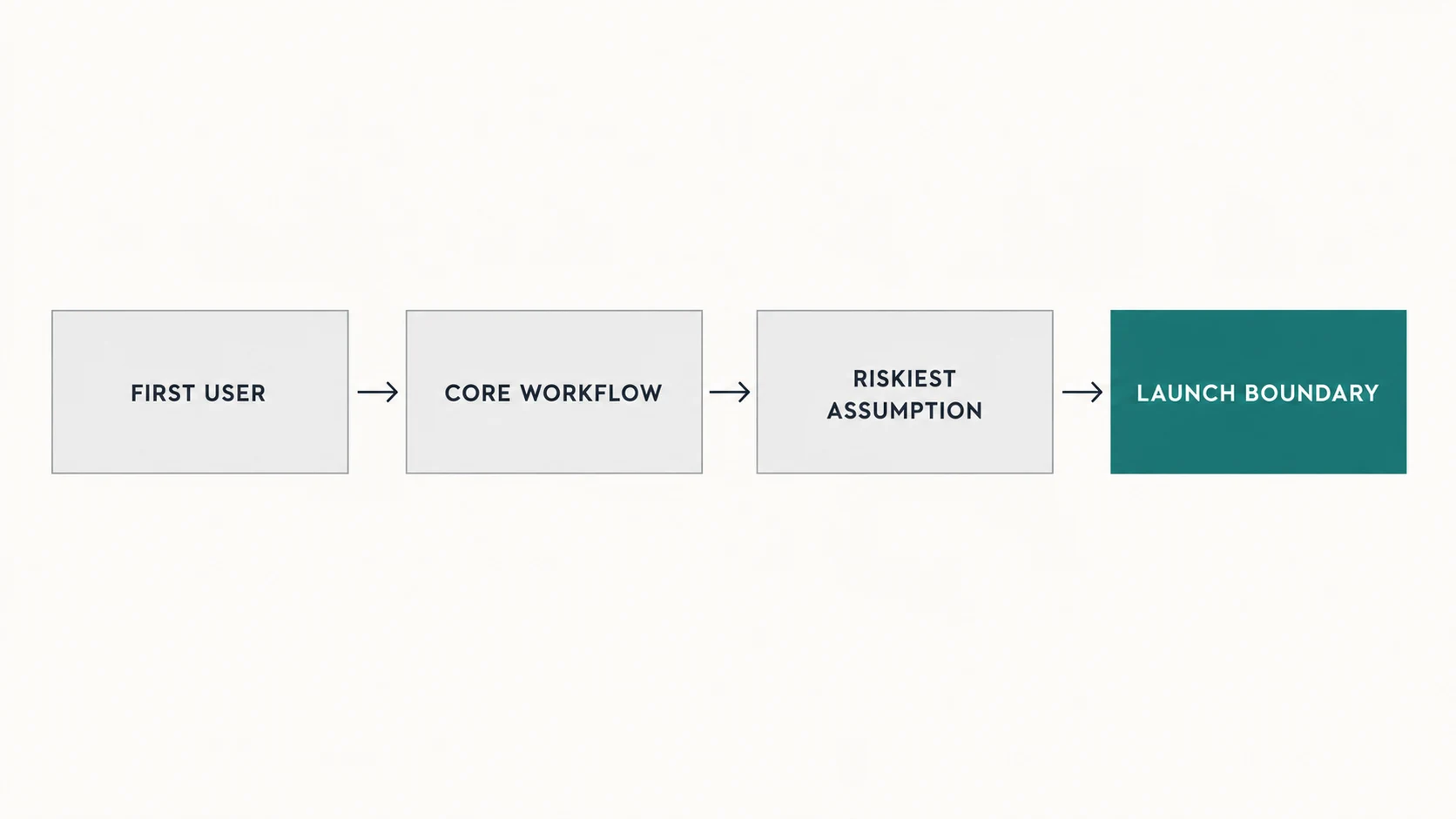
Quick answer: A good MVP development agency helps define the first user, core workflow, riskiest assumption, data model, AI opportunity and launch boundary before writing code. The right MVP proves one valuable behaviour with real users. It does not try to ship the full product at a discount.
Last updated: June 2026 · Written for UK founders, SMEs and teams planning SaaS, portals and AI products
TL;DR:
- Start with the workflow, not the platform.
- A useful MVP proves one core behaviour with one primary user group.
- Ampliflow app builds start from £997 for a focused first version. Larger products are scoped individually.
- Do not reuse website pricing for MVPs. They are different builds.
- The agency should be able to remove scope, not just accept a feature list.
What an MVP should prove
An MVP should test the most important assumption behind the product.
That does not make it an unfinished product. UK government agile guidance frames early delivery around real user feedback, short feedback loops and a stable working service that can gain capability over time. DWP goes further on accessibility: if the release is inaccessible, it is not viable. See the GOV.UK core principles for agile delivery and the DWP Accessibility Manual.
| Product idea | MVP should prove |
|---|---|
| SaaS tool | Users will complete the core workflow and return |
| Marketplace | Both sides have enough reason to participate |
| Internal product | The process gets faster, clearer or less error-prone |
| AI assistant | The AI improves a real task enough to justify trust and cost |
| Customer portal | Clients will use self-service instead of asking staff |
If you cannot name the assumption, you are not ready to scope the build.
MVP vs prototype vs v1
- 01Prototype — test the idea
- 02MVP — test the core behaviour
- 03V1 — serve early customers
- 04Scale build — support growth
| Stage | Purpose | What it includes |
|---|---|---|
| Prototype | Explore the idea | Clickable screens, no production system |
| MVP | Test the core workflow | Real users, necessary access controls, data protection, accessibility and a feedback route |
| V1 product | Serve early customers properly | More roles, polish, billing, deeper integrations |
| Scale build | Support growth | Extend security, performance and operations for the growing workload |
Do not ask an MVP to do the job of V1. That is how scope grows without learning keeping pace.
MVP scope ladder
Use this ladder to keep the first version honest.
| Layer | Include in MVP? | Why |
|---|---|---|
| Core user | Yes | Without a user, there is no product |
| Core workflow | Yes | This is what you are proving |
| Authentication and permissions | Required wherever private data or restricted actions need protection | Check identity and access even if the first version has only one user |
| Analytics | Yes | You need to see usage |
| AI feature | Only if central | AI should prove the workflow, not decorate it |
| Admin tools | Minimal | Enough to operate the product |
| Payments | Only if pricing is part of the test | Otherwise can wait |
| Advanced settings | Usually later | Often not needed to prove demand |
| Mobile native app | Rarely | A web app is faster for V1 unless device-specific features are central |
The MVP gets stronger when the boundary is explicit.
What changes MVP cost
MVP cost depends on uncertainty and complexity.
| Cost driver | Why it matters |
|---|---|
| User roles | More roles mean more flows and permissions |
| Data model | Complex records need more design and testing |
| Integrations | External systems add access, edge cases and failure points |
| AI features | Prompts, evaluation and human review need careful design |
| UX complexity | More workflows mean more screens and QA |
| Launch support | Real users create fixes, analytics and iteration needs |
Ampliflow's current public routes:
| Route | Price | Fit |
|---|---|---|
| Focused first build | From £997 | One useful workflow, simple tool, small portal, dashboard or AI-assisted feature |
| Larger MVP or AI workflow app | Scoped individually | Products with broader workflows, users or integrations |
| Product Acceleration | Scoped individually | Existing app needing UX, performance or AI capability |
For the full service page, see apps and MVP development.
If you are comparing a SaaS development agency with a lean MVP partner, look for the same discipline: a clear first user, a launchable workflow, analytics, ownership of the code and a roadmap that does not pretend every feature belongs in the first release.
If the main uncertainty is whether the proposed system can work with your data, integrations or operating constraints, test that before detailed build scope. Ampliflow's commercial and technical feasibility service is a separate route for that decision; it is not automatically part of an MVP build.
How to choose an MVP development agency
The agency should make the idea smaller before making the proposal bigger.
| Question | Good sign |
|---|---|
| What should we build first? | They ask what needs proving |
| What should wait? | They name exclusions clearly |
| Who owns the code? | The contract names transferable code, third-party licences and handover conditions |
| How will usage be measured? | Analytics and events are included |
| Where does AI belong? | They tie AI to workflow value |
| What happens after launch? | Support and iteration are planned |
Avoid any agency that treats the feature list as sacred. That is not product thinking.
When an internal tool is smarter than a SaaS MVP
Some ideas do not need to become SaaS immediately.
If the idea comes from a real internal bottleneck, an internal tool may be the better first build. You get value inside the business while learning whether the workflow has product potential.
| Build SaaS MVP when | Build internal tool first when |
|---|---|
| You have external users ready to test | The workflow already exists in your business |
| Distribution is part of the test | Operational saving is the first value |
| Pricing needs validation | Team efficiency needs fixing first |
| Multi-tenant product is central | A private tool can prove the workflow |
This is often the quieter, more commercially sensible path.
FAQ
How much does MVP development cost in the UK?
Ampliflow app builds start from £997 for a focused first version. Larger MVPs and AI workflow apps are scoped individually. Final cost depends on scope, users, data, integrations, AI features and launch support.
How long does an MVP take to build?
The timeline follows scope, content readiness, integrations, review speed and assurance needs. A focused workflow is faster to deliver than a multi-role product, but a responsible agency should confirm the schedule only after discovery.
Should an MVP be a mobile app?
Usually not at first. Most MVPs should start as web apps or progressive web apps unless device-specific features are central to the product.
Can an MVP include AI?
Yes, but only where AI supports the core workflow. Good MVP AI use cases include semantic search, document analysis, classification, summaries, routing and assistant-style support.
What should be excluded from an MVP?
Exclude anything that does not prove the core assumption: advanced settings, secondary user roles, non-essential integrations, complex billing, native apps and edge-case admin tools.
Related reading
- ↑ App Development Agency UK
- ↔ Internal Tool Development UK
- ↔ Business Dashboard Development UK
- ↔ Power BI Dashboard vs Custom Dashboard
Scope the first release
If you have an MVP idea, start by defining the user, workflow, risk and launch boundary.