Hermes Agent vs OpenClaw: Which AI Agent Should a UK Business Use?
Hermes Agent vs OpenClaw compared for UK businesses: setup, memory, skills, WhatsApp, security, hosting, cost, and when to choose each framework.
Co-founder of Ampliflow. Builds AI automation, websites, SEO/AEO, and growth systems for UK SMEs.
- 01Hermes Agent vs OpenClaw: what is the practical difference?
- 02Quick comparison table
- 03When should a business choose Hermes?
- 04When should a business choose OpenClaw?
- 05Security and governance: the part people skip
Hermes Agent vs OpenClaw is not a simple "which tool is better?" question. For a UK business, the better question is which framework can be deployed, governed, monitored, and reviewed safely for the workflow in front of you.
Last updated: May 2026. OpenClaw and Hermes are both moving quickly, so treat this as an implementation guide rather than a permanent product verdict.
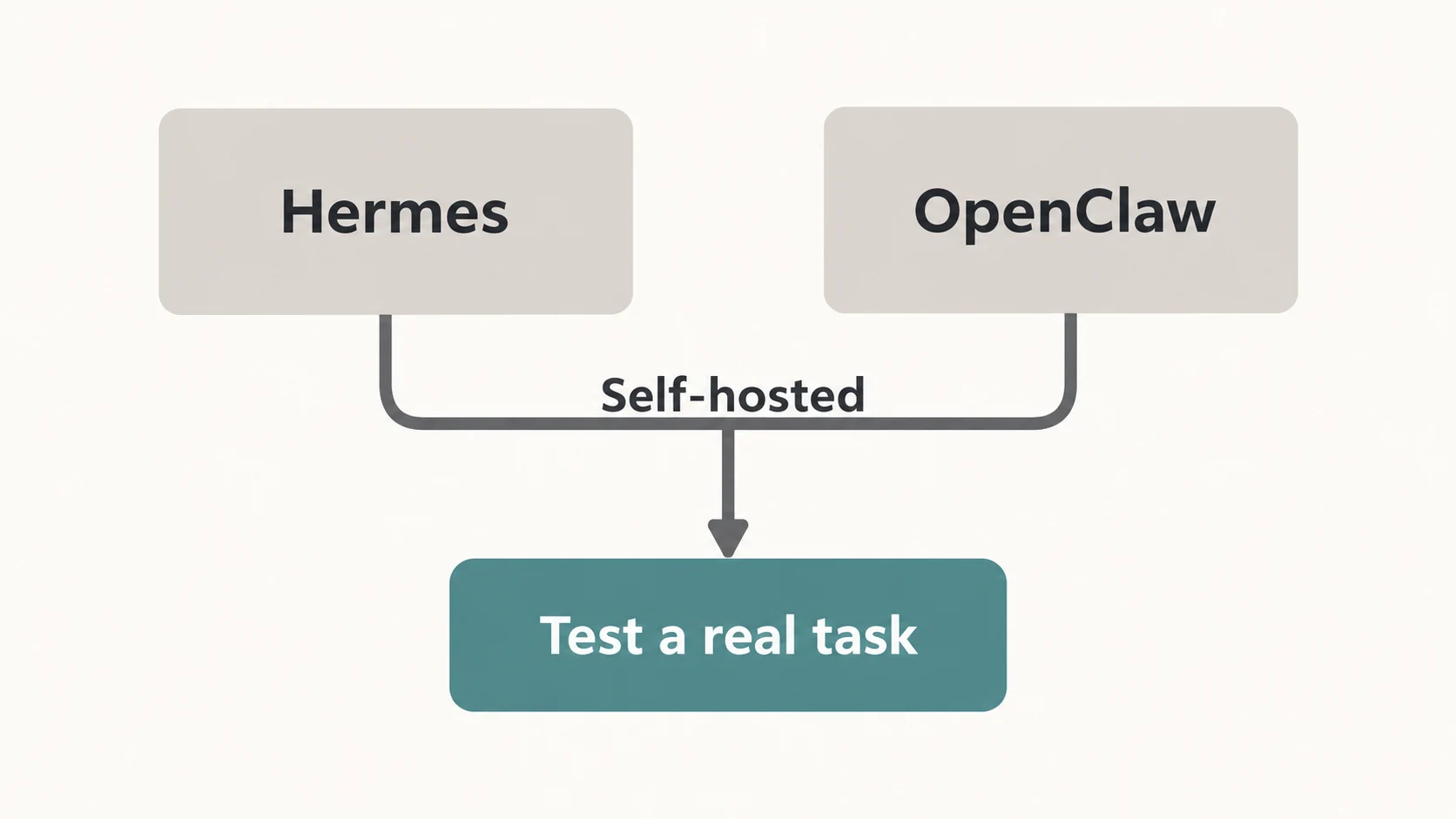
TL;DR: Both Hermes and OpenClaw support self-hosted agents with messaging, memory and scheduled work. Choose by testing the same business task, permissions and recovery path in each. Our preference for a Hermes pilot reflects our experience; it is not a benchmark proving that it is stronger in every business use case.
For the broader foundation, start with What Is Hermes Agent? A UK Business Guide.
Hermes Agent vs OpenClaw: what is the practical difference?
The products overlap. OpenClaw’s official documentation describes a self-hosted gateway for local or server deployment, messaging channels, sessions and memory; its cron documentation covers scheduled work. Compare the exact release and workflow rather than assuming these are Hermes-only features.
This distinction is practical, not academic. Businesses do not buy agent frameworks in the abstract. They buy outcomes:
- daily reporting
- lead review
- workflow triage
- customer follow-up drafts
- CRM reactivation queues
- content pruning reports
- internal knowledge retrieval
If your use case is a persistent operational workflow, both can enter the shortlist. The deciding evidence is whether the chosen integration and controls work reliably for your team.
The common mistake is comparing feature lists without asking who will run the system on Monday morning when something fails.
Quick comparison table
This table is deliberately business-focused. It is not a benchmark. It is a deployment lens.
| Dimension | Hermes Agent | OpenClaw | Business implication |
|---|---|---|---|
| Candidate workflows | Scheduled work and messaging | Scheduled work and messaging | Test the same task in both |
| Hosting | Self-hosted | Self-hosted gateway, local or server | Both need maintenance discipline |
| Memory | Persistent memory features | Session and memory features documented | Check retention and access in each |
| Skills/plugins | Skills are central to repeatable behaviour | Skill/plugin concepts exist in the broader ecosystem | Skills should become operating instructions |
| Documented channel support | Documented channel support | Test pairing, delivery and approvals | |
| Scheduled work | Cron-style jobs | Cron jobs documented | Test timezone, retries and duplicate prevention |
| Setup complexity | Technical, but narrow enough to govern | Can be technical and fast-moving | Neither should be treated as an unattended appliance |
| First pilot | Internal report or review queue | The same internal report or review queue | Compare like for like |
If you are choosing for a business, do not start with the most impressive demo. Start with the least risky workflow that would save time every week.
When should a business choose Hermes?
Choose Hermes when the workflow is repeatable, scheduled, and benefits from a human approval loop.
Good Hermes use cases:
- a Monday SEO pruning report
- a daily lead review summary
- a WhatsApp alert for high-intent enquiries
- a CRM reactivation draft queue
- an internal knowledge-base assistant that follows company rules
- a scheduled competitor or pricing monitor
These are not glamorous use cases. They are useful because they happen often and are easy to review.
Hermes is also a good candidate when you want the agent to live on controlled infrastructure. A properly configured Hermes implementation on a VPS can be easier to reason about than a pile of browser automations across personal accounts.
That does not make it effortless. You still need:
- hosting
- secrets management
- logging
- update processes
- approval rules
- recovery steps
- clear ownership
This is where our AI automation service comes in. The valuable part is not "installing an agent". It is designing the boundary around it.
When should a business choose OpenClaw?
Choose OpenClaw if your evaluation shows it better fits your team, your preferred interface, or a broader assistant-style workflow.
Look at its current integrations, interface and operational controls. Popularity alone does not show whether a deployment will fit your business.
OpenClaw may be the right path if:
- your team has already tested it successfully
- its interface suits your users better
- your use case depends on OpenClaw-specific features
- you have someone technical enough to maintain the deployment
- the data boundary is clear and low risk
Be careful with one thing: do not pick OpenClaw only because the internet is talking about it more. A framework can be popular and still be the wrong fit for your workflow.
For a neutral buying process, use an AI readiness assessment before choosing the stack.
What OpenClaw does well
OpenClaw deserves a fair comparison because it has real ecosystem activity, but the business case still depends on governance.
| Area | What is documented | Business implication |
|---|---|---|
| Skills | The [OpenClaw skills docs](https://docs.openclaw.ai/tools/skills) describe AgentSkills-compatible folders, bundled skills, managed skills, workspace skills and per-agent allowlists. | Skills can make workflows repeatable, but they also need review and ownership. |
| Cost visibility | The [token-use docs](https://docs.openclaw.ai/reference/token-use) describe `/status`, `/usage` and `/usage cost`, with cost estimates depending on authentication mode. | Cost tracking exists, but real operating cost still depends on provider, model choice and usage pattern. |
| Security surface | Agent-skill research and OpenClaw commentary both point to prompt injection, data exfiltration and supply-chain risk in local agent ecosystems. | OpenClaw should be tested in isolation before it touches live business data, credentials or local files. |
| Best fit | The docs and ecosystem point toward personal-agent and assistant-style workflows with a growing skills layer. | It may be useful, but it should not be treated as a low-maintenance business appliance. |
That is not a criticism of OpenClaw. It is the same standard we would apply to Hermes: once an agent can use tools, read files, run workflows or connect to accounts, the implementation matters more than the demo.
What about OpenClaw alternative searches?
If you are looking for an OpenClaw alternative, name the limitation you need to solve: a missing integration, difficult review process, hosting constraint or unreliable task.
Test that exact issue in Hermes before migrating. Keep source data and working configuration backed up, and verify what transfers. Skills and memory are not automatically interchangeable between products.
Security and governance: the part people skip
Security is where agent demos become business systems or fail quietly.
Both Hermes and OpenClaw can become risky if you give them too much access. The issue is not whether the framework is "safe" in the abstract. The issue is what it can touch in your environment.
Skill-based agents deserve extra caution. A 2026 paper on agent skills, "Agent Skills in the Wild", reported vulnerabilities across prompt injection, data exfiltration, privilege escalation and supply-chain risks in analysed skills. OpenClaw-focused security commentary makes the same practical point: the risk is not only the agent, but the third-party skills, local permissions and tool chains around it.
Before deploying either tool, answer these questions:
| Question | Why it matters |
|---|---|
| What data can the agent read? | Reduces unnecessary exposure |
| What actions can it take without approval? | Prevents accidental sends, edits, or deletes |
| Where are logs stored? | Helps review outputs and debug failures |
| Who owns updates? | Keeps the system from drifting or breaking |
| How are secrets stored? | Stops credentials leaking into prompts or outputs |
| How do we disable it quickly? | Gives the business a recovery path |
This is the part that rarely appears in YouTube tutorials, and it is usually the part that decides whether a business can trust the deployment.
Personal-data processing brings UK GDPR duties; marketing channels may also bring PECR requirements. Assess the workflow and retain human review for consequential actions. The precise legal duties depend on the use case.
The implementation readiness scorecard
Run this check before choosing.
| Criterion | Score 1 | Score 5 |
|---|---|---|
| Workflow clarity | "We want an AI agent" | "We need a daily lead review summary by 8am" |
| Data boundary | Agent can access everything | Agent can access only specific files/APIs |
| Approval design | Unclear | Every risky action requires approval |
| Maintenance owner | Nobody | Named technical owner |
| Logging | None | Tool calls and outputs stored |
| Failure handling | Hope it works | Timeout, retry, and escalation plan |
| Business value | Interesting demo | Saves measurable weekly time |
This scorecard is a discussion tool, not a validated pass mark. A serious gap in permissions, ownership or recovery should block a pilot even if the total looks high.
For a wider rollout model, read our 90-day AI implementation roadmap.
What the comparison pages usually miss
Most comparison pages focus on features. Features matter, but they are not the main risk in a business deployment.
The missing questions are usually operational:
- Who restarts the agent if the gateway dies?
- Who checks whether yesterday's scheduled job actually ran?
- Where do failed runs go?
- How are model errors surfaced to a human?
- What happens if the agent cannot access a source system?
- Who updates the skills when the business process changes?
- What is the rollback plan if an integration starts producing bad data?
We are careful about agent comparisons for this reason. A tool can look weaker on a feature table and still be better for a business because its operating boundary is easier to understand.
The inverse is also true. A tool can look powerful in a demo and still be a poor first deployment because it takes too much judgement to supervise.
The right question is:
"Can we explain how this agent works, what it can access, what it cannot do, and who reviews the output?"
If the answer is no, the tool is not ready for production use.
A realistic example: Monday lead review
Imagine a UK service business receiving 20-30 enquiries per week from forms, calls, WhatsApp, and email. The owner wants an agent to review new enquiries every morning and highlight the ones worth acting on first.
With Hermes, the workflow might be:
- Run at 8am every weekday.
- Pull new enquiries from the agreed sources.
- Exclude spam and duplicates.
- Group leads by urgency.
- Draft recommended actions.
- Send a summary to WhatsApp.
- Wait for human approval.
- Log the result.
With OpenClaw, the team would test whether the current deployment path supports the same workflow cleanly. If it does, it remains a candidate. If the workflow becomes harder to govern, Hermes moves ahead.
That is the practical way to compare these systems. Not "which one has more stars?" Not "which one has the bigger subreddit?" Run the same business workflow through both and measure reliability, review speed, and failure handling.
Decision rule for UK SMEs
- 01Hermes — workflow ownership and governed skills
- 02OpenClaw — interactive tool use and experimentation
- 03Neither — when a deterministic workflow is enough
Run this rule before you spend weeks testing.
If the workflow is internal, scheduled, and review-led, start with Hermes.
Include OpenClaw when its channels, integrations or interface fit the task; it also supports server-based scheduled workflows.
If the workflow is mainly API automation, consider whether a simpler automation platform is enough.
If the workflow is a product feature inside your own software, a developer framework may be the better route.
Many businesses do not need an agent framework. A company knowledge system, a controlled approval queue or a business dashboard may solve the problem more simply. Choose the workflow before the framework.
Which would Ampliflow choose?
For scheduled business workflows, we would usually test Hermes first.
Not because Hermes is universally superior. Because its shape fits the workflows we trust most:
- scheduled jobs
- messaging summaries
- memory and skills
- server deployment
- human-in-the-loop review
For customer-facing autonomy, we would be more cautious. The first version should produce drafts, summaries, and recommendations. It should not send messages, change records, or make decisions without a human.
The best first Hermes workflow is often internal:
- Pull the data.
- Summarise what changed.
- Flag what needs attention.
- Send the report to a human.
- Wait.
That sounds modest. It is also how reliable automation starts.
For the architecture behind that approach, read the Hermes business guide and the WhatsApp AI agent workflow guide.
Related reading
- Start with the Hermes business guide if you need the foundation.
- Read the VPS implementation guide if you are ready to plan deployment.
- Read the WhatsApp AI agent guide if your use case depends on messaging and approvals.
- Read the open-source AI agents shortlist if you are still comparing the wider category.
Key takeaways
- This comparison is a workflow decision, not a popularity contest.
- Hermes is strongest when the business needs scheduled work, messaging delivery, memory, and human approval.
- OpenClaw may suit broader personal-agent or assistant-style workflows, but it still needs governance.
- If you need an OpenClaw alternative, document the limitation you are trying to solve before testing another framework.
- Do not deploy either framework until access, logging, secrets, approvals, and recovery are clear.
- Ampliflow can help UK businesses choose and implement the right agent stack without turning it into a risky science project.
Frequently asked questions
Is this a fair comparison?
Yes, as long as the comparison is based on use case. They both sit in the AI agent ecosystem, but the right choice depends on workflow, hosting, governance, and user experience.
Is Hermes an OpenClaw alternative?
Hermes can be an OpenClaw alternative when you want a self-hosted workflow agent with scheduled jobs, memory, skills, and messaging delivery. It is not a drop-in replacement for every OpenClaw use case.
Is OpenClaw safer than Hermes?
Safety depends on deployment, access, secrets, logging, and approval rules. A poorly configured system in either framework can be risky.
Which is better for WhatsApp workflows?
Both projects document WhatsApp support. Test delivery, account permissions, reconnection and the approval path with a non-production account before choosing.
Can Ampliflow help us choose?
Yes. Get unstuck is the starting point. We map the workflow before recommending Hermes, OpenClaw, another framework or a simpler automation.