Hermes Agent vs LangGraph vs CrewAI: Which Framework Does a UK Business Actually Need? (2026)
Ampliflow
Advanced AI frontier lab and business growth agency. Helping UK businesses deploy agentic AI systems.
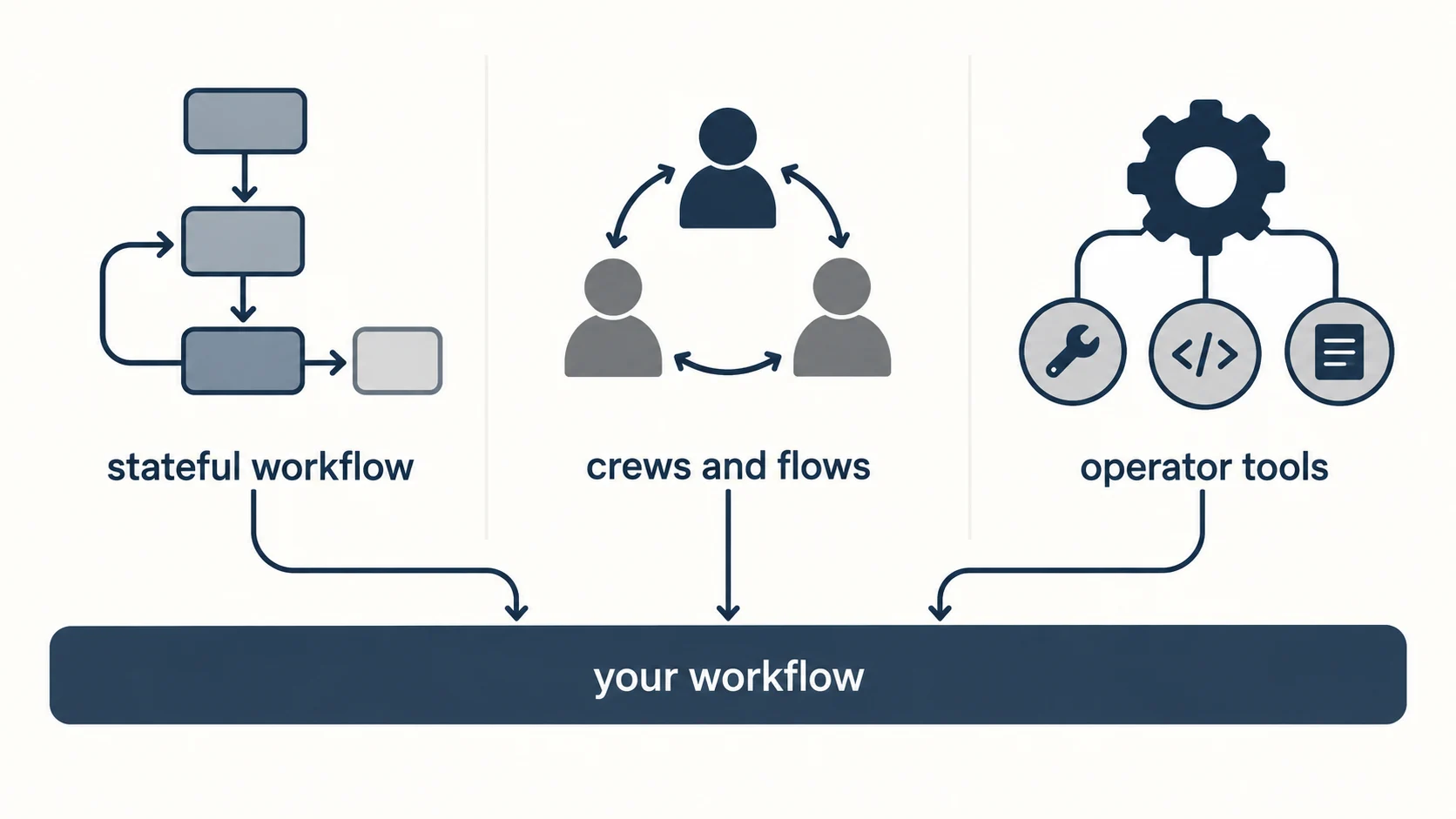
Most "best agent framework" articles compare LangGraph and CrewAI as if they are the only two choices. They are not. Hermes Agent is the third category that the developer-press has missed: a messaging-channel-first agent runtime built for non-technical operators, deployed in a day on a £4-per-month server, with no per-run cost. The three frameworks solve different problems. The right question is not which one wins; it is which layer of agent maturity your UK business actually needs right now.
Last updated: May 2026 · Covers Hermes Agent v0.13 ("Tenacity"), LangGraph v1.0.10, CrewAI Q2 2026 release · Verified against each project's official documentation
TL;DR:
- Hermes Agent = messaging-channel-first ops agents, self-hosted, £4/month VPS, zero per-run cost, autonomous skill creation
- CrewAI = role-based multi-agent prototyping, fastest to first working crew (2-3 days), native MCP + A2A protocol support
- LangGraph = production stateful workflows with checkpointing, human-in-loop, time-travel debugging, LangSmith observability
- For a UK SME under 50 staff, the right starting point is almost always Hermes (£4/month) or CrewAI (free tier) — not LangGraph
- Disambiguation: "Hermes 3" is a fine-tuned LLM you can use inside any framework. "Hermes Agent" is the runtime this article covers. They are different products from the same team
A note before we begin: which Hermes?
Nous Research ships two products with "Hermes" in the name. They are not the same thing.
- Hermes 3 is a fine-tuned large language model (Llama 3.1 8B base, 91% tool-call accuracy in published benchmarks) that you can use as the underlying brain inside any agent framework — including LangGraph, CrewAI, or Hermes Agent itself. You access it via Ollama, OpenRouter, or directly.
- Hermes Agent is a self-hosted autonomous-agent runtime — the gateway, skills system, persistent memory, and messaging integration. This is the framework being compared in this article.
The two are complementary: you can run Hermes Agent with Hermes 3 as the backbone model, or with Claude Sonnet, GPT-5, Gemini, DeepSeek, or any of the 200+ providers Hermes Agent supports. When the rest of this article says "Hermes," it means Hermes Agent.
Hermes Agent vs LangGraph vs CrewAI: what each framework actually is
LangGraph
A graph-based agent orchestration framework from LangChain. Reached 1.0 GA in October 2025; current version 1.0.10. Execution flows through typed nodes (Python functions) connected by directed edges, with a central state object that persists between steps.
What makes it different: node-level checkpointing that enables crash recovery and human-in-loop pauses, time-travel debugging that lets you replay any prior state, and first-class LangSmith integration for tracing, evaluation, and production monitoring. It is the framework large enterprises pick when they need agents that behave like real software — auditable, debuggable, deterministic.
Production users include Klarna, Uber, LinkedIn, Lyft, Coinbase, Workday, and Nvidia. Roughly 40 million monthly PyPI downloads. MIT-licensed and free. Production monitoring requires LangSmith (£30-32 per seat per month at the Plus tier).
Notable limitation: as of May 2026, no native MCP or A2A protocol support — community integrations only.
CrewAI
A role-based multi-agent framework. Agents are crew members with defined roles, goals, and backstories who collaborate by delegating tasks to each other in natural language. The execution model has two tiers: Crews (role-based agent teams) and Flows (state-aware workflow orchestration with event-driven triggers).
Around 44,600 GitHub stars; the project reports 450 million+ monthly workflows processed across customers. The 2026 releases added native support for both MCP (Model Context Protocol) and A2A (Agent-to-Agent) — currently the only framework in this comparison with both.
Free tier (50 runs/month) plus per-run pricing ($0.50/run beyond free) plus an Enterprise tier (custom pricing, up to 30,000 runs/month, includes SSO, RBAC, dedicated account management). Self-hosted via CrewAI Factory on AWS, Azure, GCP, or on-premise. Token consumption runs about 22% higher than LangGraph on equivalent tasks due to agent-to-agent coordination overhead.
Hermes Agent
A self-hosted agent operating environment from Nous Research. Current version 0.13 ("The Tenacity Release", 7 May 2026). MIT-licensed. No paid tier.
Architecture is gateway-first: a single gateway process routes commands from Telegram, Discord, Slack, WhatsApp, Signal, Email, or CLI into an execution runtime. Supports seven backends (local shell, Docker, SSH, Singularity, Modal, Daytona, Vercel Sandbox). 40+ built-in tools. 200+ model providers. Persistent memory via FTS5 full-text search across sessions, LLM-driven summarisation, Honcho user modelling.
The killer feature competitors do not have: autonomous skill creation. Hermes generates new procedural skills from completed tasks, compatible with the agentskills.io open standard, without redeployment. The agent improves over time without engineer intervention.
Runs on a £4/month Hetzner CX22, a £0/month Oracle Cloud Free Tier instance, or your developer's laptop. Full deployment guide at How to Deploy Hermes Agent.
The three-layer model
The cleanest way to think about these tools is not as competitors but as three distinct layers of agent maturity. Most existing comparisons miss this because they only look at developer-facing tools.
`text +--------------------------------------------+ LAYER 3 | PRODUCTION STATEFUL SYSTEMS |
| -> LangGraph + LangSmith |
|---|
| Customer-facing, compliance-grade, |
| audit trails, time-travel debugging |
+--------------------------------------------+ ^
| migrate when prototype |
|---|
| becomes paying-customer |
| feature |
+--------------------------------------------+ LAYER 2 | RAPID WORKFLOW PROTOTYPING |
| -> CrewAI |
|---|
| Multi-agent crew in 2-3 days, |
| role-based abstraction, MCP+A2A native |
+--------------------------------------------+ ^
| graduate when use case |
|---|
| proves out and needs |
| wider audience |
+--------------------------------------------+ LAYER 1 | MESSAGING-NATIVE OPS AGENTS |
| -> Hermes Agent (where most UK SMEs start) |
|---|
| £4/mo VPS, WhatsApp/Telegram/Slack, |
| zero per-run cost, autonomous skills |
+--------------------------------------------+ `
Layer 1 — Messaging-native ops agents (Hermes Agent) Agents that live in WhatsApp, Telegram, or Slack and serve non-technical operators. Zero per-run cost. Self-hosted. Autonomous improvement. The right tool when the interface constraint is "must work on the founder's phone, today, without requiring them to learn a dashboard."
Layer 2 — Rapid workflow prototyping (CrewAI) Agents that prove a multi-agent idea in 2-3 days before committing real engineering resources. The role-based abstraction maps to how non-technical founders already think — "I need a researcher agent, a writer agent, and an editor agent." The right tool when speed-to-proof beats long-term control.
Layer 3 — Production stateful systems (LangGraph) Agents that get baked into a product or a regulated process. Explicit checkpointing. Human-in-loop with auditability. LangSmith observability. The right tool when the agents must be explainable to a compliance officer or a board.
A typical UK SME journey: start with Hermes for ops work, prototype a customer-facing agent with CrewAI, migrate to LangGraph if and when that customer-facing agent becomes a production feature with paying users depending on its uptime.
Architectural comparison
| Dimension | LangGraph | CrewAI | Hermes Agent |
|---|---|---|---|
| Core abstraction | Graph nodes + directed edges + typed state | Role-based agents (roles/goals/backstories) + Flows | Gateway → skills → memory → backend runtime |
| State management | Node-level checkpointing; time-travel replay; pluggable persistence | Flow-level state; session persistence | FTS5 session memory; cross-session recall via Honcho |
| Human-in-loop | First-class `interrupt()` with audit trail | Requires wrappers; less granular | Channel-native (reply on WhatsApp = approve) |
| Observability | LangSmith (native) — tracing, evals, replay | Built-in tracing + Enterprise console | Self-managed logging (no native dashboard) |
| Multi-agent | Hierarchical / parallel subgraphs | Hierarchical crews with role delegation | Subagent delegation; isolated execution contexts |
| Protocol support | None native (MCP/A2A via community) | Native MCP + A2A | agentskills.io open standard; 200+ model providers |
| Primary interface | Code (Python DAG) | Code + visual editor (CrewAI Cloud) | Messaging channels (WhatsApp/Telegram/Slack/CLI) |
| Deployment | OSS self-host OR LangSmith Cloud | OSS self-host OR CrewAI Cloud / Factory | Self-host only (7 backend options) |
| Learning loop | None | None | Autonomous skill creation; self-improvement |
What each framework is best at
LangGraph wins when
- The workflow has complex conditional branches that must be deterministic and auditable
- You are in a regulated UK industry (FCA, NHS, legal) and need paper trails
- Agents are part of a production SaaS feature with customer-facing reliability requirements
- The team has Python developer resources and will pay for LangSmith
- You need to demonstrate to a board or compliance officer exactly what the agent did and why
Real verified production users: Klarna, Uber, LinkedIn, Coinbase, Workday, Vanta, Harvey, Nvidia.
CrewAI wins when
- You are validating a multi-agent idea and need to know in 2-3 days whether it works
- The use case is a content production pipeline (researcher → writer → editor) or sales/marketing automation
- You want fast access to MCP and A2A protocols (currently only CrewAI has both natively)
- The visual editor in CrewAI Cloud helps non-developer stakeholders contribute
- You will outgrow it later — and that is fine, the prototype was the point
Hermes Agent wins when
- The interface is WhatsApp, Telegram, Slack — not a dashboard
- The user is a UK SME founder who reads notifications on their phone but rarely opens dashboards
- You want zero vendor lock-in and zero per-run costs
- The agent must improve over sessions without redeployment
- You are running on minimal infrastructure (£0 Oracle Free Tier or £4 VPS) and want to keep it that way
- Use cases are operational: daily summaries, scheduled jobs, message triage, reactivation pipelines (covered in Hermes Agent Real Business Use Cases)
Total cost of ownership for a UK SME (small team, no DevOps)
Assumptions: UK firm, 10-50 staff, 5 agents running, ~2,000 agent runs per month, no dedicated DevOps engineer, GDPR compliance required.
| Cost dimension | LangGraph | CrewAI | Hermes Agent |
|---|---|---|---|
| Framework licence | Free (MIT) | Free (MIT) | Free (MIT) |
| Hosted platform | LangSmith Plus £30/seat/mo × 3 = ~£90/mo | CrewAI free (50 runs) then $0.50/run × 1,950 = ~£775/mo OR Enterprise (custom) | None — self-hosted only |
| Infrastructure | Compute (~£20-50/mo) | Included in CrewAI Cloud / minimal if self-hosted | £0 on Oracle Free Tier or ~£4/mo on Hetzner |
| Observability | Included in LangSmith | Included in Enterprise; DIY if self-hosted | DIY (no native tool) |
| Time to first agent | 10-14 days | 2-3 days | 1 day |
| GDPR data residency | Configurable with self-host + EU LangSmith | CrewAI Factory on EU cloud viable | Full control on your own UK/EU server |
| Monthly ongoing (est.) | ~£110-140/mo | £0-£775/mo (volume-dependent) | £0-£4/mo + model costs |
| Scalability ceiling | High (enterprise-proven) | High (enterprise-proven) | Medium (self-managed; no auto-scaling) |
| DevOps burden | Low (LangSmith Cloud handles deploy) | Low (CrewAI Cloud) / Medium (Factory) | Medium (server management, updates, monitoring) |
The pattern: at 2,000 runs per month, CrewAI Cloud's per-run pricing makes it materially more expensive than the alternatives, unless you negotiate Enterprise. Self-hosting CrewAI on your own infrastructure removes that cost but adds the DevOps burden.
For most UK SMEs, the realistic shortlist is Hermes Agent (cheapest, fastest to deploy, ops-focused) or LangGraph + LangSmith (predictable pricing, production-grade). CrewAI sits in the middle as the right answer for a specific use case (rapid multi-agent prototyping) but is not usually the long-term home.
When to use which — the decision tree
Three branches, based on the actual business question.
Branch 1 — Operational automation for a UK SME under 50 staff
Choose Hermes Agent. The £0-4/month cost, the WhatsApp-first interface, and the autonomous skill creation make it the right entry point for businesses where the founder reads everything on their phone. You can stand up the daily ops brief in a day; six other use cases follow within a few weeks. Migration to LangGraph is possible later if a workflow grows into a production feature, but most ops use cases never need that complexity.
Branch 2 — Prototyping a multi-agent customer-facing idea
Choose CrewAI. The role-based abstraction and visual editor mean you have a working multi-agent crew in 2-3 days. Use the free tier to validate. If the prototype proves the concept and the use case is truly customer-facing (not just internal ops), plan the migration to LangGraph for the production version.
Branch 3 — Production agent feature in a regulated UK environment
Choose LangGraph + LangSmith. Node-level checkpointing, human-in-loop interrupts, full audit trails, and time-travel debugging are not optional for FCA-regulated firms, NHS suppliers, or legal/healthcare businesses. The £100-150/month cost is small relative to the compliance cost of getting it wrong with a less-capable framework.
What about the "use all three" case?
For mature engineering teams, all three can coexist:
- Hermes Agent runs the founder's daily ops on £4/month
- CrewAI prototypes new customer-facing agent ideas on the free tier
- LangGraph runs the production agent features that paying customers depend on
This is not a fence-sitting recommendation — each has its layer. The deeper "why this layered approach works" is in our Hermes Agent real business use cases piece on the operational side, and our Claude Code for business piece on the engineering side.
Frequently asked questions
Is Hermes Agent the same as Hermes 3?
No. Hermes 3 is a fine-tuned large language model (Llama 3.1 8B base, optimised for tool-calling and agent workflows). Hermes Agent is a self-hosted agent runtime — the gateway, skills system, persistent memory, and messaging integrations. They are separate products from the same team. You can use Hermes 3 inside any agent framework, including Hermes Agent itself.
Can Hermes Agent replace LangGraph for production use?
For ops automation and messaging-channel-first agents, yes. For production stateful systems with formal observability, audit trail, and crash-recovery requirements, LangGraph is the better fit. The decision is not "which is better" but "which problem are you solving."
Is CrewAI faster to learn than LangGraph?
Substantially faster — community benchmarks suggest 2-3 days to a working crew with CrewAI versus 10-14 days for LangGraph. The trade-off is ceiling: LangGraph has more headroom for complex stateful workflows where CrewAI's role abstraction starts to feel limiting.
Can I use CrewAI and LangGraph together?
Yes, in two patterns. (1) Prototype with CrewAI, migrate the validated concept to LangGraph. (2) Use CrewAI's role-based abstraction inside a LangGraph workflow node — the role-based crews can be one node of a larger LangGraph state machine. The second pattern is rare in practice but technically supported.
Which framework is cheapest for a UK SME at small scale?
Hermes Agent. Self-hosted on Oracle Cloud Free Tier (£0) or a £4/month Hetzner VPS, with no per-run cost, and the only ongoing cost being the model API spend (typically £20-100/month for moderate use). LangGraph + LangSmith is roughly £110-140/month all-in. CrewAI Cloud at 2,000 runs/month exceeds £700/month before negotiating Enterprise.
Does Hermes Agent support MCP?
Hermes Agent supports the agentskills.io open standard for skill portability and 200+ model providers. Native MCP support via the Anthropic Model Context Protocol is on the roadmap; community integrations are available today. CrewAI is currently the only framework in this comparison with native first-class MCP + A2A support.
Is LangGraph worth it for a UK SME without dedicated developers?
Probably not as a starting point. LangGraph is a developer-first framework — you write Python code, you reason about graph structure, you maintain TypeScript types in the SDK. For a UK SME without dedicated developer resources, Hermes Agent is the right entry point; LangGraph becomes relevant if and when you have a production agent feature and a developer team to maintain it.
What about AutoGen, LangChain, or other frameworks not in this comparison?
This piece focuses on the three with active production traction in May 2026. AutoGen is technically capable but ranks behind LangGraph + CrewAI in adoption surveys. The general LangChain framework is relevant as the foundation LangGraph builds on but is too low-level for most UK SME use cases. We may write a broader framework comparison if there is demand.
Related reading
- ↑ What is Hermes Agent? A UK Business Guide — the foundational pillar
- ↔ Hermes Agent vs OpenClaw — UK Business Guide — the other major comparison your engineering team is asking about
- ↔ How to Deploy Hermes Agent — UK Business Guide — the deployment guide for the choice you make
- ↔ Hermes Agent — Real Business Use Cases — what Hermes actually does, in production
- ↔ Claude Code vs Cursor for UK Businesses — the parallel "which tool" decision on the engineering side
What should you do next?
The right framework choice for your business usually becomes obvious within an hour of describing your use case, your team, and your compliance posture to someone who has shipped production work in all three.
See how Ampliflow uses agent frameworks in production →
Or to scope your specific framework choice: Book a free agent framework working session →
Forty-five minutes, free, no commitment. We cover your candidate use cases, the realistic TCO for your team size, the data-residency posture you can defend to your DPO, and a 30-day rollout plan for whichever framework fits. You leave with a decision you can take to your board.