Cold Email vs LinkedIn Outreach: Which Works Better for UK B2B?
Ampliflow
Advanced AI frontier lab and business growth agency. Helping UK businesses deploy agentic AI systems.

Published: March 2026 | Cluster 4: Cold Email Lead Generation | Reading time: 14 minutes
TL;DR
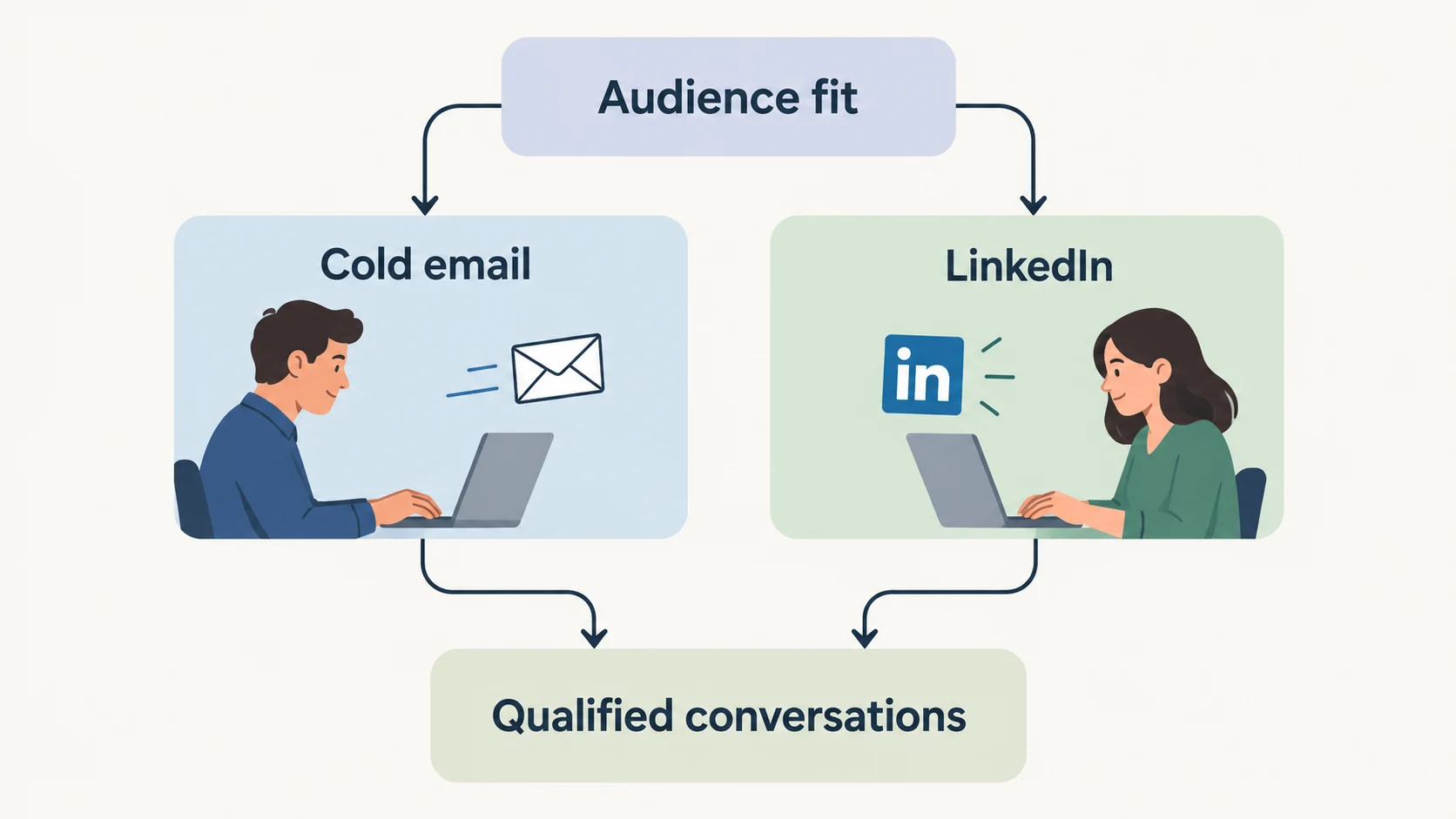
Cold email vs LinkedIn is the wrong question. Both channels work. But they work differently, cost differently, and scale differently. Cold email delivers 3-5x more volume at 60-80% lower cost per lead. LinkedIn delivers higher-intent conversations with decision-makers who are already in buying mode. The data says the best UK B2B teams in 2026 use both — cold email for pipeline volume, LinkedIn for relationship-driven enterprise deals. This article gives you the numbers, the frameworks, and the strategy to deploy each channel where it actually performs.
The Debate That Wastes More Time Than It Should
Every quarter, the same argument surfaces in UK B2B circles. Someone posts on LinkedIn claiming cold email is dead. Someone else fires back with a screenshot showing a 47% reply rate from their latest sequence. Both are telling the truth — for their specific context.
The real question is not which channel is "better." It is which channel fits your business model, your average deal size, your team capacity, and your compliance requirements.
We have run cold email vs LinkedIn campaigns side by side for UK businesses across legal, accounting, trades, dental, and technology sectors. The data tells a clear story — and it is more nuanced than either camp wants to admit.
Let us break it down.
Response Rates: The Numbers That Actually Matter
Cold Email Response Rates in 2026
Industry benchmarks for UK B2B cold email in 2026 show average reply rates between 3% and 8% for well-executed campaigns. That sounds low until you consider the volume. Sending 200 cold emails per day across three sending domains gives you 6-16 replies daily. Scale that across a month and you are looking at 120-320 conversations from a single channel.
The top-performing campaigns we see through SCALeMAIL — with AI-driven personalisation, proper domain warming, and ICP-matched lists — push reply rates to 12-18%. That is exceptional, but achievable when every variable is optimised.
LinkedIn Response Rates in 2026
LinkedIn connection request acceptance rates sit between 25% and 40% for personalised requests. But acceptance is not the same as a conversation. Of those who accept, only 15-25% respond to a follow-up message. That puts your effective response rate at roughly 4-10% — similar to cold email on paper.
The difference is what happens after the response. LinkedIn conversations tend to be warmer. The prospect has seen your profile, your content, your mutual connections. They have context. Cold email replies, by contrast, often start with "Who are you and how did you get my email?" — which means your first reply needs to do heavier lifting. For prospects who engaged previously but went quiet, ReFlow can re-engage warm leads through targeted database reactivation before you resort to fully cold outreach.
Head-to-Head Comparison
| Metric | Cold Email | LinkedIn Outreach |
|---|---|---|
| Daily outreach volume | 150-300 per domain | 80-100 connection requests |
| Average reply rate | 3-8% (12-18% optimised) | 4-10% effective |
| Time to first reply | 1-3 days | 3-7 days |
| Conversation warmth | Cold to lukewarm | Warm |
| Compliance complexity | PECR/GDPR (moderate) | Platform ToS (low) |
| Automation potential | High | Limited by LinkedIn restrictions |
Cost Per Lead: Where Cold Email Pulls Ahead
This is where cold email vs LinkedIn stops being a debate and starts being arithmetic.
Cold Email Economics
Running a professional cold email operation in 2026 costs approximately:
- Sending domains (3): £30/month
- Email infrastructure (warmup, rotation): £100-200/month
- Data/list building: £200-500/month
- AI personalisation tooling: £100-300/month
- Total: £430-1,030/month
At 200 emails per day across three domains, that is roughly 4,000-6,000 emails per month. With a 5% reply rate and 30% qualification rate, you are generating 60-90 qualified conversations for £430-1,030. That puts your cost per qualified lead at £5-17.
If you outsource to a service like SCALeMAIL, the economics shift but remain compelling — typically £997-2,500/month for a fully managed system that delivers 20-50 qualified leads.
LinkedIn Economics
LinkedIn outreach costs break down differently:
- Sales Navigator: £60-80/month
- Automation tool (if used): £50-150/month
- Content creation time: 5-10 hours/month (or £500-1,500 outsourced)
- Manual outreach time: 1-2 hours/day
- Total: £110-1,730/month (excluding time)
At 80 connection requests per day, you send roughly 1,600-2,000 per month. With a 30% acceptance rate and 20% message response rate, you get 96-120 conversations. But the time investment is brutal. Each LinkedIn conversation requires manual nurturing — you cannot automate DM sequences without risking account restrictions.
Factor in the time cost (even at £50/hour for a junior SDR), and LinkedIn's cost per lead climbs to £30-80 — three to five times higher than cold email.
| Channel | Monthly Cost | Leads/Month | Cost Per Lead |
|---|---|---|---|
| Cold email (in-house) | £430-1,030 | 60-90 | £5-17 |
| Cold email (managed) | £997-2,500 | 20-50 | £20-125 |
| LinkedIn (in-house) | £110-230 + time | 30-50 | £30-80 |
| LinkedIn (outsourced) | £1,500-3,000 | 25-40 | £38-120 |
Scalability: The Factor Most People Ignore
Here is where cold email vs LinkedIn becomes a strategic decision rather than a tactical one.
Cold email scales linearly. Add more sending domains, add more volume. Go from 200 emails per day to 1,000. The infrastructure cost increases marginally. The output increases proportionally. You can reach 20,000 prospects per month without adding headcount.
LinkedIn does not scale. You are capped at roughly 100 connection requests per day per account. You can run multiple accounts, but LinkedIn actively detects and restricts this behaviour. Every additional account adds compliance risk and management overhead.
For UK SMEs targeting a broad market — say, all dental practices in the Midlands, or all law firms with 5-50 employees — cold email is the only channel that can cover the addressable market in a reasonable timeframe.
For businesses targeting a narrow, high-value segment — say, the 200 largest construction firms in the UK — LinkedIn's depth beats cold email's breadth. You want to build relationships with those 200 decision-makers over months, not blast them with a template.
Compliance: UK-Specific Considerations
Cold Email Compliance
B2B cold email in the UK is legal under PECR regulation 22, provided you meet specific conditions. You must be emailing someone in their professional capacity, at a business email address, about a product or service relevant to their role. You must include your business identity, valid postal address, and a clear opt-out mechanism.
The full breakdown is in our guide: Is Cold Email Legal in the UK? PECR, GDPR and B2B Exemptions Explained.
GDPR adds a layer — you need a lawful basis for processing (legitimate interest is the most common for B2B cold email), and you must be able to demonstrate that basis if challenged.
It is manageable, but it requires proper setup. Get it wrong and the ICO can fine you up to £17.5 million or 4% of annual global turnover under updated PECR enforcement, aligned with UK GDPR penalty levels.
LinkedIn Compliance
LinkedIn outreach has no direct regulatory compliance burden beyond GDPR (you are processing personal data when you view profiles and send messages). But LinkedIn's own Terms of Service restrict automated outreach, mass messaging, and scraping. Violate them and your account gets restricted or banned.
The irony: LinkedIn is less legally complex but more operationally fragile. Lose your account and you lose your network, your content history, and your social proof. There is no backup.
When to Use Cold Email
Cold email vs LinkedIn is not an either/or. But there are clear signals for when cold email should be your primary channel:
- Your target market exceeds 1,000 businesses. Cold email covers ground faster than any other outbound channel.
- Your average deal size is £1,000-£20,000. The economics work because you do not need high-touch relationship building to close.
- You have a clear ICP. Cold email works when you can define exactly who you are targeting by industry, company size, role, and location. (Need help? Read our guide on Building Your Ideal Customer Profile for Cold Email.)
- You want predictable pipeline. Cold email delivers consistent lead flow once the system is tuned. LinkedIn is more variable.
- Your team is small. Cold email can be automated end-to-end. LinkedIn requires daily manual effort.
When to Use LinkedIn
LinkedIn earns its place when:
- Your target market is narrow and high-value. Fewer than 500 target accounts, with deal sizes above £20,000.
- You sell to C-suite executives. CEOs, CFOs, and Managing Directors are more responsive on LinkedIn than email — they have gatekeepers filtering their inbox but check LinkedIn personally.
- Your product requires education. LinkedIn's content platform lets you demonstrate expertise before the outreach even begins.
- You are building a personal brand. If thought leadership is part of your strategy, LinkedIn compounds over time in a way cold email cannot.
- You are in professional services. Law firms, consultancies, and accounting practices often respond better to LinkedIn because peer-to-peer credibility matters.
The Hybrid Strategy: Why the Best Teams Use Both
The most effective UK B2B teams in 2026 do not choose cold email vs LinkedIn. They orchestrate both channels into a unified outreach sequence.
Here is how a hybrid sequence works:
Day 1: Send a cold email introducing your value proposition. Keep it short — three sentences, one question.
Day 3: Connect on LinkedIn with a personalised note referencing something specific about their business (not a pitch).
Day 5: Follow-up email with a case study or data point relevant to their industry.
Day 8: Engage with their LinkedIn content — comment on a post, share an article they published.
Day 12: Second follow-up email. Different angle, different value.
Day 15: LinkedIn message referencing the email thread. "Sent you a note last week about X — curious if it landed?"
This multi-channel approach increases total response rates by 28-40% compared to single-channel outreach. The prospect sees your name in two places, which builds familiarity without being intrusive.
At Ampliflow, we build these sequences through SCALeMAIL for the email layer and advise on LinkedIn strategy alongside. Amplio ties the channels together — syncing email threads, LinkedIn conversations, and inbound calls into a single communications layer so your team never loses context when a prospect moves between channels. When combined with AmpliSearch — so your website actually converts the traffic these conversations generate — the entire pipeline becomes a system rather than a series of one-off efforts.
AI Changes the Equation
The cold email vs LinkedIn debate looked very different two years ago. AI has shifted the balance in cold email's favour for three reasons:
1. Personalisation at scale. AI can write genuinely personalised opening lines for 500 prospects in minutes. Each email references the prospect's company, recent news, or a specific pain point. This was impossible manually — and it is what separates a 3% reply rate from a 15% one.
2. Deliverability intelligence. AI monitors inbox placement, adjusts sending patterns, and rotates domains before deliverability degrades. The technical complexity that used to require a dedicated ops person is now handled by software. Read more in our Cold Email Deliverability in 2026 guide.
3. Lead scoring and prioritisation. AI analyses reply sentiment in real time — distinguishing "interested, send more info" from "not now, check back in Q3" from "remove me." This means your sales team only speaks to genuinely qualified prospects.
LinkedIn has not seen the same AI uplift. Automation is restricted by the platform, personalisation is harder to scale within DMs, and there is no equivalent of inbox deliverability optimisation.
For the full breakdown of how AI transforms cold email economics, read our pillar guide: Cold Email Lead Generation for UK Businesses: The 2026 Playbook.
What the Data Says: Our Clients' Results
Across campaigns we have managed for UK B2B businesses in 2026, here is where the channels land:
| Metric | Cold Email (SCALeMAIL) | LinkedIn (Manual) | Hybrid (Both) |
|---|---|---|---|
| Avg. cost per qualified lead | £12-22 | £35-75 | £18-30 |
| Avg. time to first meeting | 8 days | 14 days | 6 days |
| Avg. reply rate | 8-15% | 6-10% | 12-18% (combined) |
| Monthly qualified leads (per rep) | 25-45 | 10-20 | 30-55 |
| Setup time | 2-3 weeks | 1 week | 3-4 weeks |
| Scalability ceiling | Very high | Low-medium | High |
The hybrid approach consistently outperforms either channel alone. But if you had to choose one — and many SMEs do, because resources are finite — cold email delivers more pipeline per pound spent.
How to Decide: A Simple Framework
Answer these four questions:
- How many target accounts do you have? Under 500 = LinkedIn-first. Over 500 = cold email-first.
- What is your average deal size? Under £5,000 = cold email. Over £20,000 = LinkedIn. £5,000-£20,000 = hybrid.
- How many hours per day can you dedicate to outreach? Under 1 hour = cold email (automate it). Over 2 hours = LinkedIn is viable.
- Do you have a content engine? If you are publishing regularly, LinkedIn amplifies that. If not, cold email works without content.
If you are unsure where to start, book a free audit and we will analyse your market, your ICP, and your current pipeline to recommend the right channel mix.
Key Takeaways
- Cold email vs LinkedIn is a false binary — the best UK B2B teams use both channels strategically.
- Cold email delivers 3-5x more volume at 60-80% lower cost per lead than LinkedIn outreach.
- LinkedIn wins for narrow, high-value markets where relationship depth matters more than reach.
- A hybrid multi-channel sequence increases response rates by 28-40% compared to single-channel outreach.
- AI has shifted the balance towards cold email by enabling personalisation at scale, deliverability intelligence, and automated lead scoring. For a broader look at how AI is reshaping B2B outreach, see How AI Is Changing B2B Lead Generation in 2026. If you are building a broader B2B growth strategy beyond outreach, our guide on AI for business growth in the UK covers the full landscape.
- Compliance is manageable for both channels — cold email requires PECR/GDPR setup, LinkedIn requires platform ToS adherence.
- The deciding factors are market size, deal size, team capacity, and whether you have a content engine.
Frequently Asked Questions
Is cold email more effective than LinkedIn for UK B2B lead generation?
For most UK SMEs, cold email delivers more leads at lower cost. It scales better, automates more completely, and reaches prospects who are not active on LinkedIn. However, LinkedIn outperforms for enterprise deals above £20,000 where relationship building is essential. The data supports using both channels together for optimal results.
Can I automate LinkedIn outreach like I automate cold email?
Technically, yes — tools exist for LinkedIn automation. Practically, LinkedIn actively detects and restricts automated behaviour. Accounts that automate connection requests and messages risk temporary or permanent bans. Cold email automation, by contrast, is standard practice and fully supported by the infrastructure. We recommend manual LinkedIn outreach paired with automated cold email via SCALeMAIL.
What is the average cost per lead for cold email vs LinkedIn in the UK?
Based on 2026 data across our client base, cold email delivers qualified leads at £5-22 each (depending on whether you run it in-house or use a managed service). LinkedIn outreach costs £35-80 per qualified lead when you factor in time investment. A hybrid approach typically lands at £18-30 per lead. For a deeper cost analysis across all channels, see our guide on The True Cost of Lead Generation in the UK.
How do I know which channel to start with?
Start with cold email if your target market exceeds 500 businesses, your deal size is under £20,000, and you want results within 30 days. Start with LinkedIn if you are targeting fewer than 200 high-value accounts and you have time to invest in daily manual outreach. If you have the resources, start both simultaneously with a coordinated hybrid sequence. Contact our team for a personalised channel recommendation.
Is it legal to scrape LinkedIn for cold email outreach?
No. Scraping LinkedIn profiles to extract email addresses violates LinkedIn's Terms of Service and potentially GDPR. Use legitimate B2B data providers that source email addresses through compliant methods. Your cold email lists should be built from Companies House data, industry directories, and GDPR-compliant data enrichment services — never from LinkedIn scraping. For full legal guidance, see Is Cold Email Legal in the UK?.