Does Your Business Need an llms.txt File? A UK Guide (2026)
Co-founder of Ampliflow. Builds AI automation, websites, SEO/AEO, and growth systems for UK SMEs.
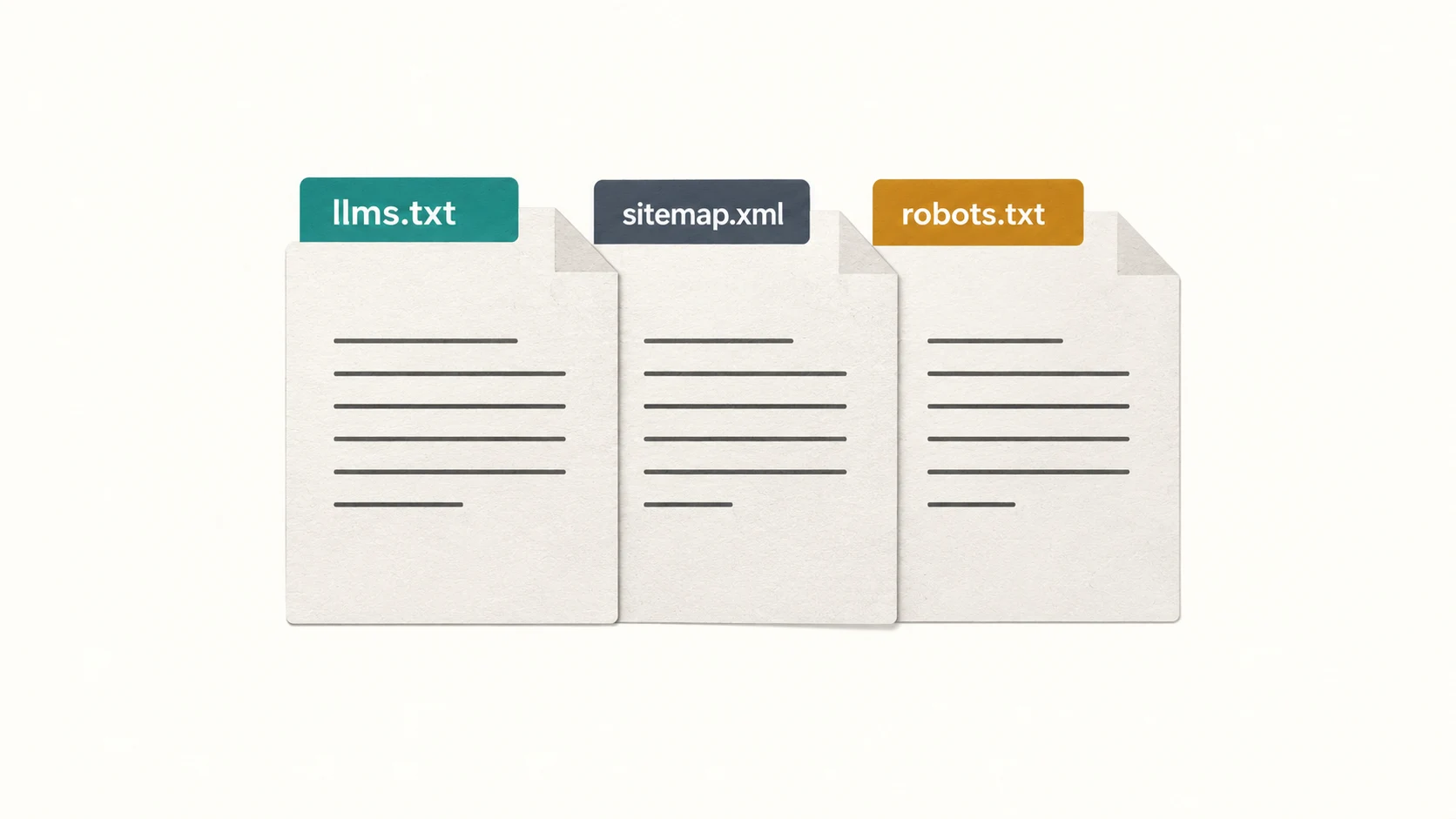
An llms.txt file is an optional Markdown guide to selected pages for consumers that choose to read it. A missing file is not an SEO fault, and Google says it ignores the file for Search visibility and ranking. This guide explains the proposal and when maintaining one may have a practical use.
Originally reviewed in June 2026 · Covers the llms.txt proposal and how it differs from robots.txt and sitemap.xml · Platform behaviour should be checked against current documentation
TL;DR:
- An llms.txt file is a curated, human-readable map of your best content for AI models — not a sitemap, not robots.txt, and not a ranking trick.
- It exists because models read context windows, not whole websites — a clean map saves them from parsing your navigation, cookie banners and JavaScript to find the one thing they need.
- The honest part most vendors bury: no major AI provider has confirmed it reads the file. Its SEO or AEO payoff is unproven, full stop.
- Add it only for a specific use. It needs maintenance and does not replace fixing the public website.
- Treat it as hygiene, not magic. If anyone sells you "llms.txt optimisation" as a citation guarantee, walk away.
An llms.txt file is a curated map of your best content, not another sitemap
An llms.txt file is a single plain-text file, placed at the root of your domain (yourbusiness.co.uk/llms.txt), that tells an AI model what matters on your site and where to find it. It is written in Markdown: a heading with your company name, a one-line summary, then sections of links — each with a short description of what the page covers and why it is worth reading.
The idea came from Jeremy Howard, co-founder of Answer.AI and fast.ai, who proposed the format in 2024 and published the specification at llmstxt.org. His argument was simple. A web page is built for a browser — full of menus, banners, scripts and styling that a language model has to wade through to reach the actual content. An llms.txt file strips all of that away and hands the model the signal directly.
Think of it as the curated reading list you would give a sharp new hire on their first day. Not every document you have ever produced — the ten or twenty things they actually need to understand the business.
The proposed distinction is curation: an llms.txt file describes selected content, while an XML sitemap helps search engines discover preferred URLs. A sitemap should not indiscriminately list every URL the site can generate.
It exists because models read context windows, not whole websites
To understand why the file emerged, you have to understand the constraint it solves. A language model does not browse your site the way a person does. When it answers a question, it works inside a fixed context window — a finite budget of text it can hold in memory at once.
Feed it your raw HTML and most of that budget is spent on cookie notices, navigation and tracking scripts before it reaches a single useful sentence. Feed it a clean Markdown map and every token earns its place.
Our LLM SEO guide covers discoverability and content clarity. An optional file cannot replace accessible pages or establish that a search product will use its summary.
There is a fuller variant too. Some sites also publish llms-full.txt — the same map, but with the complete content of each page inlined, so a model can ingest everything in one fetch. The short file is the index; the full file is the whole library.
What llms.txt does — and the part nobody can promise yet
For a consumer that actually reads it, the file can provide a short description and links. Its accuracy and value depend on maintenance and the consumer’s behaviour. Those benefits should not be assumed without checking use.
Here is what it does not do, and the part most vendors will not lead with.
Publishing a file is not evidence that a search system uses it. Google now explicitly says it ignores llms.txt for Search visibility and ranking. For another platform or documentation consumer, check its current guidance and actual use before assigning the file any value.
Google’s current documentation is a stronger basis for this decision than an old social-media comment. Do not sell the file as a route to Google rankings or AI Overview inclusion.
Build the file when someone or something has a clear use for it. Fix a confusing service page or broken enquiry route first.
A missing llms.txt is not an SEO fault. If you choose to maintain one, keep it accurate and public-only, and define how you will know whether it is being used.
llms.txt, robots.txt and sitemap.xml solve three different problems
The fastest way to see what llms.txt is is to put it next to the two files it gets confused with. They share a home — the root of your domain — and nothing else. Different audiences, different jobs, different formats.
robots.txt gives crawler instructions; it is not authentication or permission enforcement. A sitemap lists preferred URLs for discovery. llms.txt is an optional described shortlist. Neither a sitemap nor an llms.txt file needs to live at the domain root in every system, though the root is the proposed convention for llms.txt.
| File | Purpose | Important limit |
|---|---|---|
| llms.txt | Optional described links for consumers that choose to read them | Google ignores it for Search ranking |
| robots.txt | Instructions for compliant crawlers | Not authentication or a privacy control |
| XML sitemap | Preferred URLs for discovery | Does not guarantee indexing; need not list every generated URL |
If you maintain the file, keep the selection and descriptions purposeful. Do not put private material in it or expect it to change Search ranking.
How to write a good llms.txt in an afternoon
You do not need a developer or a tool. You need judgement about what matters.
- List your 10–30 essential URLs. Your core services, your two or three best guides, your pricing, your about page, your contact route. The pages you would send a serious prospect, not the long tail.
- Open a plain-text file. Start with a level-one heading —
# Your Company— then a single blockquote line summarising what you do and where you are. - Group the links under `##` section headings. Sensible groups: Services, Key Guides, Key Facts, Contact. Each link is one line:
- [Clear label](https://full-url): one honest sentence on what it covers. - Write the descriptions like a person, for a person. Specific and truthful. "24/7 AI receptionist that answers calls and books jobs" beats "innovative solutions for your needs." This is a curation exercise, not a keyword dump.
- Save it as `llms.txt` and serve it at your root, with the content type
text/plain. That is the whole technical requirement. - Keep it in sync. Review the file when services, URLs or facts change. Automated generation can help, but it still needs checks for stale descriptions and broken links.
What a working llms.txt looks like in production
Ampliflow publishes an example at ampliflow.ai/llms.txt. Treat it as an implementation example, not evidence that a search engine reads it or that it is always current. Check its actual contents against the live pages before relying on a detail.
A maintained file should describe only public facts and link to the pages that substantiate them. Avoid duplicating prices or service claims without a process to keep them aligned.
Do not copy another site’s crawler policy as a shortcut. Search, training and user-requested retrieval have different purposes, and a description in llms.txt does not enforce any of those controls.
An optional briefing should stay accurate and serve a defined reader or system. Publishing it is not proof of adoption.
So does your UK business actually need one?
Most businesses do not need one for search visibility. The practical question is whether a known user, agent or documentation workflow benefits enough to justify maintaining it.
Prioritise accessible pages, accurate information and a working enquiry journey. Add or retain an llms.txt only when a defined consumer or workflow justifies the maintenance. See the LLM SEO fundamentals for that wider work.
Frequently asked questions
Is llms.txt the same as robots.txt?
No. robots.txt gives crawler instructions; it is not a security control. llms.txt provides optional guidance to consumers that choose to read it. A website does not need both to appear in Google Search.
Do ChatGPT, Claude or Gemini actually read llms.txt?
Do not assume routine consumption by a product simply because its provider publishes an llms.txt file. Verify the current product documentation or an observed request. Google specifically says the file does not affect Search visibility.
Where exactly do I put the file?
At the root of your domain, served as plain text: yourbusiness.co.uk/llms.txt. That is the convention, mirroring robots.txt. No sub-folders, no special headers beyond a text/plain content type.
What is the difference between llms.txt and llms-full.txt?
llms.txt is the index — headings and described links to your key pages. llms-full.txt is the same map with the full text of those pages inlined, so a model can ingest everything in a single fetch. Publish the short one first; add the full one only if your content genuinely warrants it.
Will an llms.txt file improve my SEO or AI rankings?
Google explicitly says llms.txt neither helps nor harms Search visibility or rankings because Search ignores it. Any claimed effect in another AI product needs separate evidence. Prioritise accurate, accessible pages and relevant links.
How often should I update it?
Review it when important content changes, including services, flagship articles and moved URLs. Automated generation can reduce manual work but does not guarantee that every description remains correct.
My business is small. Is it worth the effort?
Only if there is a specific use and someone will maintain it. Otherwise, spend the time improving the service explanation, evidence or enquiry journey. The crawler and content fundamentals come first.
Related reading
- ↑ From SEO to AEO: How UK Businesses Can Dominate AI-Powered Search — the pillar guide and the wider framework
- ↔ LLM SEO: Optimise for ChatGPT, Claude & Gemini — the fundamentals llms.txt sits on top of
- ↔ What Is Answer Engine Optimisation (AEO)? — the foundational definition
- ↔ Generative Engine Optimisation (GEO): The Complete UK Guide — the research and the deep tactics
- ↔ What AI Search Actually Cites for UK Business Queries (2026 Data) — our original 45-query benchmark
- ↔ The Technical SEO Audit Checklist for UK Businesses — where robots.txt, sitemaps and crawlability fit
- ↔ The AEO Checklist: 12 Moves to Get Cited by AI — llms.txt is one item; here is the rest
Start by checking what is already there
Check whether the file exists and, if it does, whether it is accurate. A 404 at that address is not a search problem to fix by default.
Get unstuck → — start with a clarity chat about the business problem. A focused audit, where appropriate, should prioritise the website and search evidence before optional files.
A clear description of the business helps in many places. Put that clarity into the pages buyers actually use, and keep an optional map only when it has a defined job.