Is Your Business Invisible to ChatGPT? A 2026 UK Guide to AI Citation Audits
Co-founder of Ampliflow. Builds AI automation, websites, SEO/AEO, and growth systems for UK SMEs.
Google rankings remain an important measure of search visibility. AI recommendations are another place to investigate when customers use them to research services.
A buyer may ask ChatGPT, Gemini, Claude, Perplexity or Google AI Overviews about a service before visiting a website. A missing mention in one response does not establish that your business is invisible. Repeated, well-recorded checks can reveal questions and sources worth investigating.
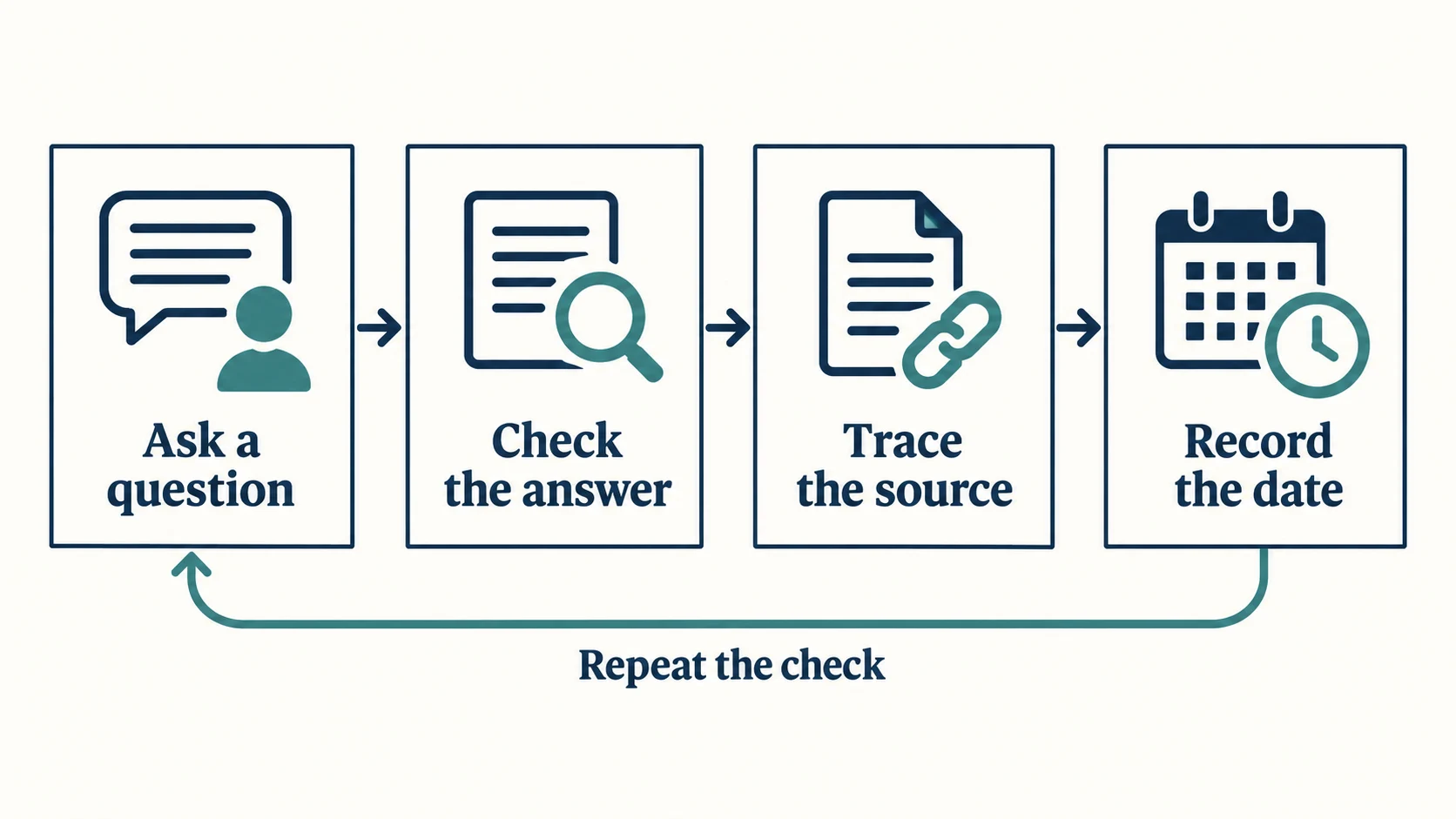
This guide shows you how to run a practical AI citation audit yourself. The method records what appeared, under which conditions and what a business owner can do with the findings.
If you do not have time to run it, there is a done-for-you option at the end. But the process here is fully actionable on your own.
What “invisible” looks like in AI search
You can be invisible in AI search even when your SEO looks healthy.
A pattern to investigate:
- You still rank for some commercial terms on Google
- Branded search volume looks stable
- Website traffic has not collapsed
- Yet, AI engines rarely mention your brand in recommendation-style answers
A missing citation has several possible explanations: the question, search mode, available sources, location and variation between responses. Site quality and accurate business information are worth checking, but an AI output does not reveal a ranking formula.
Google says its normal SEO practices remain relevant to AI Overviews and AI Mode, with no special optimisation or schema requirement. Eligibility does not guarantee appearance. See Google's guidance on AI features.
Ranking helps people discover the site, but it does not guarantee a particular AI citation.
Which engines to include in a UK citation audit
Choose the surfaces your buyers use or that you have a reason to investigate. A starting set could include ChatGPT, Gemini, Claude, Perplexity and Google Search's AI features.
Record each surface separately. Google AI Overviews, AI Mode and the Gemini app are not interchangeable reports. Note the product, available search mode and whether the answer actually consulted web sources. If a feature is unavailable, record that rather than treating it as a failed citation.
You do not need to test everything at once. Keep the first set manageable and expand when the findings justify the work.
What to measure (before you collect anything)
A citation audit needs repeatable observations, not just one favourable answer.
Track these five metrics for each engine:
- Presence rate: In how many target queries is your brand mentioned at all?
- Citation rate: In how many queries is your site used as a cited source?
- Placement: Where does the mention appear? Record it descriptively; list order is not a stable search ranking.
- Accuracy quality: Are statements about your business correct?
- Competitor share: Which competitors are cited more often than you?
Report the number of observations behind each rate and keep mentions separate from linked citations. Connect the findings with referral visits, qualified enquiries and won work where those can be measured. A mention alone is not a lead.
Build a query set that reflects buyer questions
A few ad hoc prompts can suggest questions to investigate, but they do not establish market visibility.
As a planning example, start with 24 prompts:
- 8 commercial intent prompts
- 8 comparison/prominence prompts
- 8 trust and proof prompts
Commercial intent prompts (examples)
- “Best AI SEO agency for UK SMEs”
- “Who can improve AI search visibility for law firms in the UK?”
- “Best agency for answer engine optimisation UK”
- “How to improve visibility in ChatGPT results for a UK business”
Comparison prompts (examples)
- “Ampliflow vs other UK AI SEO agencies”
- “Best alternatives to traditional SEO agencies for AI search”
- “Top agencies for GEO and AEO in the UK”
- “Who is better for AI citation growth in the UK: in-house or agency?”
Trust and proof prompts (examples)
- “Which UK agencies publish real case studies for AI visibility work?”
- “How can I verify if an agency can improve AI citations?”
- “What should an AI visibility report include?”
- “How do I audit whether my brand is visible on ChatGPT?”
Tune the questions to actual customer language, search evidence and sales conversations. Twenty-four is a manageable example, not an SEO requirement. Keep branded comparisons separate from unbranded discovery prompts: naming Ampliflow in the question biases the chance of a mention.
A practical worksheet format
Create a sheet with these columns:
- Query
- Intent type
- Engine
- Date/time
- Your brand mentioned (Y/N)
- Your domain cited (Y/N)
- Competitors mentioned
- Competitor domains cited
- Accuracy notes
- Short relevant excerpt or evidence reference
- Action owner
- Priority
- Product/model, mode, account state and location
- Whether web search or an AI summary appeared
- Prompt group, repeat number and any unavailable result
Keep the original observations so someone else can inspect the result and repeat the method.
How to run the audit step by step
Step 1: Freeze your prompt list and conditions
Run the same prompts on the same day, with the same phrasing. If you change prompts, record a new version and keep that result separate from the original comparison.
Set these rules:
- Use UK spelling and UK context in prompts
- Run all engines within a short time window
- Record product, mode, date, location and any account/personalisation differences
- Use a fresh conversation for each independent prompt
- Record outputs immediately
- Do not “improve” prompts mid-run
Consistency is more valuable than clever prompting.
Step 2: Run ChatGPT checks
Use your 24 prompts. For each result, record:
- Is your brand named?
- Is your website cited?
- Is description accurate?
- Which competitors are positioned above you?
Example query and response method
Query example:
“Best agencies in the UK for improving visibility in ChatGPT and Perplexity.”
What to record:
- Mention list order
- Whether your brand appears
- Whether a direct source is cited
- Any incorrect claims
If results vary across re-runs, note volatility rather than picking your preferred output.
Step 3: Run Claude checks
Use the same observation rules for Claude and record whether web search was available and used. Keep Gemini or any additional surface in its own set of rows rather than merging unlike outputs.
Look for:
- Recommendation presence
- Category placement (are you in the right service category?)
- Confidence language (“specialises in”, “appears to”, “likely”)
If a response repeatedly describes your category incorrectly, compare the cited material with your current public information. An incorrect answer is a finding to investigate, not proof of a specific defect in your positioning.
Step 4: Run Perplexity checks
Where Perplexity provides linked sources, inspect the actual page behind each citation. A link can be present without supporting the associated claim.
Record:
- Whether your domain is in cited links
- How frequently competitor domains recur
- Which page types are cited (homepage, service page, blog, directory)
If directories dominate, inspect why those pages fit the question. It could reflect the request for a comparison rather than a fault in your site structure. Do not create unnecessary pages or buy directory placements on that observation alone.
Step 5: Run Google AI Overviews checks
For each query, note:
- Whether AI Overview appears
- If your brand is named in the summary
- If your domain appears in cited links
- Which domains dominate citations
Google AI Overviews can differ by query phrasing and local context, so use your frozen prompt list and capture evidence carefully.
Step 6: Record your baseline
Report raw counts and rates separately for each product, mode and prompt group. For example: brand mentioned in 3 of 24 recorded unbranded responses. This is an illustrative calculation, not Ampliflow's result or the share of all customer searches.
For citation rate, state whether the denominator is all valid observations or only answers that showed source links. Record missing AI summaries and unavailable responses separately. Use the same definitions on the next run.
Do not average these into an unexplained score out of 100 or label a high score a competitive moat. A small prompt sample cannot establish that. Our AI search measurement framework connects these observations to commercial outcomes.
Patterns to look for in a first audit
Look for patterns such as these; they are diagnostic examples, not findings from a claimed client dataset:
- Brand appears in branded prompts, disappears in category prompts.
- Blog posts may get cited, service pages do not.
- Competitor comparison queries are dominated by directories.
- AI engines describe the business too broadly (“marketing agency”) rather than specifically (“AI visibility and citation optimisation”).
- Claims in AI outputs are partly outdated because site content is stale.
None of this requires panic. It requires focused cleanup.
What to check when your business is absent
Use a missing mention as a reason to investigate. The following checks can improve accuracy and usability, but none proves why an engine omitted a brand.
1) Entity ambiguity
Your brand, services, and category descriptors are inconsistent.
Symptoms:
- Different service names across pages
- Inconsistent descriptions between site and social profiles
- Conflicting trading names, addresses or service areas
Fix:
- Standardise naming across key pages
- Use one clear primary category descriptor
- Keep core entity facts consistent site-wide
2) Weak service page specificity
Many service pages read like broad brochure copy.
Symptoms:
- No concrete outcomes
- No clear scope or explanation of limitations
- No obvious use cases
- No structured question-answer content
Fix:
- Explain the service and its approved scope
- State timing only where the business can substantiate it
- Add industry-specific use cases
- Add FAQ blocks with plain-language answers
Our AI search optimisation service is an example of the type of commercial page a buyer needs: what the work covers, who it suits and the next step.
3) Thin evidence layer
Verifiable evidence helps a reader assess a claim and gives a cited answer something that can be checked. It does not guarantee selection by an AI system.
Symptoms:
- Few specific figures
- No case detail
- No linked source context
Fix:
- Add evidence-backed claims
- Publish stronger case-study pages
- Use clear before/after frameworks
If you run a technical knowledge product, pages like Company Cortex should include concrete implementation patterns, not just feature language.
4) Poor internal topic structure
A reader should be able to move from an explanation to the relevant service, proof or next question.
Symptoms:
- Isolated blog posts with weak internal linking
- No clear cluster hierarchy
- Important pages are hard to discover
Fix:
- Build tighter internal links between pillar and cluster content
- Link service pages from relevant educational content
- Keep anchor language specific and intentional
5) Schema and machine-readability gaps
Check crawl access, indexability, visible page content and descriptive internal links. These help search engines discover and understand the site.
Structured data should be accurate and match visible content. Google does not require special schema or an AI-specific file for inclusion in its AI Search features. Adding FAQ markup is not a shortcut to citations.
Prioritise a working, informative page over a checklist of markup types.
DIY citation check process you can run every month
Choose a review interval that gives the team time to implement and observe changes.
Monthly review cycle
- Run your saved prompt set across the selected surfaces, using recorded conditions.
- Update the counts, rates and evidence notes.
- Highlight top 5 missed commercial queries.
- For each missed query, identify the top cited competitor source.
- Improve one relevant page or section per query.
- Re-run those 5 queries after content update.
Allow time for crawling and changes in source selection. Repeat checks can show movement, but neither a monthly cycle nor a content update guarantees higher visibility.
How to write pages a buyer can assess
Use this practical structure on key commercial pages:
- Clear claim: What exactly do you do?
- Who it is for: Industry and business type specificity.
- Evidence block: Verified examples and sources, with limitations stated.
- Method block: A concise “how it works.”
- FAQ block: Direct answers to decision-stage questions.
This is an editorial structure for clarity, not a published AI ranking formula.
Example: turning a vague section into a citable section
Weak:
“We help businesses grow with AI and automation.”
Stronger:
“We check how your business appears in a defined set of AI answers, record the sources and identify inaccurate information or gaps worth addressing.”
Why stronger works:
- The task is clear
- The observation has a defined scope
- Findings can be checked
- There is no promised citation gain or invented delivery window
Handling engine variance without overreacting
AI outputs can vary by day and phrasing. That does not make auditing pointless.
Treat variance as a feature of the system, then design around it:
- Use fixed prompts
- Track trends, not one-off wins
- Record multiple runs for high-stakes prompts
- Focus on repeated gaps
If your brand is consistently absent across repeated runs, that is a real signal.
Real example queries and how to interpret them
Below are practical checks you can use immediately. These are methodological examples. Run them yourself in your own environment to capture current outputs and timestamps.
Query set A: category discovery
Prompt:
“Best UK agencies for AI citation visibility.”
Interpretation framework:
- If competitors are cited and you are absent, inspect their cited page types.
- If listicles dominate, consider whether the question is seeking a comparison before changing your own pages.
- If your brand appears but is generic, fix category clarity.
Query set B: buyer intent
Prompt:
“How do I know if my business is visible on ChatGPT?”
Interpretation framework:
- Are you cited as a source for the method?
- Does the response point to practical frameworks you can own?
- If not, publish stronger how-to content.
Query set C: comparison intent
Prompt:
“What should an AI visibility report include beyond a technical SEO review?”
Interpretation framework:
- Are your product distinctions understood?
- If AI conflates offers, improve disambiguation blocks and offer pages.
- Ensure pricing and scope differences are explicit.
A clear AI search optimisation service page helps a buyer understand the work offered, its scope and the next step. It does not guarantee inclusion in an AI answer.
Common mistakes that waste months
- Publishing more content without improving core page quality.
- Chasing prompt hacks instead of entity clarity and evidence.
- Measuring only mentions, not citation quality.
- Ignoring competitor citation patterns.
- Treating one positive output as strategic success.
More pages do not guarantee visibility. Prioritise accurate information, distinct buyer questions and evidence you can support.
A 30-day sprint plan
Here is an illustrative work plan. Adjust the scope to team capacity and protect existing ranking pages before editing:
Week 1
- Run full baseline audit
- Record counts and rates for each surface
- Pick top 5 missed commercial queries
Week 2
- Improve 2 core service pages
- Add clear FAQ sections
- Tighten entity and offer descriptions
Week 3
- Address an evidenced comparison gap on the best existing page
- Add a separate educational page only where the intent is distinct
- Strengthen internal links across cluster pages
Week 4
- Re-run top 10 queries
- Compare counts, rates and supporting evidence
- Prioritise next month’s top 5 opportunities
Four weeks is a planning period, not a promise of indexing, citations or enquiries.
How to report outcomes to leadership
Keep reporting simple and commercial:
- Baseline counts and rates versus the current observations
- Presence rate change by engine
- Citation wins on high-intent queries
- Top competitor movement
- Qualified enquiries, won work and the next action plan
Leadership does not need AI theory. They need visibility trend, opportunity, and next actions.
Should you do this in-house or buy a report?
Do it in-house if:
- You have a content owner and a technical owner
- You can run monthly cycles consistently
- You can implement page changes quickly
Use a paid audit if:
- You need a fast baseline with external benchmarking
- Internal bandwidth is low
- You want a focused action plan with implementation priority
Both routes can work. Choose based on the evidence you need and who will implement the findings.
A final checklist you can copy
Before you finish your first audit, confirm you have:
- A saved prompt set reflecting real buyer questions
- Recorded conditions for each chosen surface
- Baseline counts and rates with clear denominators
- Competitor citation map
- Top 5 missed commercial queries
- A 30-day implementation plan
These records let the next review compare like with like.
Bottom line
In 2026, visibility is no longer just ranking position. It is citation presence inside AI answers where buyers make early decisions.
If your brand is absent from the questions you tested, investigate the sources and your commercial pages. Check referral and enquiry evidence before attributing a sales problem to AI visibility.
Before changing content, establish a repeatable baseline with our AI search visibility measurement framework. It separates prompt coverage, mention rate, citation quality, owned-site signals and commercial outcomes instead of collapsing them into one vanity score.
The fix is practical:
- Audit citations consistently
- Tighten entity clarity
- Improve evidence and structure on core pages
- Re-run monthly and iterate
Keep the work tied to accurate answers and a clear route from relevant interest to an enquiry.
If you want help understanding the gaps, bring the site and the buyer questions you want it to answer. Get unstuck →.