How to Compare Website Design Quotes in the UK
Two website quotes can describe five pages and still buy completely different work.
One includes writing, photography selection, redirects and testing where enquiries arrive. The other includes a layout and a form. Neither price tells you that on its own.
This guide helps you compare the work, responsibility and total cost before you choose. For Ampliflow's current starting prices and the difference between one-off work and monthly plans, use our UK website cost guide.
Give every supplier the same brief
Start with the customer task. A visitor needs to find a service, decide whether you are suitable and contact the right person. An association member may need to update a listing or find an event instead. Write those tasks down before discussing page count.
Include your current URL, the pages that matter, the content you already have, the systems that must connect and who will maintain the site. Say what is missing. If nobody has written the service descriptions, that is work the quote must account for.
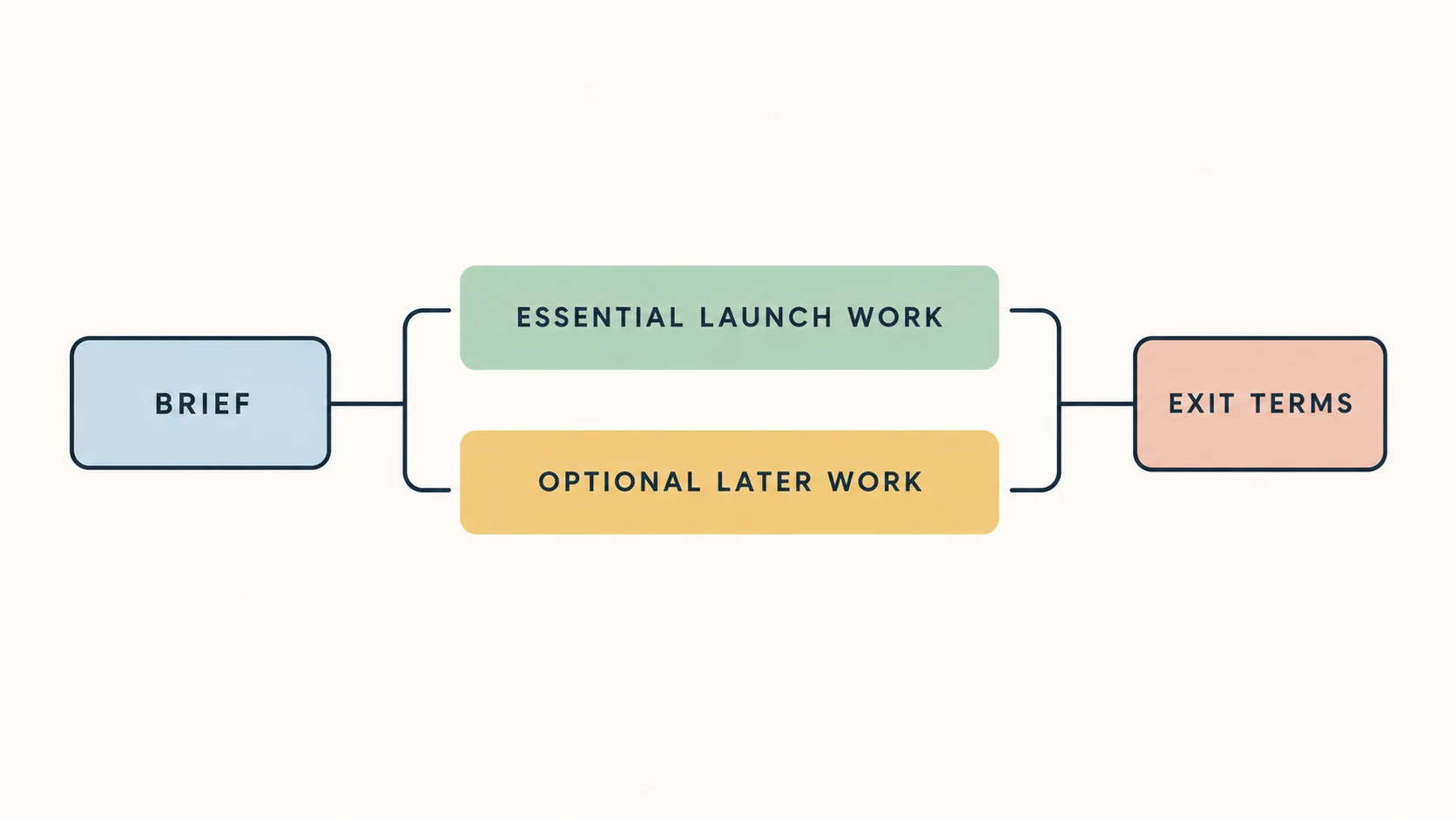
Ask each supplier to separate essential launch work from optional later work. This makes a smaller proposal a deliberate choice rather than an unexplained omission.
Compare these eight lines
| Quote line | What to establish before signing |
|---|---|
| Content | Who writes, edits and approves the words? Who supplies licensed images? |
| Design | Which page types and mobile states are included? How are revisions agreed? |
| Functionality | What exactly must forms, bookings, payments or member areas do? |
| Existing search traffic | Which URLs stay, which move and who checks redirects? |
| Enquiry delivery | Where does a submission go, and how is successful receipt tested? |
| Editing | What can your team change, with which permissions and training? |
| Ongoing responsibility | Who handles hosting, faults, content updates and connected subscriptions? |
| Exit | What access, content, assets and code can you take away, and on what terms? |
Avoid answers such as "SEO included" or "fully optimised" without a deliverable. A title and sitemap are different work from researching service demand, restructuring pages and measuring enquiries after launch.
A worked comparison: two offers that are not equivalent
The following example is illustrative, not an Ampliflow package or a competitor quote.
Offer A includes five designed pages and a contact form. You supply final copy and images. Changes after launch are quoted separately.
Offer B includes the same five pages, a content review, mapping old URLs, testing form receipt, editor training and a defined period of support.
You cannot judge the price difference until you decide whether those additional tasks are needed and who would otherwise do them. Offer A may be sufficient when you have the material, access and skills already. Offer B may reduce work for your team. Neither description proves the supplier will execute well.
Ask both suppliers to demonstrate a comparable task on work they are authorised to show. A beautiful screenshot does not prove that editing, booking or enquiry delivery works.
Use real functionality to test the scope
The Kings Heath Business Association project illustrates why a website brief can extend beyond pages: business discovery, events and participation each create different journeys. Our association website guide explains the delivered functionality and shows the evidence.
For a similar project, ask a supplier to walk through updating a member's opening hours, changing an event date and checking the public result on a phone. Establish which tasks staff can complete and which need development support.
This is evidence of functionality, not a claim that a particular website produced a particular revenue increase.
Compare ongoing costs over the same period
Put setup costs, recurring fees, usage charges, optional services and exit costs in separate rows. Confirm the billing period, minimum commitment and whether VAT is included. Do not assume any of those terms from a headline price.
A simple comparison is:
Total over the chosen period = setup + recurring fees + expected usage + agreed extras.
Record your team's likely maintenance work separately. An estimate of staff time is useful, but it is not an invoice or a guaranteed saving.
Compare the same scope and period. A subscription that includes ongoing work is not equivalent to a one-off build followed by no support. A one-off build is not automatically cheaper or more expensive over its lifetime.
Ampliflow's website service and pricing explain the current routes. Ask us to confirm your requirements and exclusions before treating a starting price as your project price.
Calculate payback using the money left after costs
If you use a payback estimate, subtract the costs of delivering the additional work. A £1,000 sale is not £1,000 available to recover the website investment.
For illustration only, a £3,000 investment and £300 left after the costs of delivering each additional sale would require ten such sales to recover the initial cost. At £150 per sale, it would require twenty. This is before overheads, tax and ongoing website costs. These are arithmetic scenarios, not forecasts.
You also need to establish whether those sales were additional and whether the website caused them. Record genuine enquiries, qualified conversations and won work; do not count spam, tests or button clicks as customers.
Agree what acceptance looks like
Before launch, agree who checks the main journeys and who signs them off. Test on a real phone, with a keyboard and with realistic content. Submit a labelled test enquiry and confirm it reaches the intended destination. Check a failure state as well as a successful one.
For an existing site, keep a list of important URLs and verify their replacements. Google's site move guidance explains redirect and monitoring considerations. A redesign is not a promise that rankings will rise or stay unchanged.
Questions buyers ask
Should I choose the cheapest quote?
Choose the lowest-cost proposal that credibly covers the required work and responsibilities. Price alone cannot tell you whether a proposal is complete or whether the supplier can deliver it.
Is custom development always better than a builder?
No. The right choice depends on editing needs, integrations, portability, cost and implementation quality. Use our Wix, Squarespace and custom comparison to frame those checks.
Can a supplier guarantee Google or AI-search visibility?
A supplier can commit to specified work and reporting. Rankings and inclusion in AI answers are outside its control. Google says its AI search features use the established SEO foundations and do not require special AI markup.
Bring the brief, not just the budget
If you have a quote or an existing website, tell us what needs to work better and what your team can manage itself. We can discuss whether the requirement fits our website work and identify the scope that needs confirming.