Seven SEO Agency Red Flags: Vague Reports, Guarantees and AI Upsells
A practical guide to spotting SEO agency red flags in proposals, contracts and reports, with questions that distinguish risk from reasonable trade-offs.
Co-founder of Ampliflow. Builds AI automation, websites, SEO/AEO, and growth systems for UK SMEs.
- 01The seven red flags at a glance
- 02Contract warning signs
- 03Pricing warning signs
- 04Green flags
- 05Buy accountable work, not certainty theatre
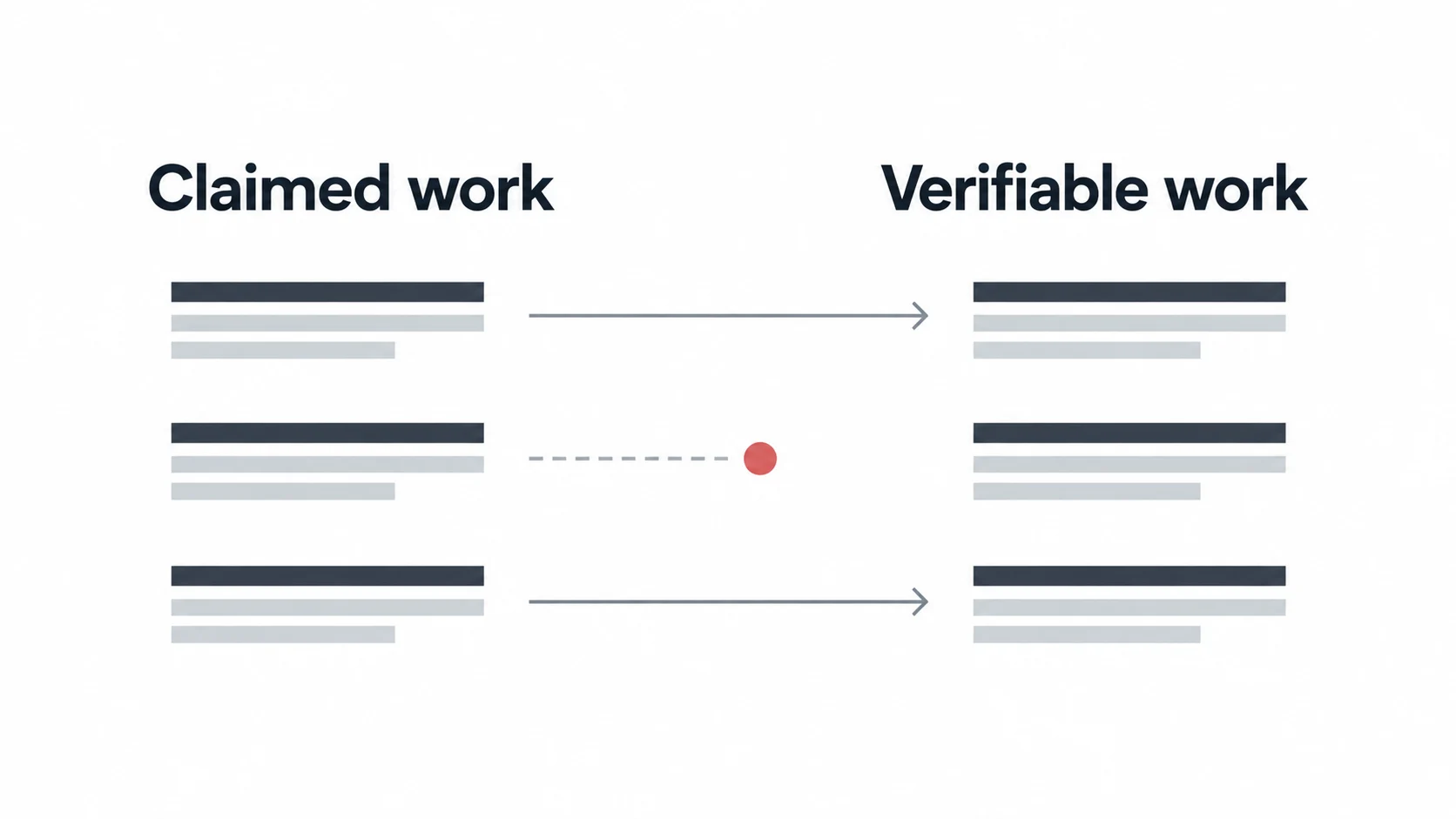
The clearest SEO agency red flag is a promise detached from work you can inspect.
Guaranteed rankings, a fixed number of backlinks, twenty articles a month and a proprietary AI visibility score all sound concrete. They are often concrete in the wrong place. The agency can control its research, implementation, checks and communication. It cannot control Google's rankings or an answer engine's recommendation.
Use these seven red flags to test the operating model behind the pitch—not to reject every agency that uses a tool, contract or package.
Checked: 14 July 2026 · UK buyer guide · Organic rankings and AI citations cannot be guaranteed
The seven red flags at a glance
- 01Guaranteed first-page or number-one rankings
- 02The monthly deliverable is “ongoing optimisation”
- 03Backlinks sold by quantity
- 04Content is sold by word or article count
- 05The agency controls all accounts and data
- 06The report is full of movement and empty of decisions
- 07“AEO” is an unexplained surcharge
| Red flag | What it hides | What to ask instead |
|---|---|---|
| 1. Guaranteed rankings | A result the agency does not control | Which work and quality checks do you guarantee? |
| 2. Vague deliverables | No way to verify monthly value | What will change in 30, 60 and 90 days? |
| 3. Backlinks sold by count | Relevance, quality and risk | Show source standards and example reasoning |
| 4. Content sold by volume | Thin, overlapping pages | Which buyer questions lack a clear owner? |
| 5. Locked accounts and data | Dependency and weak exit | Which assets and access do we own? |
| 6. Vanity reporting | Activity without commercial learning | Which qualified actions and decisions changed? |
| 7. Undefined AI/AEO upsell | Renamed SEO foundations | Which additional research and implementation are new? |
One weak answer may be fixable. Several reveal how the agency makes money.
Red flag 1: guaranteed first-page or number-one rankings
Google's own SEO Starter Guide says there is no secret that automatically ranks a site first. Search results change with competition, intent, location, systems and the quality of the wider web.
An agency can reasonably commit to:
- completing an agreed technical review;
- implementing named changes;
- producing and editing work to a standard;
- documenting sources and decisions;
- reporting transparently;
- maintaining access and communication;
- correcting its own defects.
It cannot guarantee Google's selection.
The disguised version
“We guarantee page one for ten keywords” may use low-volume or irrelevant phrases the agency chooses. A ranking no buyer searches or no suitable customer clicks is not protection.
Ask:
Which business result is this query connected to, and what happens if search intent changes?
Red flag 2: the monthly deliverable is “ongoing optimisation”
SEO is ongoing. The work should still be nameable.
A credible first quarter could state:
Month 1
- establish technical, search and commercial baselines;
- repair indexability or tracking blockers;
- improve the highest-value existing commercial page;
- produce an ordered implementation queue.
Month 2
- implement agreed technical work;
- strengthen service-page structure, proof and internal linking;
- create one distinct high-intent page where a real gap exists;
- begin relevant authority work.
Month 3
- review page-query movement and qualified actions;
- refresh pages gaining impressions;
- consolidate overlap;
- document the next quarter from evidence.
The sequence will differ. “Optimise website and build authority” is not enough to govern.
Reasonable flexibility is not vagueness
An agency should adapt when data changes. The contract can define capacity, priorities and decision cadence without pretending the exact task list is known twelve months ahead.
Ask for the next 30 days in detail and the next 90 days as hypotheses.
Red flag 3: backlinks sold by quantity
“Fifty high-DA links a month” tells you almost nothing about relevance, editorial reason, traffic, placement, ownership or risk.
Questions:
- Why would this site link to this page?
- Is the placement editorially earned, contributed, sponsored or bought?
- Is the source relevant to our customers or evidence?
- Can we see examples with client details removed?
- Are paid or sponsored relationships disclosed appropriately?
- What happens if the link disappears?
- Does the agency control a network of the sites?
- Which page deserves authority, and why?
A smaller number of genuine industry references can be more useful than hundreds of interchangeable posts.
What healthy authority work looks like
- original data or research;
- useful tools and templates;
- expert commentary;
- relevant partnerships;
- accurate professional or local profiles;
- strong documentation others need to reference;
- digital PR attached to a real story.
Authority is the result of having something worth corroborating.
Red flag 4: content is sold by word or article count
Publishing volume is easy to invoice. Search architecture is harder.
Before agreeing to twelve articles, ask:
- Which specific buyer questions do they own?
- Which current page ranks or receives impressions for each question?
- Could an existing page be improved instead?
- How is overlap checked across the full site?
- Which subject expert supplies the evidence?
- What makes each piece more useful than the current results?
- Which internal and commercial pages will it support?
- What is the refresh trigger?
Thin content is not defined only by length. A long article can be thin when it repeats common advice, invents certainty and adds no decision support.
AI-assisted writing is not the red flag
AI can support research organisation, drafting, comparison and editing. The red flag is unaccountable publication: no factual owner, no sources, no original evidence, no cannibalisation check and no editorial judgement.
Red flag 5: the agency controls all accounts and data
The business should retain administrator ownership of:
- domain and DNS;
- website and CMS;
- Google Search Console;
- analytics and tag manager;
- Google Business Profile;
- Merchant Center where relevant;
- advertising accounts;
- reporting exports;
- content and approved source files;
- outreach and placement records appropriate to the contract.
Agency access is normal. Agency-only ownership is unnecessary leverage.
Ask for the offboarding process before signing. It should cover access removal, exports, scheduled work, documentation and transition support.
Be wary of the proprietary dashboard trap
A useful dashboard can save time. It should not be the only place the evidence exists. You need access to source platforms and exportable data when the subscription ends.
Red flag 6: the report is full of movement and empty of decisions
Rankings, impressions, clicks and technical scores are diagnostic. They are not automatically value.
A useful monthly report answers:
- What shipped?
- What changed in search discovery?
- Which pages and query groups moved?
- Which qualified actions changed?
- What tracking limitations exist?
- What did the team learn?
- What will it stop, continue or test next?
- What does the client need to provide?
If the report celebrates 200 “keywords up” while the service pages and enquiries are absent, it is measuring the easiest story.
Traffic can rise while value falls
A broad informational article may attract global students while a commercial service page loses UK visibility. Segment by market, intent, landing page and action.
Google's guidance for hiring an SEO recommends asking what results to expect, in what timeframe, how success is measured and how changes will be communicated. Use those questions in the pitch and the monthly review.
Red flag 7: “AEO” is an unexplained surcharge
AI-assisted search deserves attention. It does not justify charging twice for the same crawling, content and structured-data work.
Google says standard SEO best practices remain relevant to AI Overviews and AI Mode, with no special schema or AI file required. Legitimate additional work may include:
- a controlled prompt and citation baseline;
- entity and factual consistency review;
- analysis of sources appearing in AI answers;
- content designed around comparison, suitability and evidence gaps;
- OAI-SearchBot and other relevant crawler-policy checks;
- referral and assisted-conversion measurement;
- original proof and source development.
Ask the agency to separate existing SEO, genuinely additional AEO work and shared implementation. Our AEO pricing guide provides planning bands and deliverables.
The llms.txt shortcut
Installing an experimental text file and declaring the site “AI-optimised” is not a programme. Google explicitly says it does not require special AI text files for its AI features. Inspect the crawlable site, evidence and external sources first.
Contract warning signs
Review:
- a long minimum term before any diagnostic work;
- automatic renewal with a narrow cancellation window;
- the agency retaining ownership of content or accounts;
- no approval requirement for website changes;
- undisclosed paid placements;
- no data-processing or access boundary;
- unlimited work language paired with no capacity;
- broad right to publish case-study data without approval;
- no process for leaving.
A six- or twelve-month engagement is not itself a red flag. Search work can need implementation and observation time. The concern is lock-in without milestones, access or accountable scope.
Pricing warning signs
Suspiciously cheap, impossibly broad
£300 a month can fund a narrow local brief. It cannot credibly fund national technical SEO, weekly expert articles, digital PR, daily AI monitoring and senior strategy. Ask what the provider deliberately excludes.
Expensive, still vague
Price is not proof of depth. A £5,000 retainer should show what additional research, production, implementation, authority or stakeholder support the budget buys.
Use SEO agency cost UK to compare what £500, £1,500 and £3,000 monthly scopes can reasonably contain.
Green flags
- diagnoses before proposing;
- shows raw evidence behind summaries;
- protects client ownership and access;
- distinguishes recommendations from implementation;
- gives a short prioritised queue;
- checks existing pages before creating new ones;
- explains uncertainty and tracking limits;
- names what it will not do at the budget;
- connects work to suitable customer actions;
- is comfortable recommending a smaller scope.
The strongest providers reduce noise.
Frequently asked questions
Are SEO guarantees always a scam?
A provider can guarantee its work, checks and communication. It cannot guarantee a ranking controlled by a search engine. Treat guaranteed positions or traffic as a serious warning.
Is a 12-month SEO contract a red flag?
Not automatically. It becomes risky when there are no milestones, cancellation route, account ownership or transparent deliverables. A diagnostic phase can reduce fit risk before a longer commitment.
Is link building bad?
No. Earning relevant citations and links is valuable. Buying quantity without editorial reason, relevance or disclosure creates risk. Ask how each tactic produces something worth referencing.
Should an SEO agency use AI?
It can use AI as a production and analysis tool. Human experts should own facts, strategy, originality, approval and publication quality.
How do I check an SEO report?
Start with work shipped, page-query groups, qualified actions, source-platform access and next decisions. Ask to see raw Search Console or analytics evidence behind summary charts.
Buy accountable work, not certainty theatre
The best agency cannot promise the search engine's decision. It can make its own decisions, work and evidence unusually clear. That is the standard to hold.
Related: SEO agency cost UK · Choose an AI search agency · Technical SEO audit checklist · AI search optimisation