n8n vs Zapier vs Make: A Practical UK SME Comparison
Compare n8n, Zapier and Make by billing model, workflow complexity, ownership and data protection, with a simple decision guide for UK SMEs.
Co-founder of Ampliflow. Builds AI automation, websites, SEO/AEO, and growth systems for UK SMEs.
- 01The short answer
- 02The billing model changes the answer
- 03What is Zapier best at?
- 04What is Make best at?
- 05What is n8n best at?
n8n, Zapier and Make all connect applications and move data between them. The visible feature lists overlap. The differences appear when a workflow becomes busy, branches into several paths or needs an owner who can diagnose it.
For most UK SMEs, the choice comes down to four things: who will maintain the automation, how the platform counts usage, how much technical control is needed and what data the workflow handles.
The short answer
| Choose | When it is usually the best fit |
|---|---|
| Zapier | A non-technical team wants common integrations and a quick, linear setup |
| Make | A visual builder needs branching, transformation and clearer flow inspection |
| n8n | A technical owner wants deeper control, code steps or a self-hosted option |
Treat this as a fit comparison rather than a quality ranking. A simple automation owned by an operations team may be better in Zapier than in a self-hosted n8n instance nobody maintains.
The billing model changes the answer
The three platforms count work differently.
- Zapier generally counts successful actions as tasks. A workflow with several action steps can consume several tasks each time it runs.
- Make uses credits for module actions. Branches, searches and repeated operations can increase consumption.
- n8n Cloud prices around workflow executions rather than every individual step. n8n also offers a self-hosted Community Edition, where you operate the infrastructure.
That means a headline monthly price is not a cost comparison. Model a real workflow:
textmonthly events
× average billable actions or executions
+ premium connectors
+ data transfer and storage
+ maintenance time
+ monitoring and incident response
Use the live n8n, Zapier and Make pricing pages for a quote. Plans, limits and currencies change.
What is Zapier best at?
Zapier is often the shortest route from “when this happens” to “do that”. It has a broad integration catalogue and an interface many non-technical teams can operate.
It is a strong choice when:
- the workflow is short and linear;
- the applications already have good Zapier integrations;
- the operations team, not a developer, will own it;
- rapid setup matters more than low-level control.
Watch for task consumption in multi-step or high-volume workflows. Also check whether the exact trigger and action fields you need are available; an application logo in the catalogue does not guarantee the required operation.
What is Make best at?
Make's visual scenarios make branching and data transformation easier to see. That is useful when a workflow filters, routes or reshapes records before sending them elsewhere.
It is a strong choice when:
- the team thinks naturally in visual flows;
- a scenario has several branches;
- you need to inspect bundles and transformations;
- the workflow is too involved for a short trigger-action chain.
The visual canvas can still become difficult to govern. Agree naming, error routes and ownership before a scenario grows into an undocumented map.
What is n8n best at?
n8n suits teams that want more control over logic, credentials and deployment. It supports code steps and can be self-hosted, which can matter for integration design or network access.
It is a strong choice when:
- a technical owner will maintain it;
- workflows need custom logic or APIs;
- execution-based pricing fits long multi-step flows;
- a self-hosted deployment has a clear operational reason.
Self-hosting is not “free automation”. You still own updates, backups, secrets, monitoring, availability and incident response. If nobody owns those duties, n8n Cloud or another managed platform may cost less overall.
The UK data-protection questions
No platform choice makes a workflow GDPR-compliant by itself. The answer depends on the personal data, purpose, lawful basis, processors, contracts, retention and transfers in the actual design.
Before choosing, map:
- the fields entering each step;
- where they are processed and stored;
- how long run history is retained;
- which team members can see credentials and payloads;
- what happens when a person requests access, correction or deletion;
- which subprocessors and international-transfer safeguards apply.
Self-hosting one component does not keep data in the UK if the connected CRM, model or messaging provider processes it elsewhere.
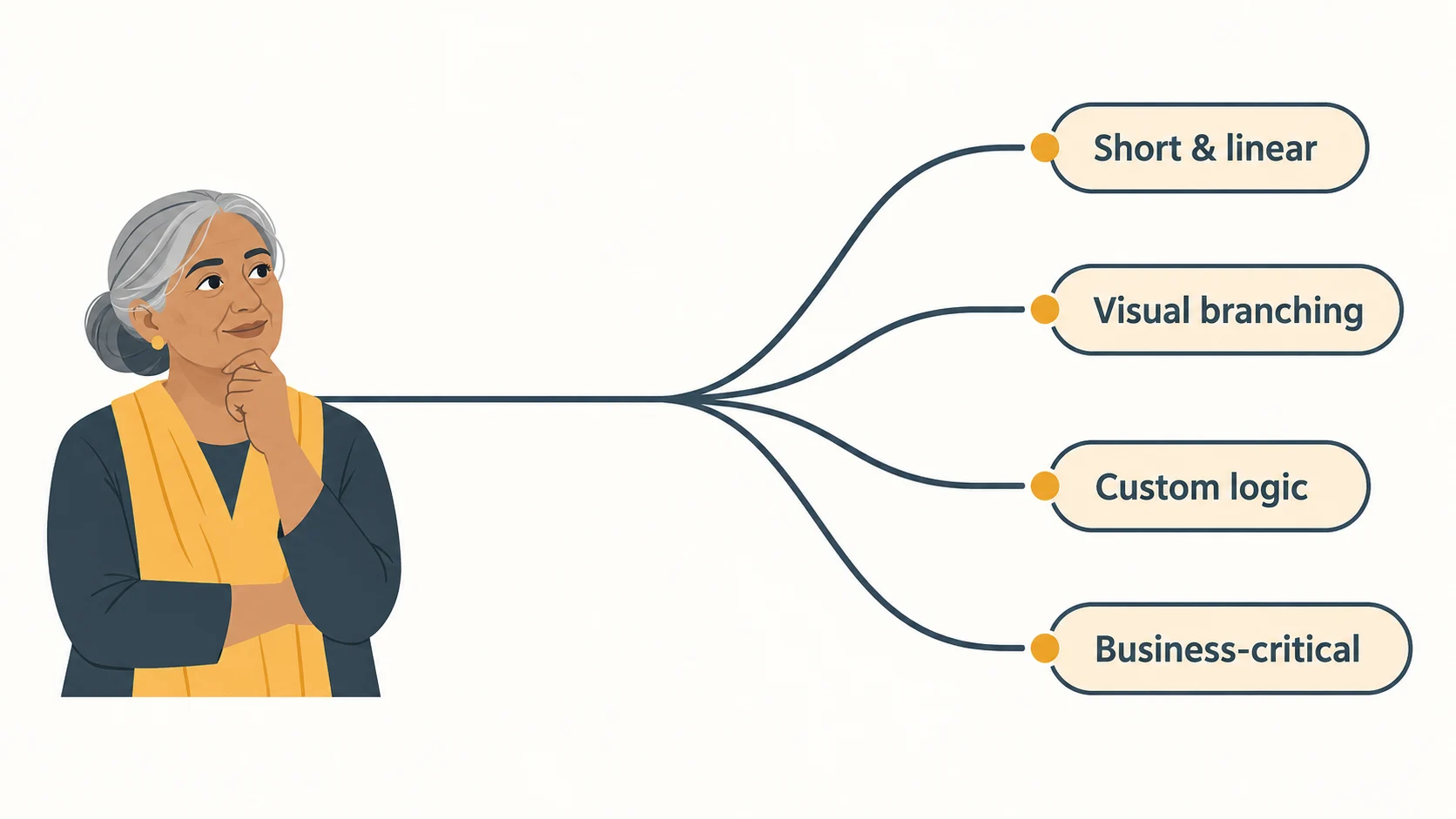
A decision tree for UK SMEs
- 01Zapier — quick managed workflows
- 02Make — visual branching and transformation
- 03n8n — technical control and custom logic
- 04Normal code — critical fixed integrations
Start with Zapier when
The workflow is common, the team is non-technical and a fast managed setup matters most.
Start with Make when
The workflow needs visual branching or transformation and the owner wants to inspect the path without writing code.
Start with n8n when
A technical owner needs custom APIs, code steps, network control or execution-based economics.
Start with ordinary code when
The integration is business-critical, tightly specified and better expressed as a small tested service. A visual automation platform is not compulsory.
Test before choosing
Build the same representative workflow in the two strongest candidates. Include the awkward parts, not only the happy path:
- missing and duplicated data;
- authentication expiry;
- rate limits;
- retries and idempotency;
- a partial failure after one system has changed;
- monitoring and manual replay;
- export and handover.
Record build time, monthly usage under realistic volume and who could fix it on a bad Monday morning.
Frequently asked questions
Is n8n cheaper than Zapier or Make?
Sometimes. It depends on volume, step count, plan limits and the cost of operating it. Compare a real workflow rather than entry prices.
Is self-hosted n8n better for GDPR?
It can give more infrastructure control, but compliance depends on the whole data flow and your operational controls. It is not an automatic legal answer.
Which platform is easiest?
Zapier is often easiest for short common workflows. Make can be clearer for visual branching. n8n usually rewards greater technical ownership.
Can these platforms run AI workflows?
Yes, but the same rule applies: use AI only where interpretation is needed. Keep fixed validation, permissions and irreversible actions deterministic.
Related reading
- AI automation for UK SMEs
- How to choose an AI automation agency
- Make vs Power Automate for UK businesses — a narrower comparison for Microsoft-centred workflows.
If the tools all look plausible but the ownership model does not, Get unstuck.