Hermes Agent for Content Production: An Approval-Led Workflow
How to use Hermes Agent for content research, drafting and repurposing while keeping evidence, brand judgement and publication under human control.
Co-founder of Ampliflow. Builds AI automation, websites, SEO/AEO, and growth systems for UK SMEs.
- 01Where Hermes fits in content production
- 02The approval-led workflow
- 03Repurposing without multiplying mistakes
- 04What to automate and what to keep human
- 05How to measure the workflow
Hermes Agent can turn a clear brief into research notes, a draft and channel variations. The useful pattern is not unattended publishing. It is a controlled production line where the agent handles repeatable preparation and a named person owns evidence, voice and release.
That boundary matters. Content can make legal, commercial and reputational claims. A fluent draft is not proof that the claims are true or that the organisation has approved them.
Where Hermes fits in content production
Hermes is an agent with tools, skills and scheduled workflows. Its official social content calendar skill separates planning and drafting from approval and publishing authority.
For a small content team, Hermes can help with:
- turning an approved topic into a research checklist;
- collecting source material into a structured brief;
- drafting an article against a fixed outline;
- producing social variants from an approved source article;
- checking required fields, links and channel limits;
- placing drafts into a review queue.
It should not decide what the business sells, invent customer evidence or publish because a schedule reached a certain time.
The approval-led workflow
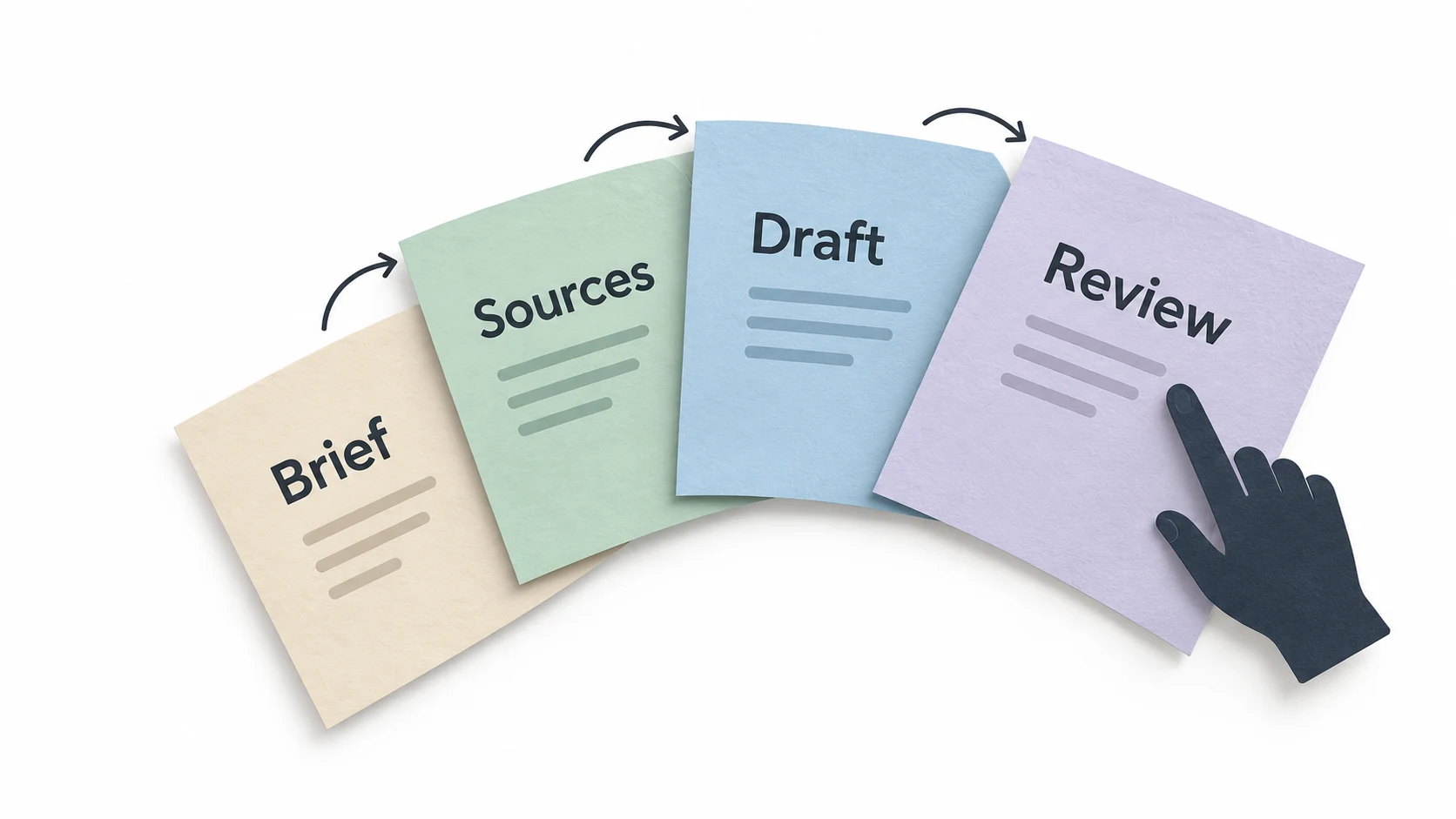
- 01Freeze the brief
- 02Build the source pack
- 03Draft to a content contract
- 04Run human editorial review
- 05Approve before publication
1. Freeze the brief
Give the agent a bounded job:
- audience and search intent;
- the question the page must answer;
- sources it may treat as authoritative;
- claims that require evidence;
- words, topics and commercial facts it must not invent;
- final format and reviewer.
If the brief is vague, the agent will spend tokens producing plausible choices the team has not made.
2. Build the source pack
Collect primary sources first: official documentation, legislation, regulator guidance, first-party measurements and named research with a visible method.
For every material claim, retain:
| Field | Purpose |
|---|---|
| Claim | The statement the draft may make |
| Source | The page or dataset that supports it |
| Date | Whether the evidence is still current |
| Scope | What the evidence does and does not cover |
| Owner | Who will approve its use |
Search snippets are discovery aids, not evidence. The agent should open the source.
3. Draft to a content contract
A reusable Hermes skill can encode the format and quality checks. Keep the contract concrete:
markdown## Required

- Answer the reader's main question in the opening.
- Use British English.
- Link material claims to primary sources.
- Preserve approved product and commercial wording.
- Mark missing evidence instead of guessing.

## Forbidden

- Invented results, clients, prices or timelines.
- Legal-compliance guarantees.
- Private credentials, paths or operating details.
- Publication or external messaging without approval.
The skill should remove repeatable ambiguity. It should not become a substitute for a clear brief.
4. Run a human editorial review
The reviewer checks four different things:
- Truth: does each material statement match its source?
- Usefulness: does the article help the reader decide or act?
- Voice: does it sound like the business, not a generic model?
- Risk: are legal, privacy, safety and commercial claims properly bounded?
Editing only for grammar misses the point. The hardest failures are usually confident claims, weak reasoning and hidden assumptions.
5. Separate approval from publication
A draft can pass editorial review and still be unapproved for publication. Record:
- the approved version;
- approver and time;
- destination channels;
- publication window;
- whether links and media were checked;
- rollback or correction owner.
If no publishing connector or authority exists, the workflow ends at an approved draft. That is a complete and useful outcome.
Repurposing without multiplying mistakes
Create channel variants only after the source article is approved. Otherwise one unsupported claim becomes a blog post, email, LinkedIn post and video script before anyone catches it.
The safe sequence is:
textapproved evidence
→ approved source article
→ channel-specific drafts
→ channel review
→ deliberate publication
Each channel still needs its own check. An email has consent and unsubscribe considerations. A social post has space and context limits. A video may need spoken qualifications that were obvious in the article.
What to automate and what to keep human
| Automate or assist | Keep under named human ownership |
|---|---|
| Outline assembly | Editorial position |
| Source-field extraction | Source quality judgement |
| First draft | Commercial facts and promises |
| Link and format checks | Legal and regulatory interpretation |
| Channel variants | Brand voice approval |
| Review-queue routing | Publication and correction |
This division is not anti-automation. It puts automation where consistency helps and human judgement where consequences live.
How to measure the workflow
Do not measure success by word count. Track:
- time from approved brief to review-ready draft;
- percentage of claims with acceptable sources;
- reviewer corrections by category;
- rejected drafts and why;
- organic impressions, qualified visits and enquiries after publication;
- correction or rollback incidents;
- cost per approved article, including review time.
If review time rises because the agent creates more weak material, the workflow has not improved.
When not to use Hermes for content
Avoid the pattern when there is no source owner, no reviewer or no stable editorial standard. It is also a poor fit for urgent crisis statements, bespoke legal advice or sensitive announcements where authorship and accountability must stay tightly controlled.
A good template and a human writer may be the better tool for occasional content. Add an agent when the repeated workflow is real.
Frequently asked questions
Can Hermes publish content automatically?
It can be connected to publishing tools, but technical capability is not approval. Keep publication behind recorded authority and a deliberate release step.
Does Hermes replace an editor?
No. It can prepare and transform material. A human still owns evidence, judgement, brand and release.
How much content should it produce?
Only as much as the team can source, review and maintain. A smaller set of accurate articles is more valuable than an overflowing draft queue.
Should the agent learn from reviewer edits?
Turn stable corrections into explicit instructions or tests. Do not assume an unattended agent has absorbed feedback unless the system demonstrably stores and applies it.
Related reading
- Hermes Agent skills for custom extensions
- Hermes Agent monitoring and reliability
- What is Hermes Agent?
If your draft pipeline is moving faster than your evidence and approvals, Get unstuck.