AI Consulting for Small Businesses: The UK Founder's Guide (2026)
A practical guide for UK small businesses considering AI consulting: what consultants do, when outside help fits, how to compare scope and what to measure.
Co-founder of Ampliflow. Builds AI automation, websites, SEO/AEO, and growth systems for UK SMEs.
- 011) What AI Consulting Actually Means for a Small Business
- 022) 8 Signs Your Small Business Needs AI Consulting
- 033) 5 Signs You Do Not Need AI Consulting (Yet)
- 044) What Does AI Consulting Cost for UK Small Businesses?
- 05How to Vet an AI Business Consultant Without Getting Burned
TL;DR
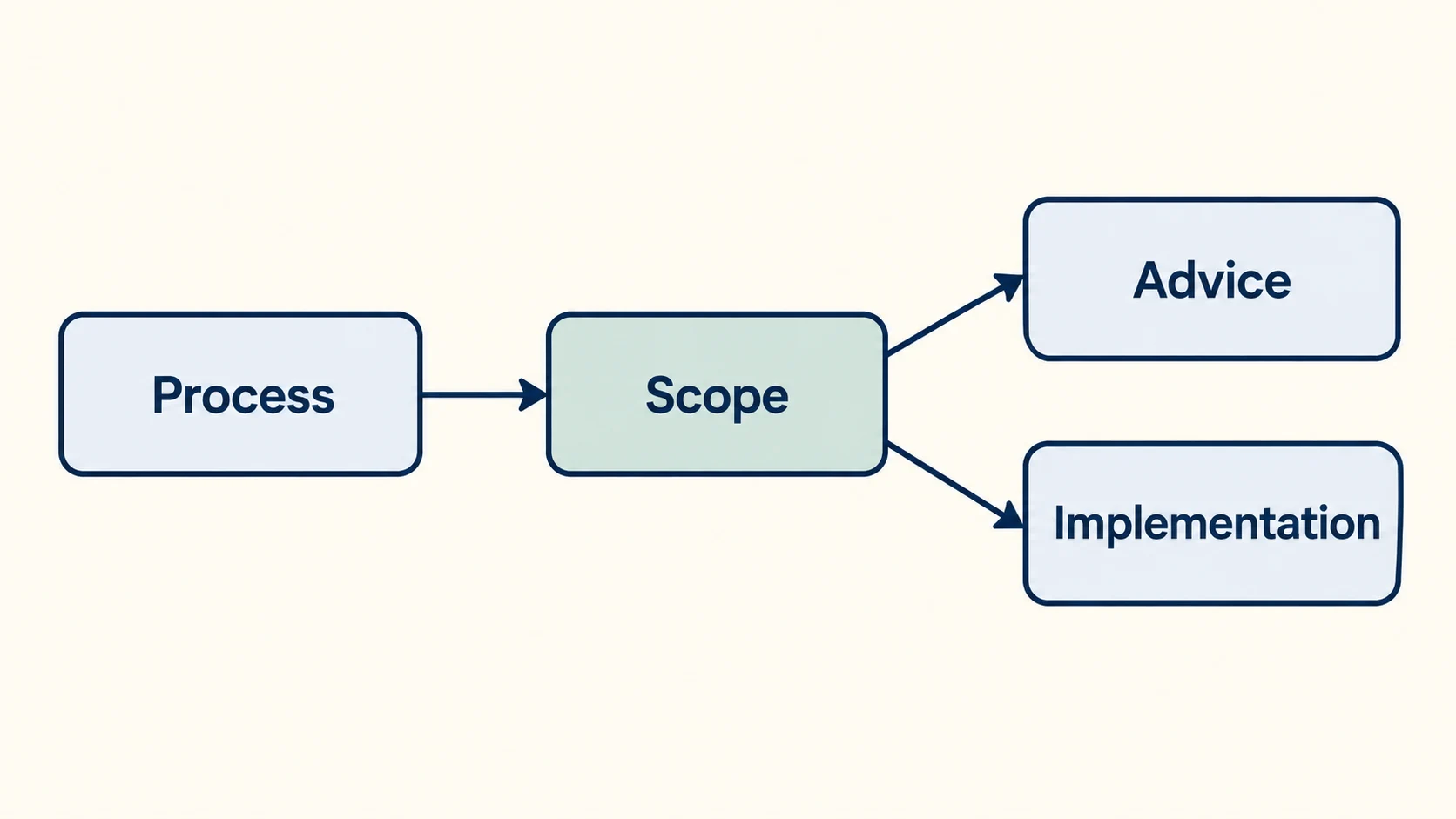
If you run a UK small business and are considering AI consulting, begin with a process you can observe, not a tool list or a promised result. Write down what happens now, who owns it and where delays, repeat work or errors occur. That gives you something concrete to assess and measure.
AI consulting can mean advice on a decision, a workflow review, tool configuration, system integration or ongoing support. The scope varies by provider. Make clear whether you need a recommendation, implementation help or both before comparing proposals.
This guide helps you decide whether outside advice fits the problem, what to ask a consultant and how to test an AI-supported process without treating a fluent demo as evidence of a business result.
If you are looking for a small business AI consultant in the UK who can also help implement a first workflow, the AI automation agency UK page explains how Ampliflow approaches discovery, implementation and handover.
If you are new to the wider picture first, read AI Automation for UK Businesses in 2026 and the AI Automation UK SMEs 2026 Guide. Then come back here for the decision on hiring help.
1) What AI Consulting Actually Means for a Small Business
An AI consultant may help with one or more parts of a business decision:
- Reviewing a defined workflow and comparing possible interventions.
- Selecting tools that fit the task, systems and constraints.
- Supporting configuration or implementation if that is within the agreed scope.
The actual scope varies. Some consultants advise; others also configure tools or implement workflows. Confirm who is responsible for each part before agreeing to proceed.
Start with the operational problem
A small business question may be much narrower than a company-wide AI programme. For example, you might want to assess:
- Better lead qualification before your sales calls.
- Faster first responses for customer enquiries.
- Automatic summaries from meetings and calls.
- Quicker reporting from scattered spreadsheets.
- Smoother handover from sales to delivery.
Ask how the consultant would investigate the problem, what could be tested and what evidence would support a next step. Timing depends on access, dependencies and scope, so have it stated in the proposal rather than assuming a standard schedule.
The real spectrum of support
Common types of support include:
- Workflow diagnosis: someone reviews a defined process and identifies options to assess.
- Recurring advice: priorities, vendor choices and process reviews, with the cadence agreed.
- Implementation support: setup, integration, maintenance and handover responsibilities defined in writing.
Choose the scope that answers the decision. Additional work is useful only when it addresses a defined need.
UK business context: separate AI use from integration
The UK Business Data Survey 2026 found that 51% of small businesses which handled digitised data reported using AI for at least one purpose. Across businesses that used AI, 21% said their tools were integrated with existing business systems. These figures have different survey bases; they do not measure demand for consultants or the results of consulting projects. The survey also notes that estimates vary with how AI use is defined. Read the UK Business Data Survey 2026 for its definitions and methodology.
For your own decision, ask:
- Which systems and records would the workflow use?
- What information may be shared, with whom and for how long?
- Who checks the output and handles exceptions?
- What observable result would justify keeping or changing the process?
A good starting point for this conversation is a simple framework. This piece on AI Readiness Framework helps you assess where you are before spending anything serious.
2) 8 Signs Your Small Business Needs AI Consulting
You do not need to describe your company as an "AI business" to consider outside help. Start with recurring work that is difficult to manage or measure.
1. You are drowning in repetitive admin but cannot justify another hire
If your team repeatedly chases documents, copies data between systems, drafts similar emails or updates records, trace one example from start to finish before choosing a fix.
Check whether the work is repetitive and its rules are clear. Tasks involving judgement or exceptions may still need a person, whether or not another tool is added.
Repeatable tasks may be candidates for automation, while decisions that need context or judgement may still belong with a person.
2. You have tried ChatGPT but cannot make it stick
If you have tried prompts or basic automations but returned to the old process, identify why. The missing piece may be an owner, reliable information, system access, time to review outputs or a better-defined task.
3. The same work is repeated across channels
Your team may be re-entering the same information, rewriting routine updates or checking several systems to complete one handover. Map the repeated steps and the review needed before deciding whether an AI tool would help.
If you want to avoid common mistakes while scaling output, this is worth a read: Common AI Automation Mistakes.
4. A response or handover is regularly delayed
Slow replies can delay a useful next step. Check when delays happen and whether the cause is staffing, routing or unclear ownership before deciding whether automation addresses it. A practical assessment should include the human handover, not just the first response.
5. You are making decisions on gut feel because data is scattered
For example, the information you need may be split across:
- CRM partly updated.
- Finance in another tool.
- Delivery in spreadsheets.
- Customer feedback buried in inboxes.
If you need to compare service profitability, lead sources or delay points but the information is split, define which reports and systems are required before commissioning a dashboard. Our business dashboard development service explains how Ampliflow approaches bringing operational data into one usable view.
6. You have outgrown spreadsheets but cannot afford enterprise software
This can be a reason to review how information is stored and used before introducing another tool.
Before replacing spreadsheets, identify what is failing: access, version control, workflow, reporting or audit needs. A clearer process or a feature in software you already use may be enough.
7. You are spending money on tools you barely use
Review which tools are used, who owns them and where information is duplicated before adding another subscription. The answer may be to simplify, change a process or keep the current setup.
8. You want to scale without scaling headcount at the same rate
More work can add onboarding, queries, exceptions and follow-up. Map which steps increase with demand and decide whether a process change would help before choosing a tool.
3) 5 Signs You Do Not Need AI Consulting (Yet)
It is just as important to know when to wait.
Knowing when to wait is part of the decision. Ask what would need to be true before the work is ready to start.
1. The process is still changing
If people handle the work differently each time, document the current steps and exceptions before trying to automate them.
An unstable process can make automation inconsistent. Document the recurring steps and exceptions before deciding what to automate.
2. You are pre-revenue
If you have not confirmed the business problem or customer need, prioritise learning what customers need before buying additional tools. Revenue stage alone does not determine whether outside advice is useful.
3. The team can still coordinate the work simply
If people can manage the process directly and exceptions are clear, a written checklist or change to the existing tool may be enough. Team size alone does not show whether outside advice would pay back.
4. You do not have a clear business problem to solve
"We should do something with AI" is not a strategy.
A hypothetical problem statement might be: "Quote follow-up is slow; we need to find where requests are getting stuck."
If you cannot name the problem in one line, pause and do that first.
5. You are already profitable and growing with no meaningful constraints
If your systems are genuinely working and growth is steady, there is no rule saying you must introduce AI right now.
Focus on what is already driving results. Revisit when friction appears.
4) What Does AI Consulting Cost for UK Small Businesses?
The scope can range from diagnosis to implementation, integration, governance or ongoing ownership. Compare proposals against the same responsibility rather than a headline price alone.
| Engagement | What should be explicit before pricing |
|---|---|
| Workflow diagnosis | Inputs, evidence, written output and decision owner |
| Strategy workshop | Participants, decisions required and implementation owner |
| Focused automation build | Workflow boundary, integrations, testing and handover |
| Wider operations build | Systems, permissions, migration risk and assurance |
| Ongoing support | Cadence, included changes, reporting and exit terms |
A few questions can help you compare these types of engagement.
Scope a workflow diagnosis
A workflow diagnosis is useful when it examines a defined process, states its assumptions and leaves you with evidence for a decision. Ask what will be reviewed and what you will receive.
If you want a structured entry point, Get unstuck and compare the resulting scope against other options.
Workshops are good for alignment, not execution
A workshop can help people agree on the problem and the decision required. Ask who will own implementation and how the agreed actions will be assessed.
A bounded test can make uncertainty visible
Before a test, agree what will be measured, how the starting point will be recorded, which cases count and who will review the result. Depending on the workflow, useful measures might include:
- whether required information was captured accurately;
- time between an enquiry and the next human action;
- whether a booking or update was confirmed in the receiving system;
- how often a person had to correct, repeat or take over the task.
Choose measures that fit the process. A demonstration or a target written before a baseline is not evidence that the change has delivered an outcome.
Agree the terms of recurring support
If a proposal includes ongoing support, clarify its cadence, included work, reporting, any separately charged changes, access and handover. Agree what evidence will be reviewed and what happens if priorities change.
Check how implementation would be managed
If you need help beyond advice, confirm who will implement the change and who in your business will review it. Clarify any minimum term, handover, documentation, access and support responsibilities before work begins.
5) How to Get Started Without Overspending
Control the decision before committing spend. Start with a problem you can describe and evidence you can review.
Start with a bounded diagnosis
An outside view may help you compare options, but ask how its conclusions are reached and what remains uncertain.
Before discussing implementation, compare the proposed scope with your own view of the business and the evidence you already have.
Pick one process to automate first
Keep a first test focused on one process with:
- high frequency,
- clear pain,
- measurable output.
Think lead triage, onboarding handover, support routing, invoice chasers, or weekly reporting.
Measure before expanding
Set baseline numbers before making changes.
At minimum track:
- time saved per week,
- turnaround speed,
- error rate,
- customer satisfaction signals,
- financial impact.
If the improvement is real, scale to the next process.
Match the commitment to the evidence
Early AI work is partly discovery. The agreement should define checkpoints, ownership, exit terms and what evidence justifies expanding the work. Avoid a long commitment when the first workflow and success measure are still unclear.
Build internal capability while you use external support
Your consultant should not become a permanent black box.
Ask for:
- simple process docs,
- recorded walkthroughs,
- light training for key team members,
- shared dashboards.
One workable arrangement is outside support with clear in-house ownership of the process and its information.
If you need practical implementation support after an assessment, see our automation services.
6) AI Consulting vs DIY: When Each Makes Sense
- 01DIY — clear task, low risk, internal time
- 02Consultant — unclear system, higher risk, external evidence
- 03Hybrid — internal owner with specialist delivery
You can absolutely do this yourself in some cases. The right choice depends on budget, technical confidence, and urgency.
| Factor | DIY | Consultant |
|---|---|---|
| Capability | Fits the team's skills and available time | Specialist advice or implementation may fill a defined gap |
| Cost | Internal time and any tools | Depends on the written scope and terms |
| Delivery | Depends on internal capacity and access | Depends on scope, access, dependencies and review |
| Responsibility | The business owns the decisions and checks | Responsibilities depend on the agreement; due diligence still matters |
| Ongoing support | Arranged internally or with the tool provider | Confirm whether it is included and what it covers |
When DIY usually makes sense
DIY is often right if:
- you enjoy tools and process design,
- you have protected time each week,
- your workflow is fairly simple,
- your risk tolerance is high.
DIY may reduce external service costs, but it still uses staff time and may require paid tools. Your team remains responsible for testing and reviewing the result.
When hiring a consultant usually makes sense
Consulting is often right if:
- you are time-poor,
- operational pain is already affecting growth,
- your team needs structure and accountability,
- repeated attempts are stalled and the cost of delay can be assessed.
Ask the consultant to document assumptions, controls and handover. Delivery speed depends on scope, access and the review process.
A practical middle ground
One possible arrangement is:
- Agree a defined assessment and any test scope.
- Keep a named internal owner for the workflow.
- Decide what follow-up support is needed after reviewing the evidence.
This can keep operational knowledge with the team while making outside responsibilities clear.
Common Questions UK Founders Ask Before Hiring
"Do I need to change all my software first?"
Not automatically. Ask whether the proposed workflow can use the systems you already have and what requirement would justify a migration.
"Will my team push back?"
Include the people affected in the assessment. Be clear about which tasks would change, who would review exceptions and how staff can raise concerns.
"What should we check about data protection?"
Ask what personal data is processed, for what purpose, which providers receive it, who can access it and how long it is retained. The ICO's AI and data protection guidance explains the issues organisations should assess. The right controls depend on the use case; a generic compliance claim is not a review of your data flow.
"How quickly should we expect results?"
It depends on the task, data, system access, call or transaction volume and staff adoption. Agree a baseline, a review point and the evidence required before work begins; do not treat a planned target as a delivered result.
How to Vet an AI Business Consultant Without Getting Burned
Use these questions to assess whether a provider's evidence fits the workflow you are considering.
Ask for evidence that fits the proposed work
Ask to see a relevant workflow, test plan or redacted artefact and how its outcome was checked. If a provider describes a result, ask what was measured, over what period, which cases were included and whether the evidence is from comparable work. A polished demonstration alone does not establish a client result.
Ask what they would do first
You want specifics:
- information and access they need;
- how they will map the process and its exceptions;
- how a test would be bounded;
- which measures and owners would be agreed.
If the steps, responsibilities and evidence are still vague, you do not yet have enough detail to compare proposals.
Ask what they would not automate yet
Ask which exceptions, data conditions or risks would make them recommend a different approach or delay automation.
Ask how they handle handover
You need documentation, access, and internal enablement. If your business cannot run the system without them, that is dependency risk.
Ask about pricing boundaries
What is included? What becomes extra? What assumptions could change the scope or cost?
Clear commercial boundaries up front prevent friction later.
AI Consulting for Small Businesses: The Practical Path for 2026
Choose an engagement for the business decision it will support, not the label attached to it.
For a small business considering outside help, a careful sequence is:
- Define the workflow and record a baseline.
- Agree the scope and test conditions.
- Measure the outcomes that matter to that workflow.
- Expand only if the evidence supports it.
That keeps the decision tied to an observable workflow rather than the label attached to the technology.
If you need help deciding where to start, Get unstuck. If the first workflow is then clear enough to implement, our automation service explains the staged delivery path.
And if you are still weighing the bigger strategic picture, keep these open in another tab:
- AI Automation for UK Businesses in 2026
- AI Automation UK SMEs 2026 Guide
- AI Readiness Framework
- Common AI Automation Mistakes
Take the first sensible step, measure it, then choose the next one.